
1916 – Hamilton Building (Former Bank of Hamilton), Winnipeg, Manitoba
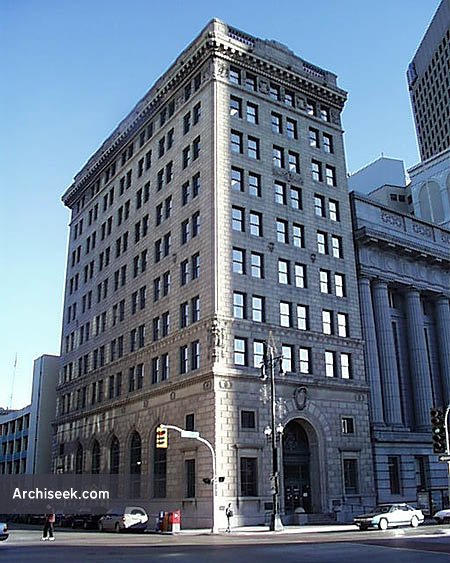
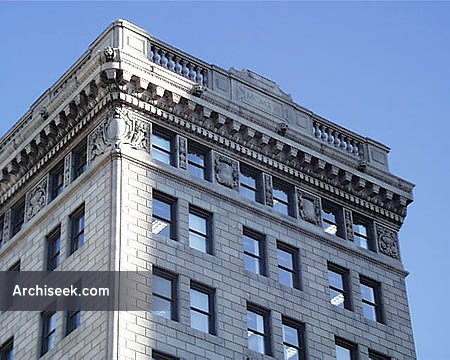
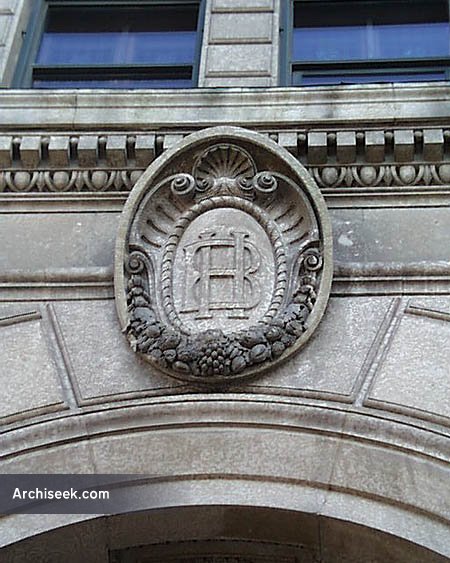

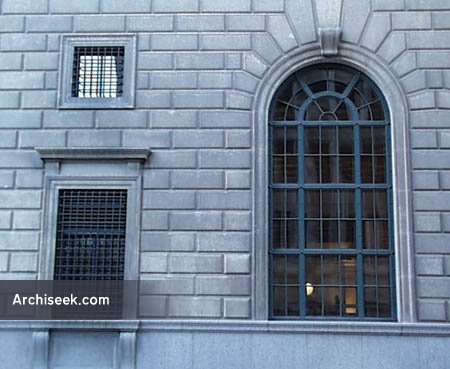
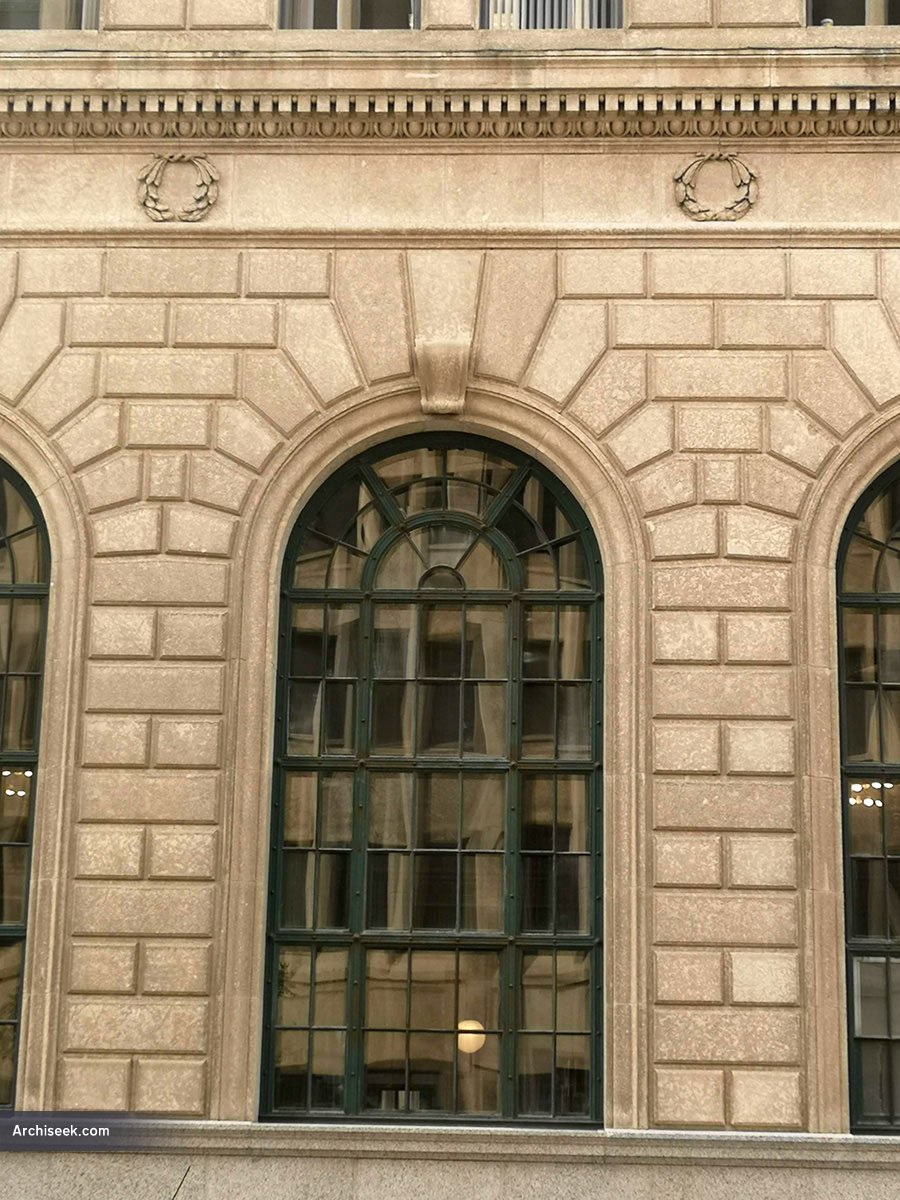


In 1897, the building and lot on the south-east corner of Main and McDermot was purchased for $30,000 by the Bank of Hamilton. Extensive alterations and an addition were undertaken before the Bank moved into new premises in 1898. In 1915 it was discovered that construction of the new Bank of Commerce next door had caused serious settlement problems to the older structure. Bank officials decided to demolish rather than repair the structure, and plans were undertaken for a new Bank of Hamilton on the site. Work commenced on John D. Atchison’s plans in July 1916, but due to material shortages caused by the war, it was not completed until 1918, at a total cost was $400,000. Construction magazine praised the treatment of the façade, noting the decorative cornice and the few sculptural accents. The massive archway over the main entrance features a magnificent bronze grill with the Bank of Hamilton emblem in the centre.
The upper stories which are given over to offices are indicated by the small rectangular windows, while the bank’s quarters are distinctly marked b,y arcade openings that forms the motive of the high ground storey. The entrance to both parts is through a high arched doorway which is rendered impressive by the simplicity of its treatment, and which is given scale by its delicately detailed bronze grille. This archway with its greenish initial tracery silhouetted against the great blackness of its shadowy depth, and its elegant keystone cartouche, is the feature of the facade; the rest of the wall in being kept simple giving it the fullest effect. At only one other point is a decorative note struck, namely, by the cartouche on the corner bearing the arms of the Bank. The name of the bank appears in bronze letters on the freize over the entrance, while an agreeable effect is given to the wall surfaces by the fossiliferous marking of local Tyndall stone.
Entering, one steps into a s(iuare hall flooded with light and walled in Botticino marble and with ceiling of antique gold, which forms a vestibule to the bank as well as to the elevator and stair hall. A noteworthy feature of the scheme here is an elliptical stair leading to the superintendent’s department, the simplicity of the graceful spiral of the string curving upward without visible support and carrying a light bronze handrail on turned spindles, being a particularlv fine achievement. The walls are extremely simple and the character of the vestibule worked out mainlj’ with cornice, door and base mouldings, low marble lienches, and the ceiling enrichment.
In the banking room the arcade which outwardly expresses this interior so well, continues as the dominating motive of the architectural scheme. It forms the four walls, admitting the north light from McDermott Avenue, and separates the banking room from the alcove spaces in the main storey mezzanine, used for clerks and files and automatic tubes and telephone stations. Altogether the result of this splendidroom (luite establishes tliat an effective treatment is not dependent upon elaboration of workmanship but may be achieved by fine proportions, the discriminating’ use of features and detail and by emphasis rightly placed. The walls are of Botticino marble, warm grey in tone. The floors of colored marble in geometrical patterns. The moldings are few. There is small use of carving. The note of strong color’ occurs in the ceiling. This together with the Belgian black marble counter tops, the bronze screens and the dark wood and upholstery of the furniture, gives the room an interest and character relieved of all monotony or greyness. The ceiling is rich and beautiful and has dark beams, supported by marble corbels, and glowing with bright color in varied ornamental patterns, well set off by the dull-greenish hues of the spaces between.
The bronze of the tellers’ enclosures, of the mezzanine balcony railing, of the clock over the entrance to the bankingroom, of the elevator enclosures and easel directory, and of the lightingfixtures, is of the finest design and workmanship, carrying out the character of sobriety and good taste which characterizes the whole building.
Construction, November 1919
In 1921, the Bank of Hamilton noted a marked shrinkage in customers’ balances, and some of its Manitoba branches were closed. Despite reassurances in the annual report of the Bank of Hamilton c.1922, negotiations were soon underway for the 1923 amalgamation with the Canadian Bank of Commerce. The merger was effected on 31 December 1923, where after the Bank of Hamilton ceased to exist as a separate corporate entity.
For some years, the building functioned as the Main and McDermot branch of the Bank of Commerce, until 1969 whenthe Bank of Commerce moved to Lombard Place, leaving the Bank of Commerce banking hall and the bottom storeys of the former Bank of Hamilton vacant. In 1981-82, architect Robert Gregoire of the Prairie Partnership supervised the restoration of the banking hall of the Hamilton Building to its original glory. The upper storey offices were renovated to modern standards and are now offices for the City of Winnipeg.
Share!
Cite This Article
Published May 6, 2010 | Last Updated March 11, 2026


