
1894 – Arnott’s, Henry Street, Dublin


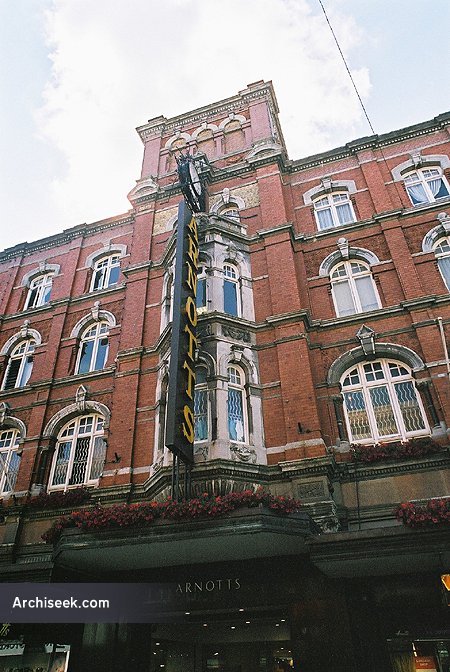


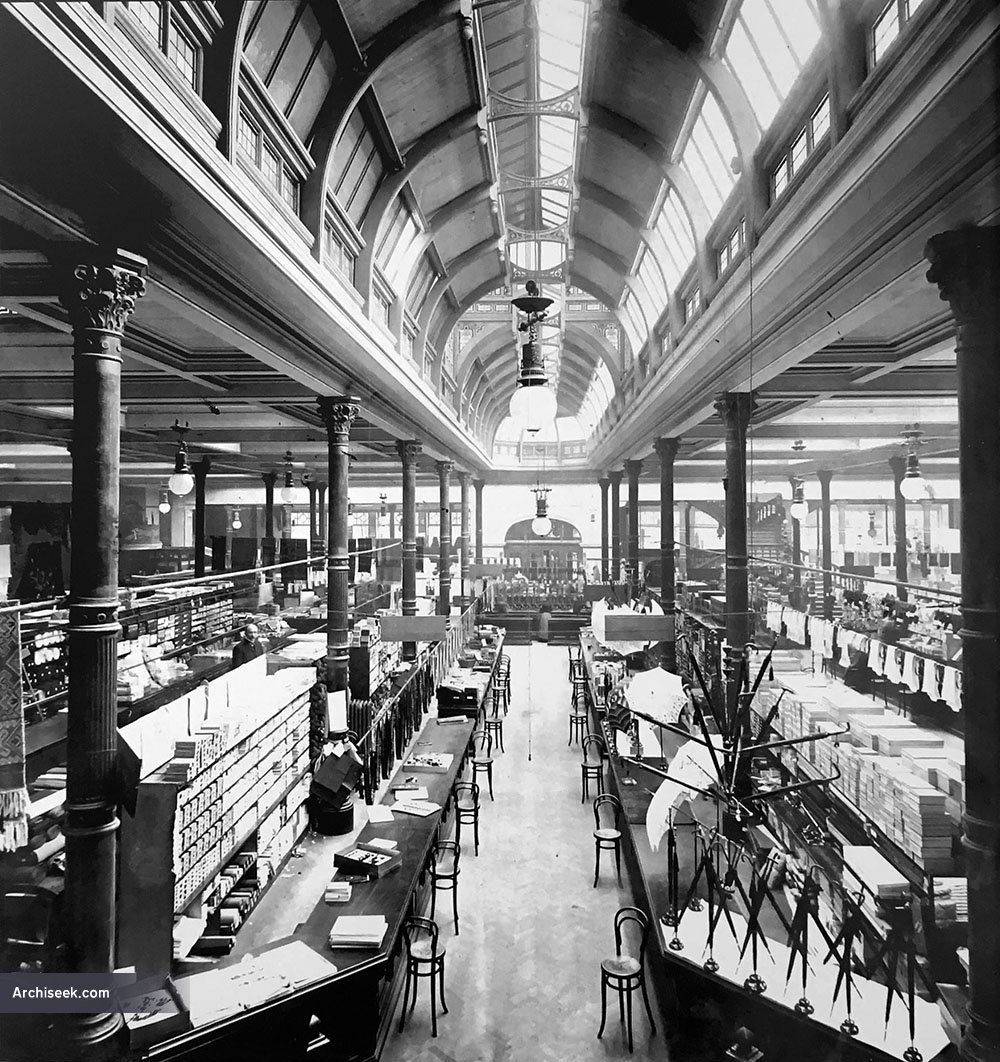


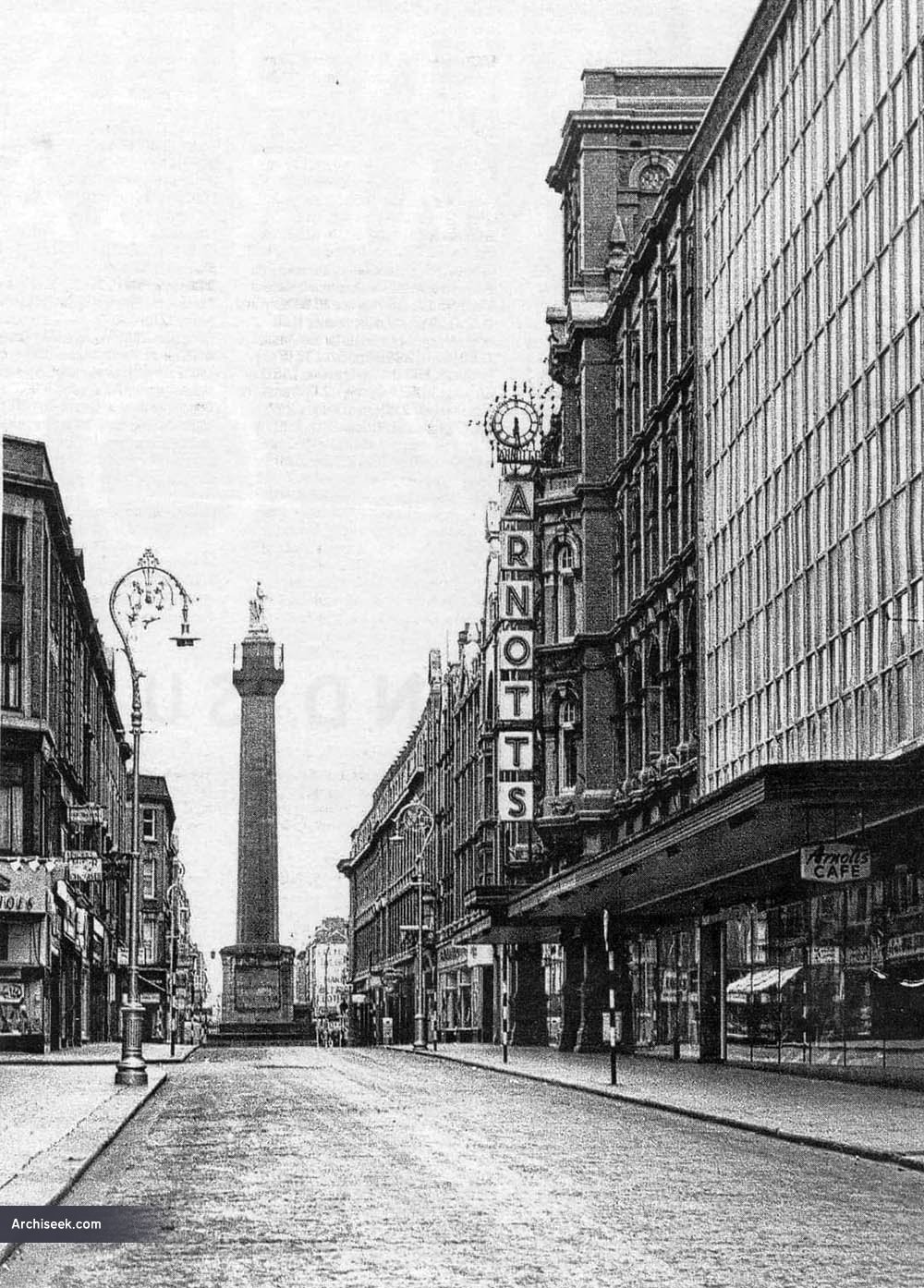
Ireland’s largest single department store, a grandiose Victorian design, the building has suffered greatly through fire, partial demolition and unsuitable extensions. One of the two great architectural landmarks of Henry and Mary Street, the other being the former Todd, Burns & Co. store, now Penny’s.
The original block which stretched from Princes Street to Henry Street was completely destroyed in 1894 after a fire. The replacement was designed by G.P Beater, who also designed the original, in 1894, and extended in 1904.
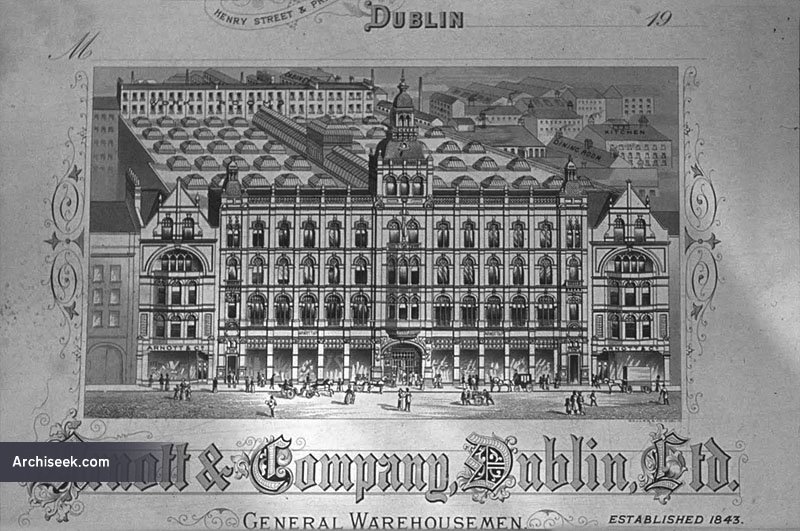
We give in this issue an illustration of the new premises in Henry-street, Dublin, proposed to be erected for Messrs. Arnott and Co., Limited. This well-known firm was established in the year 1843, under the name of ” Cannock and White,” but after some years, owing to the death or retirement of the original members of the Firm, the Company assumed its present title.
As our readers will doubtless remember, almost the entire of the company’s extensive premises were destroyed by the disastrous fire in May last ; but, owing to the energy of the “Board” and those employed by them, temporary premises were erected on a portion of the site of the destroyed warehouses, and business resumed in all its branches in less than five weeks from the date of the fire. These temporary premises will in due course be replaced by the imposing structure we now illustrate, designed by Mr. George P. Beater, M.R.I.A.I. , architect to the company, which will be one of the finest of its kind in this city, and for its size will bear favourable comparison with any similar erection in the kingdom.
The front to Henry- street is intended to be of red brick with, limestone dressings ; and will have a frontage of 153 ft., and a depth from front to rere of about 220 ft.; the width of the premises which extend behind Nos. 9, 10, and 16 Henry-street , is about 215 ft. , with a frontage to Princes- street of over 170ft.
The basement floor, which will have an area of over 40,000 square feet, will be devoted mostly to the ” wholesale,” and the warehouse on street level, with a similar floor space, to the general retail, furnishing, carpets, damask, and other branches of the business. On the upper floors, provision will be made for ladies’ dress rooms, work. rooms, counting house, and for other of the various branches of the business.Building operations have already been commenced at a section of the warehouses in Princes-street, and the Directors hope within a few weeks to be in a position to invite tenders for the main portion of the works, which, however, we are informed, will have to be carried out in several sections, owing to their size, and in order that the business may be interfered with as little as possible. To the left-hand side of the main building, we show No. 16 Henry-street , which up till the date of the fire was occupied by Messrs. Simpson and Co., but which now is the property of the Company, and which they purpose using for their own business until the main premises are completed. It is of red brick with limestone and terra-cotta dressings and ornamentation and has been designed so as to work in with the large building. Mr. John Good is contractor for this portion of the work and also the premises being erected in Princes-street.
To the right of the main building we show 9 and 10 Henry- street, which were to a great extent destroyed by the fire in May last, have been rebuilt since (Mr. E. Moloney being the contractor), in style to correspond somewhat with No. 16. These works throughout were also designed and executed under the superintendence of Mr. G. P. Beater.
The Irish Builder, April 1, 1895
For some reason, the store depicted itself for many years on their bags with two central towers and a longer facade. The top of the tower was removed in 1949. And a further curtain-walled extension added in the early 1960s, since remodelled.
Share!
Cite This Article
Published April 7, 2010 | Last Updated December 30, 2025


