
Praxiteles

Forum Replies Created
- AuthorPosts
- November 9, 2009 at 3:44 pm in reply to: reorganisation and destruction of irish catholic churches #773240
Praxiteles
ParticipantSt. Mary’s Church, Inidan River on Prince Edward Island (1900-1902) by William Critchlow Harris- and entirely wooden construction.


the interior is interesting in that, among other notable fetures, it retains a an altar rail spanning both transepts and the nave in front of the chancel and flanking chapels- as at Cobh Cathedral (a feature which, apparently, was unknown to Professor O’Neill and even to the ABP inspector, Mr. Rabbit).
The octagonal Bapitstery from the exterior:

 November 8, 2009 at 9:09 pm in reply to: reorganisation and destruction of irish catholic churches #773239Participant
Cathedral of St John the Baptist, St. John’s, Newfoundland (1841-1855) by Ole Joergen Schmidt
“It was the Bishop’s original intention that the stone required for the construction of the church would be procured locally, and large quantities were quarried and transported from Kelly’s Island, Conception Bay: from Signal Hill, St. John’s; and several other sites near the city. However, it soon became apparent that it was simply too difficult and too expensive to land enough local stone in St. John’s for the needs of so large a building. Bishop Fleming therefore arranged to have Galway limestone and Dublin granite shipped from Ireland”.

 November 8, 2009 at 10:23 am in reply to: reorganisation and destruction of irish catholic churches #773238Participant
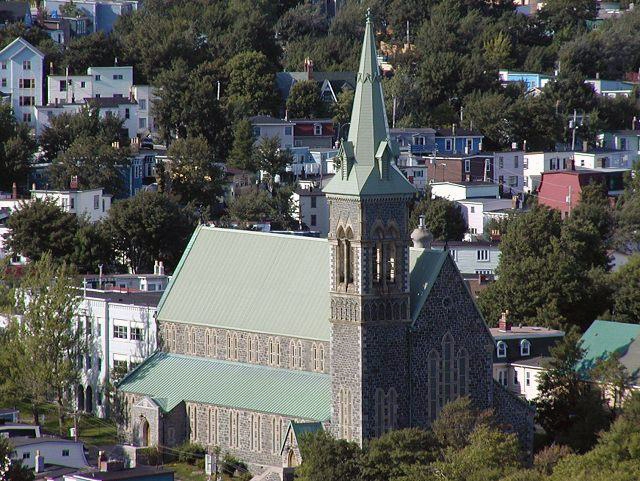
St Petrick’s Church, St. John’s, Newfoundland, (1855-1881) by JJ McCarthy.
Praxiteles does not quite know what it is but of the 19th century Irish gothic revivalists JJ McCarthy’s churches have been most vandalized by the iconoclasts. As with Monaghan and St. Saviour’s in Dublin, so too this one has been internally gutted.
St. Patrick’s Church, a late Gothic Revival, also termed Neo-Gothic, style building was designed by J.J. McCarthy, a very important Irish architect, and was possibly built by local T. O’Brien, local architect and mason. The cornerstone of St. Patrick’s Church was laid on September 17, 1855, by Bishop Mullock and other distinguished clergy from Canada and the United States. American financier, Cyrus Field, contributed £1,000 to help with construction costs. Despite Field’s substantial contribution, financing the project proved difficult. Financing troubles combined with labour shortages resulted in the numerous construction delays and, consequently, the structure was not completed until 1881.
 November 7, 2009 at 10:42 pm in reply to: reorganisation and destruction of irish catholic churches #773237Participant
Basilica of St. Patrick, Ottawa (1869-1873) by Augustus Laver of the firm Fuller and Laver.

The original stenciled ceiling which had been painted out but which has recently been recovered during a conservation campaign


http://www.flickr.com/photos/pcellis/9330961/
The High Altar – still mercifully intcat:

The recovered stencil work in the south nave:


 November 7, 2009 at 10:02 am in reply to: reorganisation and destruction of irish catholic churches #773236Participant
The church of St Pierre on the Ile d’Orleans, Quebec (1715-1719) by André Paquet

The French spire:

The interior with its original heater:

The High Altar with two nave altars distinguished by continuous railing:
http://www.flickr.com/photos/caya_6/203317637/in/set-72157600002102384/
Detail:
http://www.flickr.com/photos/caya_6/203542196/in/set-72157600002102384/
Ceiling detail:
http://www.flickr.com/photos/caya_6/203542197/in/set-72157600002102384/
http://www.flickr.com/photos/caya_6/203542193/in/set-72157600002102384/
November 6, 2009 at 4:50 pm in reply to: reorganisation and destruction of irish catholic churches #773235ParticipantBAILLAIRGÉ, THOMAS (baptized François-Thomas), architect, wood-carver, and politician; b. 20 Dec. 1791 at Quebec, son of François Baillairgé*, a master painter and wood-carver, and Josephte Boutin, and grandson of Jean Baillairgé*, a master carpenter and architect; d. there 9 Feb. 1859.
Thomas Baillairgé belonged to a renowned family of craftsmen who had been settled at Quebec since 1741. According to his father’s diary, Thomas began to attend the English school at the age of eight. Then he probably studied at the Petit Séminaire de Québec while his father taught him the rudiments of wood-carving and architecture. Young Thomas was undoubtedly in some degree a disciple of Jérôme Demers, a teacher of science and architecture at the Petit Séminaire. Demers, as superior of the seminary and vicar general of the diocese with responsibilities such as supervising the construction of religious buildings in the name of the bishop of Quebec, subsequently granted his patronage to Baillairgé whom he termed the “leading architect in the whole of Lower Canada.†As for his apprenticeship, historian Émile Vaillancourt* points out it is not unlikely that Baillairgé worked with René Beauvais*, dit Saint-James, in Louis Quévillon*’s workshop around 1810. But, since this assertion is not based on documentary evidence and Baillairgé’s whole career tends to invalidate it, it must be called into question. He may, however, have worked with wood-carver Antoine Jacson* in his father’s atelier.
According to Georges-Frédéric Baillairgé, the family’s biographer, Thomas started in the trade in 1812. That year he entered “into full possession of the workshop of his father, [who had been] appointed treasurer of the city.†But in fact it was in 1815 that he really began his career as an architect and wood-carver at Saint-Joachim, near Quebec, where in partnership with his father and under the guidance of Demers he undertook to decorate the interior of the village church.
Baillairgé made his mark primarily as an architect. From 1815 to 1848, the year he retired, he drew up the plans for a considerable number of churches, presbyteries, public buildings, and houses. In the field of religious architecture Baillairgé enjoyed a commanding position because of both the scarcity of French Canadian and Roman Catholic architects and the close relations he maintained with the diocese of Quebec. Yet he did not succeed in gaining recognition in the Montreal region, where he attempted only two ventures: in 1824 when he presented a proposal for the reconstruction of Notre-Dame, which was rejected, and in 1836 when he drafted the plans for the church of Sainte-Geneviève. On the other hand, there is hardly a religious building in the eastern part of the province erected between 1820 and 1850 that does not bear his mark, either because he drew up the plans or because it was constructed by a contractor on the model of one of his churches.
Baillairgé built three types of churches. First, there were small parish churches that followed the architectural tradition inherited from the French régime. They are designed in the form of a Latin cross, with a semicircular apse and a bell tower rising above a façade ornamented only by niches, windows, and portals. In collaboration with Demers, he drafted the plans for a church of this kind at Sainte-Claire in 1823. This building seems to have been a significant accomplishment, since he repeated the design frequently – in 1830 at Lauzon, in 1839 at Saint-Pierre-les-Becquets (Les Becquets), and in 1845 at Saint-Anselme, to mention only a few examples; there were, of course, variations, for no two of Baillairgé’s buildings were exactly alike. On the other hand, several rural parishes wanted a more majestic church incorporating a façade with two bell towers. In 1828 Baillairgé and Demers proposed at Charlesbourg a plan that could satisfy these expectations. At Grondines (Saint-Charles-des-Grondines) in 1831 and at Sainte-Croix in 1835, Baillairgé revived this type successfully: a screened façade enhanced a building that in other respects was rather traditional. But, beginning with the construction of St Patrick’s at Quebec in 1831, Baillairgé developed an entirely new model linked more tenuously with architectural tradition. The nave was divided into three spaces by pillars supporting lateral galleries, and the formal treatment of the façade heralded the new layout of the interior. The architect used this model with some variations at Deschambault in 1833 and Sainte-Geneviève in 1836.
In among these three types of church, a number of other edifices show Baillairgé’s never-ceasing quest for renewal of tradition: for example, the church of Sainte-Luce built in 1836 and that of L’Ancienne-Lorette erected the following year, in which the façade became more monumental even though a central bell tower was retained. But it was primarily through interior architecture that other intermediate variations were characterized. After completing the plans for the interior décor of the church of Saint-Joachim in 1815, Baillairgé repeated the semicircular retable (the structure housing the altar) on several occasions, at Lauzon, Saint-Antoine-de-Tilly, and Saint-François on the Île d’Orléans for instance. Yet, when the retable he carved in 1824 at Lotbinière in the form of a triumphal arch was a success, he proposed the same style for various other churches, notably one at Charlesbourg in 1833 and another at Sainte-Luce in 1845. Lastly, the kind of interior architecture found in St Patrick’s Church occurs again at Deschambault in 1841, at Lévis in 1850, and in the nave of the church of Pointe-aux-Trembles (Neuville) in 1854. But the last two instances must be listed as the work of his school, since the master had retired, making way for his pupils.
Baillairgé also drafted the plans for a number of public edifices, the first and most important undoubtedly being the parliament building begun in 1830 on the present site of Montmorency Park. This was in fact a more elaborate version of the architecture employed for the Séminaire de Nicolet in 1826. Similarly, a simplified form of the bishop’s palace at Quebec, for which the plans were delivered in 1844, can be seen in the convent of Saint-Roch and the Collège de Sainte-Anne-de-la-Pocatière.
In addition to churches and public buildings, Baillairgé drew up the plans for several houses. Research into this aspect of his work has only begun, however, and since neither the plans nor the accompanying contracts are signed, only the architect’s rather unusual penmanship makes it possible to detect that the plans are his. The houses so far identified were principally on Rue Saint-Louis and Rue Sainte-Ursule, but this does not rule out the possibility that similar houses were built in other adjoining parts of old Quebec.
Baillairgé followed the dominant style of his age, neoclassicism. This movement, which equally affected America and Europe at the beginning of the 19th century, was marked by a return to the principles underlying classical architecture and drew inspiration from the new science of archaeology. At the same time, there was growing interest in history, in the epochs which have in turn left monuments on the architectural landscape. That Baillairgé absorbed the neoclassicism introduced into Lower Canada by British architects, treatises, and books with illustrations of models, is clear from his library, which contained Colin Campbell’s Vitruvius Britannicus, James Gibbs’s Book of architecture, and Jacques-François Blondel’s Cours d’architecture. Baillairgé also watched new buildings going up, and it is quite clear that the work of such men as Henry Musgrave Blaiklock*, Frederick Hacker, Richard John Cooper, and George Browne* had an influence on him. But beyond these new developments Baillairgé took into account the architectural heritage of Lower Canada, and it is a synthesis of new influences and acquired knowledge that he expresses in designs and also in techniques and materials. This synthesizing endeavour gives Baillairgé’s architectural production a familiar image that maintained continuity in development, and so distinguishes his work that he can be considered the creator of an original style: the neoclassicism of Quebec.
If the edifices constructed according to his plans testify to this classical renewal, Baillairgé’s style of draftsmanship also represents a development within the architectural profession. By following the precepts in the manual on architecture written by Demers, Baillairgé compels recognition as an architect rather than a master builder. Demers had affirmed that architecture drew its principles from the observation of nature, but that these “natural rules†were little respected in Lower Canada at the beginning of the 19th century. Accordingly, Baillairgé endeavoured to become the architect representing order, an indispensable element in architecture. He prepared more and more drawings, increasingly precise and detailed, to guide the work on site, thus depriving builders and contractors of freedom of choice and hence noticeably weakening the influence of tradition on the evolution of forms and techniques. Between the drawing he completed in 1829 for a house to be built for the Hôtel-Dieu of Quebec and the plans used in 1841 for the construction of the École Mgr Signay in Près-de-Ville at Quebec, this development is clearly discernible. It marked the true beginnings of the architectural profession.
This evocation of order was particularly evident when Baillairgé carried out the interior décor of a church. For example, as early as 1815 at Saint-Joachim, in collaboration with his father, he presented a wholly new decorative scheme, conceived as a unified whole. From then on the architect took the place of the usual ateliers of wood-carvers who scattered their ornamentation throughout the churches. At Saint-Joachim all the carvings are subordinate to an architectural framework that dictates the general arrangement, to fulfil the architect’s desire for a coherent effect. It is not surprising that Baillairgé’s aesthetic notions led him to advocate the use of plaster for ornamental motifs, and that figurative woodcarving declined perceptibly as his career advanced. The interior architecture of St Patrick’s Church was executed in plaster in 1831, with the architect excluding all carved ornamentation.
Baillairgé was, however, a highly skilled woodcarver. The bas-reliefs depicting La foi and La religion in the church of Saint-Joachim, and the statues of La foi and L’espérance in the church of Saint-Louis at Lotbinière, are amongst the great achievements in wood-carving. By using a style of antique inspiration with folds cut closely and deeply, Baillairgé gave evidence of a coherent approach in his neoclassical aesthetics. But there is more to it than this. His art suggests a clear intention to escape from a vision of faith relying on narrative or anecdote. His restrained style dispenses with figurative references; he uses themes which are theological in character and he carefully avoids the descriptive episodes of the Old and New Testaments. He increasingly retained in his plans only non-figurative carving, in particular symbolic ornaments (trophies and instruments of the Passion, for example). In this respect his art was linked with the concerns of the church in Lower Canada, which around 1830 was seeking to reaffirm its position, within a traditional society facing disintegration, by preaching a return to doctrine and to the gospel message. The interior architecture of Baillairgé’s churches was in tune with this reorientation of the church; at least it expressed this intention in the religious iconography employed. The renewal in architectural style, combined with the new iconology, gave significance to interior architecture despite the absence of carved figures, and conferred on Baillairgé a quite special position. Thus it is easy to understand why the church thought so highly of him that it treated him, in effect, as the diocesan architect.
But at the same time Baillairgé was a victim of his own success. Tied to his drawing-board, as much by the volume of work and the care he devoted to it as by his determination to separate himself professionally from those who engaged in construction, he took to giving very liberal and varied interpretations to his plans. As he did not visit the sites and follow the progress of buildings, the work was often quite out of his hands from the moment the structure was begun. At Deschambault the façade was not completed, and at Grondines the bell towers were scaled down. Elsewhere, contractors, who were skilful but insensitive to the aesthetics of the master, cut down his plans to adapt them to parish needs and resources. Baillairgé also showed far too little concern for the developing urban setting. For example his bishop’s palace faces the stables of Notre-Dame and turns its back on the street.
Baillairgé had a number of pupils and as a result he enjoyed unquestionable influence. In his workshop the tasks were specialized, as Georges Frédéric Baillairgé pointed out: Louis-Thomas Berlinguet excelled in colonnades and architecture in general, Joseph Girouard in large-scale constructions, Louis-Xavier Léprohon, André Paquet, dit Lavallée, and Thomas Fournier in the interior ornamentation of churches, André-Raphaël Giroux* in the making of wooden models, Léandre Parent in figures of Christ, and Charles Baillairgé* in the boldness of his conceptions. Of all these pupils it was Thomas’s second cousin Charles who was to leave the strongest imprint on the second half of the 19th century, but at the price of an unavoidable break with the aesthetics of his master. On the other hand, Giroux and Paquet carried on Baillairgé’s work after his retirement, but by 1845 they had been forced out of Quebec by the emergence of Victorian architecture in the urban environment. If Quebec architects such as Charles Baillairgé, François-Xavier Berlinguet, Joseph-Ferdinand Peachy*, David Dussault, and David Ouellet* mostly continued in the vein of Thomas Baillairgé’s work until about 1920, it was precisely because of the renewal that Baillairgé had brought to the profession in preferring the workshop to experience on site, and the plan to the building. But this prolonged survival of French Canadian architects unchanged in an environment subjected to North American eclecticism also caused a distinct sclerosis, since at the turn of the century Quebec was still training architects as Baillairgé had, whereas schools of architecture had sprung up everywhere. And by and large this state of things gave Quebec its image as a traditional city, despite the amount of new construction undertaken in the second half of the 19th century.
Baillairgé was an all-round artist. Like his father, he engaged in architecture and to a lesser degree in wood-carving. He occasionally gave his attention to painting but, like his uncle Pierre-Florent*, apparently preferred music. At least this is a plausible explanation for an interest in organs which led him for some years to serve as the tuner for the organ in the cathedral of Notre-Dame, and also to build himself a similar instrument in his dwelling.
A sober, reserved, pious man, Baillairgé led an uneventful bachelor’s life entirely devoted to his work. He made only one journey, in 1846, during which he stayed a short time in Montreal and then visited his cousin, the notary Jean-Joseph Girouard, at Saint-Benoît (Mirabel). He seems at one point to have been attracted to public life, since on at least two occasions, in 1834 and 1835, he was elected to the municipal council of Quebec representing Séminaire Ward. It is known that he engaged in several land transactions. In 1815 he and his father received a grant of land in Upper Town belonging to the Ursulines. A series of deals he subsequently concluded makes it evident that he was comfortably off, even if he occasionally resorted to loans. Although Baillairgé did not enrich himself through his work, several of his pupils, including Paquet, who worked as contractors, acquired sizeable fortunes.
When Baillairgé retired in 1848 to make way for his second cousin Charles, he drew up his will. He divided his properties among his closest relatives and bequeathed his money to the Hôpital Général in Quebec and to the Quebec Education Society. However, he took care to leave his library, tools, and instruments to three of his pupils, Charles Baillairgé, Giroux, and Parent. He died on 9 Feb. 1859 at Quebec, at the age of 67. There, two days later, he was buried without ceremony in the crypt of the cathedral, the building which was the major achievement of his grandfather and his father, and for which in 1843 he himself had created the façade.
Luc Noppen
[More detailed information on the life and work of Thomas Baillairgé can be found in the author’s thesis “Le renouveau architectural proposé par Thomas Baillairgé au Québec, de 1820 à 1850 (l’architecture néo-classique québécoise)†(thèse de phd, univ. de Toulouse-Le Mirail, Toulouse, France, 1976), a copy of which has been deposited in the rare book section of the library at Laval Univ., Quebec. l.n.]
AC, Rimouski, Minutiers, J.-B. Pelletier, 8 sept. 1845. ANQ-BLSG, CN1-5, 19 janv. 1838. ANQ-Q, CE1-1, 9 janv. 1787, 21 déc. 1791, 11 févr. 1859; CN1-17, 22 déc. 1845; CN1-27, 28 juin, 10 août 1830; CN1-60, 1er nov. 1824; CN1-61, 5 oct. 1841; CN1-80, 22 avril 1834, 1er avril 1835, 24 juill. 1837, 13 mai 1841, 11 févr. 1843, 11 févr. 1847, 5 août 1848; CN1-102, 26 déc. 1838; CN1-116, 20 mars 1832; CN1-155, 16 oct. 1837; CN1-188, 16 juin 1831, 12 nov. 1832; CN1-208, 11 févr. 1825; 5 nov. 1830; 22 mars, 26 avril 1831; 3 mai 1834; 26 mai 1845; 16 févr. 1852; CN1-212, 17, 21 mai 1828; 7 juill., 28 oct., 21 nov. 1829; 30 nov. 1830; 14 mars 1832; 19 nov. 1833; 10 juin 1840; 8 mai 1841; CN1-213, 14 mars 1845; CN1-219, 12 juill. 1841; CN1-230, 5 févr. 1811, 17 oct. 1815; CN1-253, 27 mai 1831; CN1-255, 10 mai 1856; CN1-267, 6 juin 1828, 22 juill. 1830. ASQ, mss-m, 1040a. MAC-CD, Fonds Morisset, 1, 2695, 1–3; 2, B157/T454. Le Journal de Québec, 12 févr. 1859. G.-F. Baillairgé, Notices biographiques et généalogiques, famille Baillairgé . . . (11 fascicules, Joliette, Qué., 1891–94), 3: 71–86. David Karel et al., François Baillairgé et son œuvre (1759–1830) (Québec, 1975). Raymonde [Landry] Gauthier, Les tabernacles anciens du Québec des XVIIe, XVIIIe et XIXe siècles ([Québec], 1974). Luc Noppen, Notre-Dame de Québec, son architecture et son rayonnement (1647–1922) (Québec, 1974). Luc Noppen et al., Québec: trois siècles d’architecture ([Montréal], 1979). Luc Noppen et Marc Grignon, L’art de l’architecte: trois siècles de dessin d’architecture à Québec (Québec, 1983), 76–82, 87–106, 192–93, 200–1, 210–13, 216–17. Luc Noppen et J. R. Porter, Les églises de Charlesbourg et l’architecture religieuse du Québec ([Québec], 1972). Émile Vaillancourt, Une maîtrise d’art en Canada (1800–1823) (Montréal, 1920), 85. G.-F. Baillairgé, “Biographies canadiennes,†BRH, 20 (1914): 348–51. Marius Barbeau, “Les Baillairgé: école de Québec en sculpture et en architecture,†Le Canada français (Québec), 2e sér., 33 (1945–46): 243–55. Alan Gowans, “Thomas Baillairgé and the Québecois tradition of church architecture,†Art Bull. (New York), 34 (1952): 117–37. Marc Grignon, “Architectes et architecture . . . dans l’ordre,†Habitat (Montréal), 2 (1983): 29–33. Gérard Morisset, “L’influence des Baillairgé,†Technique (Montréal), 26 (1951): 307–14; “Thomas Baillairgé, 1791–1859, architecte et sculpteur,†24 (1949): 469–74; 26: 13–21, 245–51; “Une dynastie d’artisans: les Baillairgé,†La Patrie, 13 août 1950: 18, 42, 46. Luc Noppen, “L’architecture intérieure de l’église de Saint-Joachim de Montmorency: l’avènement d’un style,†RACAR (Montréal), 6 (1979): 3–16; “Le rôle de l’abbé Jérôme Demers dans l’élaboration d’une architecture néo-classique au Québec,†Annales d’hist. de l’art canadien (Montréal), 2 (1975), no.1: 19–33. A. J. H. Richardson, “Guide to the architecturally and historically most significant buildings in the old city of Quebec with a biographical dictionary of architects and builders and illustrations,†Assoc. for Preservation Technology, Bull. (Ottawa), 2 (1970), nos.3–4: 73.
© 2000 University of Toronto/Université Laval
November 6, 2009 at 11:00 am in reply to: reorganisation and destruction of irish catholic churches #773234ParticipantSt. Joseph, Deschambault, Quebec (1835-1838) by Thomas Baillairgé


 November 6, 2009 at 10:21 am in reply to: reorganisation and destruction of irish catholic churches #773233Participant
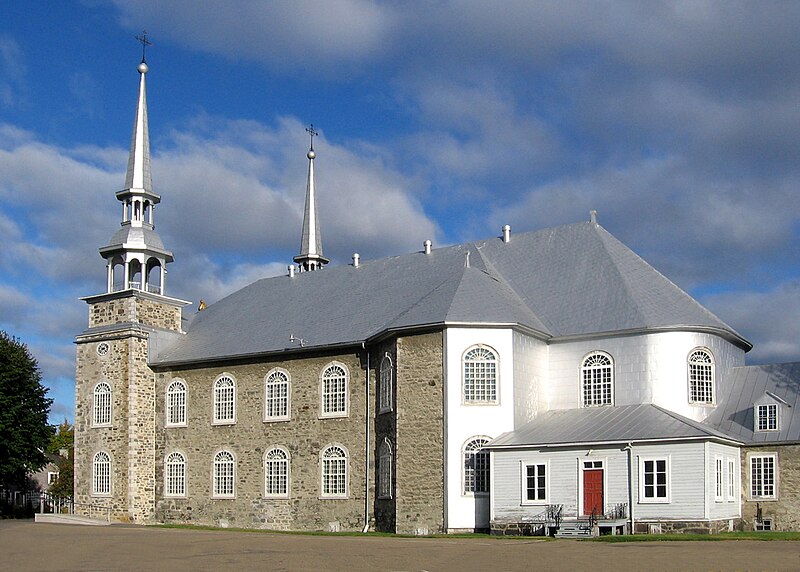
The church of St. Charles Borromée, Charlesbourg, Québec, Canada (1828-1830) built by Thomas Baillairgé.
Some initial notes:
 November 5, 2009 at 8:46 pm in reply to: reorganisation and destruction of irish catholic churches #773232Participant
@Gregorius III wrote:
Is there ever a case [different climate] in which double-glazing is a positive step? In the past months I encountered a new church-building with glazing over their “2nd hand” XIX c. stained glass windows, I mentioned that it was bad for the preservation of the windows – they however received quite different advice during their installation…
Just hold on a few years and you will notice that the lead corrodes and the glass usually drops out. Even removing double glazing creates difficulties given the micro-climatres created behind the double glazing and their impact on the glass.
November 3, 2009 at 12:02 pm in reply to: reorganisation and destruction of irish catholic churches #773227ParticipantA tentative list of sites to be proosed to the UNESCO as world heritage sites in Ireland has been preared by the Dept. of the Environment and is currently in public circulation for public comment. From what one can see, the Dept. seems to think that world class heritage items in Ireland ceased with the arrival of the Celts and the concentration on archeology would suggest that we have an archeological importance second only to Pharaonic Egypt. Is there and possibility that a revised list or an expanded list might suggest something more “recent”?
The list can be seen here:
October 28, 2009 at 3:46 pm in reply to: reorganisation and destruction of irish catholic churches #773225ParticipantSt Colnan’s Cathedral, Cobh, Co. Cork
Readers will be disappointed to hear that the St. Colman’s Roman Catholic Trust Limited has not yet made annual returns to the Copanies Office. Although Annual Returns should have been wiled with the CRO on 30 September 2009, for some reason, no returns have been made rendering the company in breach of the law. Has this been noticed by the CRO and, perhaps more importantly, by the officer for the Enforcement of Corporate Law?
Here is the link with the relevant details:
http://www.cro.ie/search/submissionse.asp?number=194310&BI=C
October 27, 2009 at 10:24 am in reply to: reorganisation and destruction of irish catholic churches #773223ParticipantSt. Colman’s Cathedral, Cobh, Co. Cork
When we look at Ashlin’s drawings of 1888 for the tympan of the West portal of Cobh cathedral, we note that he specified the usual form of deeisis: Christ enthroned with Our Lady on his right (marked B.V.) and St. John the Baptist on the left (marked S.J). Two further figures were introduced into the deeisis (or intercessory) form with kneeling figures of Blessed Thaddeus McCarthy (on right) and St. Colman on the left.
However, as built, changes were introduiced into the iconography: Our Lady and Blessed Thadessus McCarthy remain as planned, but St. John the Baptist disappears and is replaced by a standing St. Colman holding a model of Cloyne cathedral with its round tower indicating that he is the founder of the diocese, and St Brendan, the Navigator, patron of mariners. The figure of St. John the Baptist was installed on a plinth in the archway of the door opposit another of St. Joseph.
 October 27, 2009 at 10:13 am in reply to: reorganisation and destruction of irish catholic churches #773222Participant
St. COlman’s Cathedral, Cobh, Co. Cork
A detail of the tympan as buikt:
 October 26, 2009 at 10:07 pm in reply to: reorganisation and destruction of irish catholic churches #773221Participant
St Colman’s cathedral, Cobh, Co. Cork
Some further drawings by G.C. Ashlin for the interior of the West door: 1888.
October 26, 2009 at 9:57 pm in reply to: reorganisation and destruction of irish catholic churches #773220ParticipantSt. Colman’s Cathedral, Cobh, Co. Cork
here we have some pictures of G.C. Ashlin’s drawings for the West portal of Cobh Cathedral detailing the tympan. The drwaings date from 1888. The plans also show the signature of Barry McMullan who built the West facade -sprawled across which we now have the sight of much “restorative” scaffolding.
October 26, 2009 at 9:38 pm in reply to: reorganisation and destruction of irish catholic churches #773219ParticipantPraxiteles hopes that the installation of the underfloor heating system in St Finnbarr’s was a good deal more successful than the system installed in Cobh Cathedral which is causing massive damage to the mosaic floors. Perhaps account was also taken of the fact the when Hacker Hurley undertook to “restore” the North cathedral in Cork, he actually threw out an under floor heating system – even poor old Hacker has his positive qualities. In the case of St Finnbarr’s it might have been wiser simply to refurbish the system installed by Burgess who – unlike many contemporary soidisant architects – actually knew what he doing.
October 26, 2009 at 9:31 pm in reply to: reorganisation and destruction of irish catholic churches #773218ParticipantPraxiteles happened on the following piece during a recen search on google:
Maintenance of a Masterpiece
St Fin Barres Cathedral, Cork
A Paper by John Burgess,
B.A., BAI (Mech Eng), M.Des. Sc. (Building Services), C Eng.
For the presentation to a Joint Meeting of the
Cork Region IEI / CIBSE
At Rochestown Park Hotel
on 12th November 2002John Burgess Maintenance of a Masterpiece
Arup Consulting Engineers
13 November 2002
CONTENTS
Page
1. INTRODUCTION 1
2. ST FIN BARRE 1
3. A NEW CATHEDRAL 2
4. THE ARCHITECT 2
5. THE CATHEDRAL BUILDING 3
6. MAINTENANCE OF ST FIN BARRES CATHEDRAL 6
7. UPGRADING OF THE HEATING SYSTEM 7
7.1 Consultation 7
8. DESIGN 8
9. PROGRAMME – (BEFORE AND AFTER) 9
10. UNDER FLOOR HEATING 9
11. ENVIRONMENTALLY SUSTAINABLE DESIGN (ESD) 10
12. SUMMARY 11
13. ABOUT THE AUTHOR 11
John Burgess Maintenance of a Masterpiece
Page 1 Arup Consulting Engineers
13 November 2002
1. INTRODUCTION
Putting St Fin Barres Cathedral in context, it was built between 1860 and 1880 at a time when
building was still very much a manual exercise. The machinery we have today to chisel stone to
work at heights was not available back then. It is quite amazing then that not one, but 2 Cathedrals
(St Colmans in Cobh being the other) of great architectural merit would be built in the same period.
It is intriguing to note that while these 2 buildings looked to the past for their architectural
excellence, another project of international acclaim to be built only 60 years later was to rely on
totally different building materials and methods to achieve a design that was ahead of its time,
Christ the King in Turners Cross.
But this evening’s story is about St Fin Barres and to that we turn our attention.
2. ST FIN BARRE
In the year 606, he moved to Corcach Mór, or the “great marsh”, where he founded his monastic
school on the site of the present cathedral. This site is known as the birthplace of Cork. He died in
the year 623 and is remembered as the Patron Saint of Cork on the 25th September.
The success of St Fin Barre’s monastic settlement was instrumental in the founding of Cork, it
being listed among the 5 principal schools up to the tenth century. Down through the ages, Christian
worship has been maintained at this settlement through times thick and thin. More recently the
medieval cathedral spire was to be the target of a 24lb shot during the siege of Cork in 1690, its
Gougane Barra – Birthplace of St. Fin Barre
John Burgess Maintenance of a Masterpiece
Page 2 Arup Consulting Engineers
13 November 2002
proximity to Elizabeth Fort being a little too close for comfort. However it wasn’t until the
demolition of the steeple in 1865 that this relic was found. The shot now hangs inside the Cathedral.
3. A NEW CATHEDRAL
In 1861, the Chapter of St Fin Barres decided that a new Cathedral would be built to replace what
was perceived by all as a plain building. A competition was arranged, among the requirements of
which was that the cost of the building should not exceed £15,000. The winning entry, out of a total
of 68 entrants from across Europe, was inscribed “Non Mortuus Sed Virescitâ€, (‘He is not dead but
flourishing’), the motto of William Burges. Burges was criticised by other architects because the
cost of the towers, spires and sculptures was not included in his estimate. Times have not changed
much in this regard!
The Bishop of the time, John Gregg, clearly understood that the design presented by William
Burges was a vision worth pursuing. With the assistance of the local community and in particular
from Crawford the brewer and Wise the distiller some £100,000 was spent on the building.
In 1865 the Bishop laid the foundation stone and on St. Andrew’s Day, 1870, the building was
consecrated. The towers and spires were not completed until 1879. It is difficult to estimate the
value of the building in today’s terms because, quite simply, it is irreplaceable.
4. THE ARCHITECT
William Burges was born 2nd December 1827. His father Alfred Burgess was a successful Civil /
Marine engineer who was responsible for projects at Blackfriars Bridge, Westminster Embankment
(the foundations for the Houses of Parliament, where William was to learn from A.W. Pugin),
Docks in Belfast, Dover, Cardiff, among others.
Despite the exposure to large scale engineering development Burges grew up to be one of the most
respected architects of his time. Somewhere along the line he dropped the second ‘S’ in his family
name, perhaps as a means to distance himself from his engineering background! William Burges
was a Gothic Revivialist and would have had his first exposure to Gothic design when his father
presented him with a copy of A. Pugin’s â€Contrasts†at the tender age of fourteen!
At the age of sixteen Burges served his apprenticeship with the special architect to Queen Victoria,
Edward Blore, in 1844 working on the Archbishop’s private chapel in Lambeth Palace and later at
Westminster Abbey where important 13th century structures were uncovered. And it was medieval
architecture of the 13th century that formed the basis for the Gothic revivalist movement.
J. Mordaunt Crook noted in his research that the Victorian architectural profession was quite
unimpressed with the new age of Iron. The Industrial Revolution had introduced a new material,
and it was the subject of much debate. Edward Lacy Garbett in his ‘Rudimentary Treatise on the
Principles of Design in Architecture’ identified 3 phases in architectural development – ‘the
Depressile, the Compressile and the Tensile methods’ aligning with the Beam (Greek), the Arch
(Gothic) and the Truss (being that of the Age of Steel). But the attempts to accept the new
technology were frowned upon, Crystal Palace was not appreciated for its transparency and lack of
John Burgess Maintenance of a Masterpiece
Page 3 Arup Consulting Engineers
13 November 2002
architectural style, instead the Victorian architects chose to return to the past for the basis of their
designs.
And it was Burges who left no stone unturned in his quest to learn from past masters across the
length and breadth of Europe. After some brief expeditions to Paris and Normandy, he set off on the
Long Journey in 1853. He spent 2 years traveling mainland Europe, France (Beauvais, Rouen,
Amiens, and southern regions), Italy (where Sicily & the mosaics of Monreale were of interest). He
returned to Europe many times again and visited Constantinople (Istanbul) in Turkey (Galata, the
mosques of Santa Sophia and Suleiman the Magnificent) and Greece to witness Athens. He studied
oriental art from India to Japan, all the time drawing, measuring and preparing details for use in
construction of later projects.
In 1855 Burges made a prize-winning design for Lille Cathedral and again he entered a winning
design in 1856 for the competition to build the Crimea Memorial Church in Constantinople. But
neither building was carried out; his first important ecclesiastical design to be realised being St Fin
Barre’s Cathedral, Cork, which he began in 1862.
During the design & construction of St Fin Barres Cathedral, Burges met the third Marquis of Bute
in Cardiff, Wales in 1865. The Marquis was of a similar mind to Burges in relation to the gothic
revival movement and with his wealth, Burges was able to undertake the restoration of Cardiff
Castle and Castell Coch (pronounced ‘Cork’ and also located in Cardiff).
Burges continued with designs for many other projects, small and large, from furniture to large
scale developments such as the design for Trinity College Hartford. He was an incredibly
determined and focused individual. He maintained records of his life in small pocket sized diaries,
writing, while wearing his myopic glasses, so small that one needs to use a magnifying glass to
decipher his text. He had an interest in birds, keeping an aviary at his home, the Tower house in
London. While an eccentric and idiosyncratic man, he had a sharp sense of humor, which quite
often spilled over into his design.
Burges worked with the Marquis up until his death, probably from bronchitis and overwork, on 20th
April 1881 at 53 years of age. He had never married, time was in scarce supply, ‘ a commodity that
can never be regained’ and art always had his first priority.
At a memorial service in the Cathedral, the Bishop delivered a fitting eulogy :
“It is a solemn thought that the creating mind … of that gifted man – is now at rest, that no more
work will be done by the genius who, before one stone of this magnificent Cathedral was laid,
planned it all and saw it in his own mind.â€
The Resurrection Angel on the pinnacle of the sanctuary roof was a gift from Burges to the
Cathedral.
5. THE CATHEDRAL BUILDING
The building of St. Fin Barre’s was a remarkable achievement in a time where the benefits of the
industrial revolution had yet to offer any real relief to the meticulous detailing so evident in the
masterpiece we see today. It took 3 different building contractors to complete it. First there was
Robert Walker, whose withdrawal 2 years after the laying of the foundation stone delayed
proceedings by 9 months. Then there was Gilbert Cockburn of Dublin who took over the helm from
August 1867 to August 1873. And lastly Delany of Dublin completed the spires. Bishop Gregg laid
the uppermost stones on the 2 western spires in April 1878, 2 months before his death. Topping out
of the main central spire took place on 23 October 1879.
The Cathedral is built of Cork limestone, the interior of Bath stone and the walls are lined with red
marble from Little Island on the south side and Fermoy puce on the North side. Burges maintained
John Burgess Maintenance of a Masterpiece
Page 4 Arup Consulting Engineers
13 November 2002
control over all the stages of the work. He designed all the sculpture, mosaics, furniture, stained
glass and metalwork. Thus the Cathedral preserves a remarkable unity of style throughout.
One of the many features of this building is its size. For a cathedral, its footprint is quite small.
Burges, in his attempts to overcome this shortfall, has successfully achieved a balance, externally
through the design and location of the 3 spires and, internally through the expansive volume created
by the vaulted ceilings of the nave, sanctuary and north / south transepts and befittingly the added
‘headroom’ beneath the central spire over the choir stalls.
What is most impressive about the building is the use of the different art forms to illustrate the story
of Christianity in a most complete manner. One only has to take the time to ‘read’ the building to
learn the biblical history that is so colorfully and masterfully displayed.
The stone-masonry is second to none. The western front, the entrance to the Cathedral, is fine
sculpture on a massive scale. The rose window is ‘held’ in the frame by the symbols of the 4
evangelists, angel for Mathew, lion for Mark, ox for Luke and eagle for John. These were carved on
site by C.W. Harrison of Dublin. The tympanum over the central door portrays the Day of
Resurrection, the dead are seen rising from their graves, some being welcomed into heaven and
others being turned away. Each portal has full scale figures on each side. The 4 shown here are
located in the left portal are 4 of the 12 Apostles – Andrew, James, Thomas (patron saint of
architects) and Matthias. In the soffit of the portal arches are representations of rural occupations,
professions, and female occupations. Note the cooper, its link with the brewing and distilling
industries. Over a door to the North Transept, St John is recording while an angel measures the New
Jerusalem. The angel is holding a measuring stick which was the main form of measuring at the
time of construction.
The steeple is ‘supported’ at each corner by 4 mystical beasts (mentioned in the book of Daniel).
The north eastern side is also adorned with the rising turrets that accommodate the spiral stairs that
lead up to the stormwater parapets and to the inside of the steeple itself. The steeple is an amazing
feat of building engineering with 8 walls rising to meet at the apex 240 feet above ground.
In all, 1260 pieces of sculpture adorn the fabric of the Cathedral. Most were designed and modelled
by Thomas Nicholls and carved in-situ by R.MacLeod and a team of local stonemasons.
John Burgess Maintenance of a Masterpiece
Page 5 Arup Consulting Engineers
13 November 2002
The stained glass is no less impressive. The west rose window illustrates the story of creation
according to the book of Genesis. The nave windows illustrate stories from the Old Testament
while in the east end around the sanctuary are illustrations of the life, death and resurrection of
Jesus. Burges drew up the overall iconographic scheme, the design of the windows was undertaken
by Burges, Fred Weekes and H.W. Lonsdale. The clerestory windows in the Nave show the signs of
the Zodiac. A series of birthday cards have been produced based on these images.
John Burgess Maintenance of a Masterpiece
Page 6 Arup Consulting Engineers
13 November 2002
The mosaic flooring tells other stories. Composed of marble from the Pyrennees and laid by Italians
from Udine, in the sanctuary or altar area, a net is shown tied down by stone at the foot of the brass
railing and held up by corks bobbing in the water around the edge of the ambulatory. Different
peoples are represented here – a farmer, a soldier, a child, amongst others. This story is taken from
Mathew 13:47 “the kingdom of heaven is like a net let down into the sea, where fish of every kind
were caught in itâ€.
Woodwork presented another opportunity to display other messages. The Bishop’s throne, the work
of Walden of London, shows the heads of former bishops at its base including that of St Fin Barre
and contains a statue of the Saint in its pinnacle. The choir stalls have quaint carvings at the bench
ends and also beneath the Canon stalls of small birds and animals.
Exquisite metalwork is shown in the brass railings and in the stupendous lectern, which was
originally designed for Lille Cathedral, another competition which Burges won, but unfortunately
was not invited to build.
6. MAINTENANCE OF ST FIN BARRES CATHEDRAL
The maintenance of St. Fin Barres Cathedral was always going to be a challenge for those who
followed in the wake of Burges’s dream. The building has stood well the test of time but at 132
years old is in need of substantial restoration works. Indeed major works have already been
undertaken under a programme headed “St Fin Barres Beyond 2000â€.
Stained glass windows need to be protected. As part of works undertaken in the late 1990’s, the
high-level stained glass windows were recamed and storm proof glazing with ventilated cavity
installed. The vaulted timber ceilings were repaired and a new coat of varnish applied.
John Burgess Maintenance of a Masterpiece
Page 7 Arup Consulting Engineers
13 November 2002
Repairs to the roof have also been completed. This work entailed the replacement of the slate and
roof battens and repair to some rotting timbers in the roof structure. Lead flashings were repaired.
Much credit is due to the team, supervised by Denis King and led by O’Sheas Builders, for the
successful execution of a difficult repair project without incurring any damage to the Cathedral.
Marble walls have been assessed and remedial works are being undertaken by Lochplace
Conservation under the watchful eye of Christopher Southgate. Re-gilding of the engraving is
bringing out the memorials for all to read again, one example being that of Berthe Valentine Ducret
who built the first leper colony in Burma.
7. UPGRADING OF THE HEATING SYSTEM
In the Spring of 2000 a serious leak developed which apart from threatening the integrity of the
mosaic flooring, left the heating system in an inoperable state. Amazingly the system had survived
130 years of operation with only some minor changes. Approval was granted to proceed with the
replacement of the heating system in August 2000. The project objectives were to replace the
heating system, whilst respecting the preservation orders on the building and to deliver it in time for
Christmas season of 2000, a period of only 4 months!
St. Fin Barre’s Cathedral is a Grade ‘A’ listed building with the most onerous heritage and
conservation requirements one could expect. These requirements apply, not only to the external
facades of the building, but also to the internal fabric and layout. It is also daunting to anyone
attempting a project of this nature that no matter what one aspires to, it is never going to match the
original design by Burges himself.
So how does one undertake such a project?
7.1 Consultation
Following receipt of instruction to proceed by the client, the Select Vestry of St Fin Barres Union of
Parishes (ably led by the Dean Michael Jackson, now Bishop of Clogher, Edwin Vincent and
Marcus Calvert), final reviews of the scheme design were closed out and all comments taken on
board.
Specialist conservation engineers (Christopher Southgate and Industrial Archaeologist Dr. Colin
Rynne) were engaged to advise on the course of action to be taken with respect to the preservation,
recording and or demolition of the original heating system. A Planning Application had to be lodged
for review and approval by Cork City Conservation Department (Pat Ruane). One of the conditions
of approval was to record the existing system photographically. Archaeologists (Sheila Lane and
Associates) were engaged to advise on proposed routes and also to survey trenches for incoming gas
mains.
Before any changes were made to the system, a full survey was carried out and a drawing of the
original system produced. Indeed, it was central to Burges’s design philosophy that one should
“Measure much and for those who specialize in the preservation of the design and the materials in
John Burgess Maintenance of a Masterpiece
Page 8 Arup Consulting Engineers
13 November 2002
old buildings, one literally has to get down, get dirty and understand the extent of what it is we are
trying to conserve. Some of the original pipes and valves have been retained for record purposes. It
was found that the piping to the pipe rack beneath the Chancel mosaic flooring had been rediverted
at some stage and fed directly from the boiler house. This was probably needed to reduce the heat
emitted from the highest part of system in the Chancel and provide some balance to the rest of the
Cathedral.
The original heating system consisted of a solid fuel boiler in an underground chamber, which
circulated water using gravity circulation through banks of six-inch diameter cast iron pipes. All of
these pipes were located in underground ducts and heat was circulated through floor grilles, which
were strategically placed around the Cathedral.
Asbestos surveys were carried out and the insulation of part of the original heating pipes had to be
removed under strict isolation and containment procedures. Specialists in video recording of
drainage systems (Dynorod) were employed to inspect and record the inside of the existing
chimney, as this had to be reused with a stainless steel lining acting as a flue to the new boiler
system. It was evident from the videoscope that the mortar in the lining of the chimney had been
eroded away from repeated brushing and reaction with the products of combustion.
8. DESIGN
The new system had to take account of existing services provisions (extremely limited, but what is
so different about that today!). The boiler room is a well concealed ‘hole in the ground’ in which the
new plant and equipment has been successfully accommodated. The most difficult architect this
author has ever worked with has been dead for 120 years!!
John Burgess Maintenance of a Masterpiece
Page 9 Arup Consulting Engineers
13 November 2002
The design of the new system had to consider the method of installation as well as the system itself.
In this regard, any hazards that could pose a fire risk were identified and excluded from the works.
One example of this was in the selection of new pipe materials. Conventional welding methods
were ruled out, and a relatively new technology employed whereby electro-fusion welding of
polyethylene pipes could be undertaken without any fear of spark ignition of a fire. The flexible
pipe material also provided much needed workability to enable it to be installed in the existing
trenches with access only provided from the existing floor grilles.
Organ maintenance specialists were consulted and their advice taken on board. Any new heating
system had to be installed such that any heating distribution network passing through the organ pit
emitted no heat whatsoever. This was achieved by laying the pipes inside a reflective-foil lined
‘coffin’ filled with thermal insulation before having the lid screwed on.
9. PROGRAMME – (BEFORE AND AFTER)
It was imperative that the programme of works (including demolition) worked in with the operation
of the Cathedral itself. Given the need for production of a design for issue to tender to obtain a
competitive quote, and the need to allow for approval of the planning application, there was extreme
pressure placed on the project team from the word GO.
The successful contractor (Standard Piping Limited) was appointed by mid October providing just
over 2 months to remove the original system, procure all major pieces of equipment and have the
system installed and operating by Christmas.
Despite some minor hiccups in the last week, the system was put into operation just 4 hours before
the first Carol service in Xmas of 2000 ! Visions of Burges’s colorful display of Goliath’s head in a
dismembered state were kept in abeyance and this author lived to tell the tale.
10. UNDER FLOOR HEATING
While conservation issues always remained to the fore, the problem of heating a building with such
high internal spaces and such large thermal inertia (limestone walls lined with marble panels)
presented a major challenge to the design team. The solution has introduced the concept of
providing 2 different heating principles, one to heat the air in a similar fashion to the original
system, while the other provides a radiant effect close to the seated occupants through the use of
underfloor heating. This radiant heat source helps to offset the chill of the surrounding walls and
columns and provides considerable improvement to occupant comfort. The Cathedral is now being
used more frequently for concerts, classical music and choral recitals, and has been used for
conferring of graduates.
John Burgess Maintenance of a Masterpiece
Page 10 Arup Consulting Engineers
13 November 2002
Wood scientists and timber drying specialists were consulted to determine the most appropriate
method of drying the existing floorboards. It was important to identify the Equilibrium Moisture
Content EMC at which the boards could be secured without having the prospect of significant
shrinkage or expansion thereafter. In the end it was considered prudent to use the underfloor heating
system itself to gently apply heat uniformly to the boards to reduce moisture content to acceptable
levels of 14 %. This had been shown to result in considerable shrinkage and so it was decided to
heat the boards while they were loose laid, with the securing of the boards only to be undertaken
when moisture content was reduced to the target EMC level.
11. ENVIRONMENTALLY SUSTAINABLE DESIGN (ESD)
Of equal importance to all other aspects of the project, was the need to deliver a new system that
benefited not only the Cathedral and its occupants, but also the environment. In this regard, all
options available to St Fin Barres Cathedral were explored. Even the remote chance of securing a
source of waste heat from the Beamish and Crawford brewery was followed up.
Eight independent heating zones were identified, 3 underfloor heating and 5 radiator. These zones
facilitate heating of the Cathedral in areas when the need arises without having to heat the whole
building. Outside air compensation control has been provided in a unique way to maximize low
return water temperatures and in turn increase the efficiency of the boiler plant. This consists of 3
boilers, 2 of which are condensing. Primary / secondary pumping circuits have been provided.
A Building Management System has been implemented to facilitate ease of user interface and
system monitoring. As well as temperature measurements, relative humidities are monitored in the
Nave and in the Strongroom which houses the Burges Archive. This archive contains drawings of
the Cathedral and cartoons of all stained glass windows.
An audit of fuel bills over the preceding years was undertaken to identify a benchmark performance
indicator for the new system. Analysis of the first year’s energy bills indicates that a reduction of 70
kWhr for every hour of operation is achieved with the new heating system. This is equivalent to a
reduction of 30 tonnes of Carbon Dioxide emissions to the atmosphere over a typical heating
season. Heaven will be a cleaner place!
The new heating system installation is a state of the art system, which is highly energy efficient and
environmentally friendly. The system was winner of the 2001 Boiler System Design Award, an
annual competition promoted by the Sustainable Energy Ireland on behalf of the Department of the
Environment. The heating system is quite responsive despite the large thermal inertia of the
building. Further monitoring of the system will be undertaken to identify optimum zone control.
John Burgess Maintenance of a Masterpiece
Page 11 Arup Consulting Engineers
13 November 2002
12. SUMMARY
St Fin Barres Cathedral is a special building that is of major national and international importance.
Its location is synonymous with the birthplace of Cork city itself. Its design is a testament to the
people of Cork in the late nineteenth century and to the architect William Burges. The architecture
is one of the best examples of 19th century gothic revivalist design in the world. Despite being only
130 years old the style is distinctly medieval which reinforces the historical importance of the site.
Works planned to be undertaken in the near future include the following :
Recaming of the stained glass windows on the lower levels,
Restoration of the organ,
Repair of marble panels,
Repair of railings,
Repair of bell tower frame,
Recording of the Burges Archive,
Upgrading of visitor amenities.
Maintenance of this Grade A listed building presents a challenge to all involved. City planners,
conservation engineers, project managers, design engineers, contractors, archaeologists, the team
involved in conservation of this building comes away with experience of working with the master
craftsman himself.
The Cathedral continues its life as a place of worship, while at the same time contributing to the
fabric of life in Cork City and the community at large. All are welcome to visit the Cathedral and
witness the Christian story as told through the different forms of artistic expression – sculpture,
mosaics, stained glass, wood carving, metalwork, painting and architectural form. Opening hours
for visitors are from Monday to Saturday :
Winter 10.00am to 12.45pm and 2.00pm to 5.00pm
Summer 10.00am to 5.30pm
Cork is well endowed with a rich and colorful architectural and engineering heritage. It is important
that with the success of the late 20th century in the development of so many large industrial and
pharmaceutical complexes, the engineering community takes stock of its obligation to the
maintenance of our rich heritage. It is with the help of projects like St Fin Barres, and other first
class refurbishment works such as Fota House, that the people of Cork can look forward, with pride,
to being citizens of the European City of Culture in 2005.
13. ABOUT THE AUTHOR
John Burgess graduated from Trinity College Dublin in 1984 as a mechanical engineer. He lived
in Australia for 13 years, where he worked mainly in the building industry, specialising in the
Design and Installation of Heating, Ventilation and Air Conditioning systems for a wide range of
John Burgess Maintenance of a Masterpiece
Page 12
commercial projects. He completed a Masters Degree in Building Services at the University of
Sydney.
John has developed a wide range of experience and in particular in Environmentally Sustainable
Design. Projects of significance in Sydney include the refurbishment of the old Commonwealth
Bank in Martin Place (a major restoration project), the Royal Agricultural Showgrounds
Exhibition Halls in Homebush (forming part of the Olympic facilities), the Department of
Architecture and Design Science at the University of New South Wales (a naturally ventilated
building relying on passive design principles to overcome the hot summer climate) and the Renzo
Piano tower, Aurora Place. Experience in Ireland has continued unabated with work on projects
such as St Fin Barres Cathedral, Crawford Art Gallery, the Millennium Hall in City Hall,
Merchants Call Centre, Software Development Centre, health related projects and the UCC Art
Gallery all providing a very active involvement in the Irish building industry.
John is an associate with Arup Consulting Engineers, based in the Cork office.October 26, 2009 at 8:21 am in reply to: reorganisation and destruction of irish catholic churches #773217ParticipantFollowing on David Clayton’s exposition of the theological significance of “number”, here we have him on the concomitant question of the theological significance of “proportion”:
October 25, 2009 at 10:48 am in reply to: reorganisation and destruction of irish catholic churches #773216ParticipantDeapite the assurances from very dodgy sources, it would appear that those concerend people were correct in their concerns and can now demonstrated beyond reasonable doubt that “damage” has been caused to the building by the 1992-2000 “restoration programme. We quote the clerical gusher below:
“Since then, some concerned people have organised opposition to the proposals. At their request, people have signed a petition that the proposals not be implemented. Many who were asked for their signature had not seen the proposals. Some were under the erroneous impression that the original altar and sanctuary were being destroyed, or other damage caused to the building. “
October 25, 2009 at 10:44 am in reply to: reorganisation and destruction of irish catholic churches #773215ParticipantAnd here we have another almighty bit of gushing:
CATHEDRAL RESTORATION.
The Cathedral of St. Colman at Cobh is the Mother Church of the Diocese of Cloyne and that from which the Bishop presides over his diocese. As such it is the Church which unifies all the parishes of the Diocese. Each parish is represented in the Cathedral by a window depicting its Patron Saint.
Thirty years ago each parish modified its own churches to celebrate the Mass in a way that reflected the new understandings of the Second Vatican Council. These requirements were spelled out in the Documents issued after the Council, especially in the General Instruction of the Roman Missal, issued by Pope Paul VI in 1969 and the Instruction of the Congregation for Divine Worship of 1970. For most people the changes to their Parish Church meant parting with some of their memories. It also meant that the manner of celebrating the Mass allowed greater involvement of the People of God, as called for by the Second Vatican Council. Few would now regret the exchange of a silent Latin celebration for a celebration that involves the members of the congregation in the Mass around God�s table and in a language that makes that involvement more meaningful.
The Cathedral of St. Colman at Cobh is a building of such extraordinary architectural beauty that, when the first winds of change were blowing, it was decided to put a temporary arrangement in place for celebrating Mass until a detailed study could be made on how to adapt the setting for the Mass most sensitively and in keeping with the new norms. Thirty years later the temporary arrangement is still in place.
When the task of conserving the Cathedral began nine years ago, it was indicated that, as part of the programme, this outstanding need would be addressed. As the completion of the programme of conservation came into view, Bishop Magee established a group to study the issue, keeping in mind both the requirements for best practice in celebrating the Mass and the delicate architectural heritage of the building.
The group which was established numbered fifteen and involved a mixture of lay and religious representatives of the diocese and of Cobh parish and some specialists in heritage, liturgy and architecture. Six options were identified and examined. One emerged as the proposal most acceptable to the majority of the members, including the heritage specialists and the liturgical specialists. The Committee presented this proposal to the Bishop as their recommendation of the way forward.
The proposal involved restoring the Sanctuary to the original design and removing the “temporary” plywood altar in use since the 1960�s. For the celebration of Mass the Sanctuary would be extended. A new Altar, Chair, Ambo and Cathedra would be placed on the extended Sanctuary. The Pulpit would be kept and possibly used as an Ambo. To ensure that the extension to the Sanctuary be an integral part of an overall enlarged Sanctuary, incorporating totally the original sanctuary, 14 feet of the 100 ft. of altar-rails would be opened.
The proposals, with the approval of the bishop, were first communicated to the parishioners of Cobh through the showing of a computer-generated video of what the proposed changes would look like. Some parishioners had understandable fears that “destruction” would be done in this beautiful Cathedral Church. A further leaflet of explanation was distributed to every house in Cobh parish to dispel fears. It clarified the following misconceptions.
THE FEARS
Original Cathedral Altar might be removed
Altar Backdrop (reredos) might be destroyed
Tabernacle may be taken away
Blessed Sacrament might be put elsewhere
Sanctuary Light would be removed
Altar Rails would be removed
Pulpit could be removed
Timber screens might be removed
Mosaic floor could be dug up
Extra cost incurred
THE FACTSOriginal Cathedral Altar remains untouched
Altar Backdrop (reredos) remains untouched.
Tabernacle remains exactly as it is and where it is.
Blessed Sacrament remains in existing Tabernacle
Sanctuary Light remains where it is
Of 100ft. of Altar Rail presently used (including side-gates), 86ft. would remain in use for the distribution of Holy Communion. Fourteen feet would be re-used elsewhere within the Cathedral
Pulpit remains
Timber screens remain as they are
Flooring covered by extended Sanctuary is protected
The cost of Re-ordering the Interior was included in original budget for restoration in 1992
Since then, some concerned people have organised opposition to the proposals. At their request, people have signed a petition that the proposals not be implemented. Many who were asked for their signature had not seen the proposals. Some were under the erroneous impression that the original altar and sanctuary were being destroyed, or other damage caused to the building.
The proposals are designed to restore the Sanctuary to its original appearance and extend it to accommodate new requirements. They are fully acceptable to the Bishop, and to the Heritage and Liturgical specialists who were consulted and are in keeping with the existing norms of the Catholic Church for the celebration of Liturgical Ceremonies. The Cathedral authorities had previously signed an agreement with the Heritage Council on the protection of the heritage aspect of the Cathedral and this agreement will be respected in full.
St. Colman�s Cathedral is the concern of the people of the whole diocese. Bishop Magee wishes that the people of the diocese would accurately understand both the proposals and the reasons for them. A poster is on display in your church and we invite you to view it. Further information is available from Fr. Jim Killeen at Cloyne Diocesan Office, Cobh.
- AuthorPosts


