
Praxiteles

Forum Replies Created
- AuthorPosts
- May 11, 2011 at 10:25 pm in reply to: reorganisation and destruction of irish catholic churches #774597
Praxiteles
ParticipantTramore parish launches campaign for €1.8m church revamp
(A wonderful opportunity to dispose of the brutalist 70’s reordering!)
The parish of Tramore in County Waterford has launched a €1.8m fund-raising appeal to pay for the planned refurbishment of the seaside town’s Holy Cross Church.
The revamp will include a new roof, insulation, a new heating system, new doors and the repointing of the church’s spire, which itself has had remedial work in recent years.
The parish hopes that the project can be undertaken over the coming year and has appealed to Mass goers in Tramore for help with the €1.8m price tag.
Because of the height and complex structure of the roof, re-slating it is the biggest element of the project and a major contributor to the cost. As well as replacing the slates, the parish plans that insulation will be installed to improve heating in the church.
The 150-year-old building is listed as a national monument, so the slates must be replaced with ones of the exact same type and size to comply with planning requirements.
And the majority of the old slates cannot be re-used as they were nailed both top and bottom.
The upper part of the church’s spire has already had remedial work carried out but re-pointing is still needed around its bell to preserve it into the future.
Consultant architects engaged by the parish have also suggested that refurbishment of some of the exterior, such as cleaning of the walls and repairing the gutters, while not essential, would be desirable.
Last year, a pilot weekly Planned Giving envelope collection system was tested and to start the fund-raising rolling, this will be extended to all homes in the parish, which will soon receive donation envelopes.
But Tramore Parish Council said it will be looking for other fun and intuitive ways of raising funds and has called for suggestions.
The complete construction of Holy Cross Church, or more properly the Church of the Exaltation of the Holy Cross, took place between 1856 and 1871.
May 6, 2011 at 10:34 am in reply to: reorganisation and destruction of irish catholic churches #774596Participantthen to paraphrase the Abbot of Citeaux, ‘the Lord will know his own’gunter Old Master
Gunter,
I think that was Simon de Montfort in relation to the seige of Béziers!!
May 5, 2011 at 8:50 pm in reply to: reorganisation and destruction of irish catholic churches #774594ParticipantNews From America
 May 5, 2011 at 3:19 pm in reply to: reorganisation and destruction of irish catholic churches #774592Participant
Praxiteles recently received the following:
INTBAU ITALY
September Course in Sicily
Dear Friends:In my capacity as Member of the Board of INTBAU USA I want to inform you of this wonderful opportunity to spend a week in Sicily in September studying traditional building design and methods. The message below is forwarded from Michael Mehaffy the INTBAU USA Chair.
Forwarded Message from Michale Mehaffy:
INTBAU USA Chapter is partnering with INTBAU Italy and Politecnico de Milano to offer discounted fees!
Dear Members,
We are delighted to inform you of an exciting opportunity for a trip of a lifetime: a Summer School program (September 4-11) in traditional architecture and urban design, in the stunning setting of Sicily. The event is hosted by our colleague Giuseppe Amoruso, chair of INTBAU-Italy, a great teacher and a good friend!
Sicily has one of the most splendid architectural and urban histories anywhere, spanning Greek, Roman, Medieval, Renaissance, and much more. The workshop will take place within the confines of the historic Parco della Madonie, a very scenic mountainous zone just east of Palermo that includes 15 historic towns and villages. The government is seeking to develop a sustainable economy around local products, local identity, agroturismo and historic architecture.
What can such places teach us about the possibilities for better traditional buildings in other places today? What do they teach us about sustainability and resilience? How do they take advantage of their local materials, passive energy techniques, and local identity? What are modern Sicilians doing today to conserve and build on this great heritage, developing viable economic activities around slow food, agroturismo and “slow urbanism?” Come find out!
The workshop will study the site, and develop a pattern book that documents:
· tangible and intangible local values and character
· proposals for regeneration of the historic centers
· creation of “albergo diffuso” (town hotel) model, developing communication design strategies, and branding natural and built landscapes for sustainable tourism
This is a real project, as well as a wonderful opportunity to study and learn! (You can of course easily combine additional study and travel in Sicily before or after. I myself have rented a car and driven around the perimeter of the island and its many fantastic sites, which is an absolutely unforgettable experience.)
As noted, the course will be in early September, from Sunday the 4th to Saturday the11th — an ideal time to travel. The cost will be 1000 Euros per person (currently about $1400) – BUT if we get a minimum of ten, the cost will be 700 Euros (currently about $1000).
This includes all meals and accommodation. It does not include any travel. (Currently air travel from New York to Palermo starts at about $750. You can also go to London and get a much cheaper connecting flight from there.)
For information or to enroll, please email direct to Giuseppe at giuseppe.amoruso@polimi.it
This is one of a series of new benefits we will be offering our members in the months and years ahead, as we work to build opportunities for our members. And it’s an excellent example of the benefits available from participation in INTBAU’s international network.
Don’t forget, we will also have our regular annual conference here in the States too – details of that will be coming soon!
Michael Mehaffy
Chair, INTBAU-USA
May 2, 2011 at 9:38 pm in reply to: reorganisation and destruction of irish catholic churches #774591Participant@gunter wrote:
Praxiteles, that link is for the period 1851 to 1951, is there an online version of the Rupert Gunnis dictionary as well?
will see
April 28, 2011 at 5:40 pm in reply to: reorganisation and destruction of irish catholic churches #771905ParticipantOn line dictionary of SculptorsA useful resource
DICTIONARY OF SCULPTORS
The huge ‘Dictionary of sculptors in Britain, 1660-1851’ published a
couple of years ago, is now online at http://sculpture.gla.ac.uk/. Many
of the entries refer to memorial sculptures in churches.April 28, 2011 at 11:39 am in reply to: reorganisation and destruction of irish catholic churches #774589ParticipantRichard King
From the Irish Times:
“Design disciple Richard King
OVER THE past quarter of a century the name of Harry Clarke has become synonymous with stained glass in Ireland. But many of the windows we know as “Harry Clarkes” are actually the work of his younger colleagues at Harry Clarke Studios, among them the windows at St Mel’s in Longford, designed by Richard King.
King was born in Castlebar, Co Mayo, in 1907. He became the chief designer for Harry Clarke Studios after Clarke’s death in 1931. His style clearly owes much to Clarke’s tutelage, but his own artistic stamp is also evident. He admired modernist contemporaries such as Evie Hone and Mainie Jellett, and he was also well versed in contemporary spirituality, drawing inspiration from the scientist-theologian Pierre Teilhard de Chardin.
The windows from St Mel’s will probably be in crates for quite some time, but there are many examples of King’s work to be seen around Ireland as well as in the UK and even Australia.
Check out St Elizabeth of Hungary, roses spilling from a spectacular blue dress (which wouldn’t be out of place on a Eurovision stage), at St Anthony’s Church in the Franciscan friary in Athlone, where St Bonaventure is also to be found, his chiselled jaw straight from Hollywood central casting, his youthful figure clad in Star Wars red”.
Any possibility of identifying more of the work of this stained glass artist?
April 23, 2011 at 11:47 am in reply to: reorganisation and destruction of irish catholic churches #774586ParticipantFire at Sagrada Familia, Barcelona
Spanish police detained a man suspected of starting a fire at the Basilica of the Holy Family in Barcelona.
The fire destroyed the sacristy and caused major damage to the basilica’s crypt. Europa Press reported that the suspect was found hiding in the sacristy with a cigarette lighter.
The fire began on April 19 around 10:45 a.m. local time in the crypt. It spread to the sacristy, which was completely destroyed, including a number of paintings and all the liturgical vestments.
It took firefighters 45 minutes to contain the blaze.“Seven or eight” people saw the 65-year-old man set the fire and restrained him until police arrived.
Investigators said the man denied any involvement in the incident.The basilica re-opened later that day, but the crypt remained closed to due to smoke damage.
Around 1,700 people were evacuated from the basilica, and four basilica employees were treated for smoke inhalation.
April 16, 2011 at 10:06 pm in reply to: reorganisation and destruction of irish catholic churches #774585ParticipantFota II Conference on Sacred Art and Architecture

The proceedings of the Fota II Conference on Sacred Art and Architecture have been published and are now available from Four Courts Press, Dublin or Septre Publications, New York.
Further details of the book can be found here:
April 16, 2011 at 9:57 pm in reply to: reorganisation and destruction of irish catholic churches #774584ParticipantVatican researchers have scaled the cupola atop St. Peter’s Basilica to use high-tech tools to study the dome’s innards and found the structure to be more sturdily built than experts had long believed, the Vatican’s newspaper said Tuesday.
The research, conducted by two members of the basilica’s engineering and maintenance department, “does not only allow us to discover the materials and techniques used for the construction, but it allows us to learn its actual state of health,” L’Osservatore Romano wrote.
It said the research found that the 16th-century equivalent of today’s reinforcement concrete was used to construct the dome, which was largely based on a design by Michelangelo.
Before the project began, researchers combed art historians’ writings, but concluded they “presented numerous inaccuracies,” since much was based on either oral tradition or on accounts that were never verified, L’Osservatore said.
The basilica office was closed for the day, and the researchers could not be reached for elaboration.
One of the researchers climbed the dome “like an Alpine mountaineer,” and, armed with geo-radar, discovered seven internal iron rings used to hold the travertine stone together, the report said. Scholars, using centuries-old documents, had thought only two rings were used to girdle the structure, it added.
The Vatican says the dome, topped by a cross which towers 520-foot (136.5-meters) above the ground, seems to have been even more sturdily constructed than long believed.
Using techniques of the latter 16th century, the builders “used a system of reinforcement similar to modern reinforced concrete,” the researchers concluded, according to L’Osservatore.
Iron chains, set at various heights, helped reinforce the stability of the cupola, to the likely relief of countless tourists who have made the dizzying climb inside the dome to admire the view from the top.
L’Osservatore said researcher Marta Carusi, scanning the dome’s walls with a geo-radar device, determined “the exact position of girdling rings, bars and chains” used to keep the dome stable.
“Hidden inside the walls, these materials weren’t able to be pinpointed and the memory of (their use in construction) had been lost,” the paper said.
The geo-radar exam, which involves electromagnetic impulses and echoes, allowed experts to find many more metallic underpinnings than long believed, the paper said.
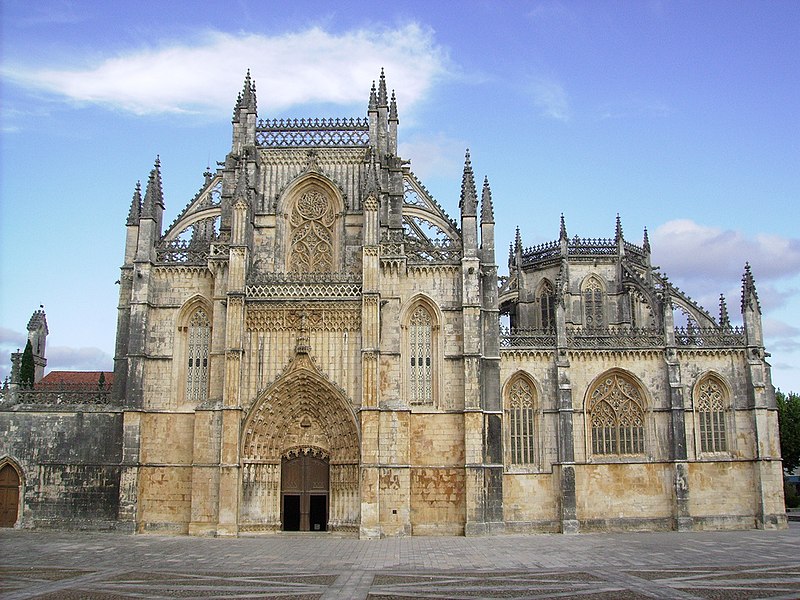
April 15, 2011 at 9:34 am in reply to: reorganisation and destruction of irish catholic churches #774583ParticipantThe Monastery of Batalha:


 April 15, 2011 at 9:24 am in reply to: reorganisation and destruction of irish catholic churches #774582Participant
The Monastery of Batalha in Estremadura in Portugal


 April 12, 2011 at 1:22 pm in reply to: reorganisation and destruction of irish catholic churches #774581Participant
A photographic miscellanea of English Gothic churches:
http://www.thechurchphotographer.co.uk/2010/01/bishopstone-st-mary-a-warning-for-the-unwary.html
April 11, 2011 at 9:55 pm in reply to: reorganisation and destruction of irish catholic churches #774580ParticipantThe Frauenkirche Munich
The foundation stone of 1468 laid by Sigismund, duke of Bavaria and Count Palatine by Rhein:
Clam fortuna ruit fragili pede tempus et hora
Nostraque sint semper facta dolenda nimis
Ecce Sigismundus princeps serenissimus urbis
Bawarie Reni duxque comesque diu
Huic animi pietas virtus prudentia summa
Alma deo complens votaque digna pie
Virginis excelse templum dum construi cernit
Saxum fert primum letus honore Dei
Cristo dum libeat domus hec sibi congrua busto est
Cui corpus confert ossaque cuncta favet
spiritus astra colat volitans ad littora pacis
Lumine sic divo vita perennis erit
Anno milleno quadringent sexaque geno
Octavo dom[ini] sicque nono febrio
epigramma illustrissimi principis et d’ d’
Sigismundi anno etatis sue 29 • Smd.April 7, 2011 at 11:40 pm in reply to: reorganisation and destruction of irish catholic churches #774579ParticipantApril 7, 2011 at 11:25 pm in reply to: reorganisation and destruction of irish catholic churches #774578ParticipantThe Frauendom in Munich
As rebuilt after the war:


 April 6, 2011 at 6:04 pm in reply to: reorganisation and destruction of irish catholic churches #774577Participant
The Frauendom, Munich, Baroque interior 1858

The 1870 neo Gothic restoration.
 April 6, 2011 at 6:00 pm in reply to: reorganisation and destruction of irish catholic churches #774576Participant
The Frauendom in Munich in 1946


 April 5, 2011 at 10:20 pm in reply to: reorganisation and destruction of irish catholic churches #774575Participant
From the City Journal:
Theodore Dalrymple
How the Irish Bubble Burst
The Emerald Isle’s story is a microcosm of the global economic crisis.
23 February 2011
If you want to study the economic crisis of the last few years, go to Ireland, where you will find it in its purest form. Ireland is a small country, with a population of just 4.4 million, and the connection between clientelistic politics, bankers’ cupidity, and the mass psychology of bubble markets is easiest to comprehend there.Dotted around the country, outside of almost every town and sometimes in the middle of nowhere, are housing estates—completed, half-completed, and never-to-be-completed—which are unsaleable, will almost certainly never be inhabited, and are destined to fall into graceless ruins. Some 300,000 new dwellings now stand empty in the Irish Republic, a number whose equivalent in the United States would be approximately 21 million.
The madness that gripped the country can be gauged from a few examples. A 25-acre piece of land on the edge of Dublin on which a derelict factory stood sold in 2006 for $550 million. After the banking collapse two years later, it was valued by the National Asset Management Administration, the public-sector organization set up to handle the banks’ toxic assets, at $80 million, a sum itself arbitrary in the absence of a flourishing market. The Anglo-Irish Bank, which eventually collapsed and left taxpayers a legacy of approximately $40 billion of debt, lent an average of $1.7 billion to each of six property developers; it lent more than $650 million each to another nine. A house in Shrewsbury Road, Dublin, sold for $80 million in 2005 but, now standing empty, is on the way to dereliction, and no house on the road—a millionaires’ row—has sold for the last two years, despite a fall in prices of at least 66 percent. During the boom, taxi drivers and shop assistants would tell you about the third or fourth house they had bought—on borrowed money, of course—and of their apartments in Europe, from Malaga to Budapest to the Black Sea Coast of Bulgaria. It was not so much a boom as a gold rush, or a modern reenactment of the Tulipomania.
All this would not have been possible were it not for the insouciance of foreign banks. The Royal Bank of Scotland alone lent $50 billion in Ireland. German banks extended $140 billion in credit and the British banks as much again. The champions, on a per capita basis, were the Belgians, weighing in at $57 billion. (The cautious Americans lent only $70 billion.) The gross external debt of Ireland is just a fraction less than half a million dollars per head, that is to say, more than $2 trillion in total. It is not difficult to see why a rescue was needed, or who was being rescued: not the Irish, but all of us.
During the boom, the government—under the direction of Ireland’s largest political party, Fianna Fáil, in power for most of the last 80 years and famous for its patronage network—increased public-sector employment by 25 percent and also the rate of remuneration. The average public-service wage rose from $39,000 a year in 1998 to $64,000 in 2008, with pensions following suit, in return for a pledge not to go on strike.
This huge increase in expenditure no doubt cemented the political loyalty of its beneficiaries. The budget was balanced, but only superficially, in a narrow accounting sense, by means of tax receipts from construction and property deals whose size was grossly inflated by unsustainable borrowing from abroad. A balanced budget, then, is not by itself a sign of fiscal health.
When the music stopped and the Madoff-style pyramid collapsed, the government was left with obligations impossible to meet. Public service salaries have already been cut by as much as a quarter, with more to come; national sensibilities have been wounded by the fact that creditor nations, especially Germany, are dictating Irish policy; and, of course, political loyalties have evaporated. Fianna Fáil will almost certainly suffer the worst defeat in its history in the upcoming elections, though reports of its demise as a political force are premature. The subsequent government will have no choice but to pursue unpopular policies. Memories being short, no one will blame Fianna Fáil (“a criminal organization, like the Mafia,” said the banker son of an Irish friend of mine) for this necessity, instead remembering the good times under its rule.
Unemployment is now 13 percent in Ireland; it would be higher if 5 percent of the working-age population (principally the young and well-qualified) had not emigrated over the last two years. Other exports are doing well, and Ireland has a trade surplus, but nowhere big enough, alas, to service its debt. For the moment, to stave off the collapse of many banks, the necessary fiction that the country is not bankrupt is maintained (I was surprised by how full the restaurants were, but this might have been the orchestra playing on the Titanic). Default is not impossible, however, and some even advocate it.
Theodore Dalrymple, a physician, is a contributing editor of City Journal and the Dietrich Weismann Fellow at the Manhattan Institute.
April 5, 2011 at 9:44 pm in reply to: reorganisation and destruction of irish catholic churches #774574ParticipantLongford Cathedral:
- AuthorPosts


