
GrahamH

Forum Replies Created
- AuthorPosts
GrahamH
Participant😀 Yes that just about sums it up.
Wonderful place, however the director did stress that any alterations made would be in the form of additions to the building, and that the original part would conserved pretty much as it is.
A big problem is the lack of flexibility the current space offers – as mentioned, only a tiny fraction of the two million specimen collection is on display. I’d imagine there’s little scope for much rotation with the current state of things.Lovely building too – much more attractive in its orginal modest form than the bloated National Gallery across the way, though the blind windows at ground level are a shame.

It was cleaned by the OPW last year and looks better still now.
ParticipantThe inconsistencies in the workings of Dublin City Council never fail to surprise. On the one hand O’Connell Street is generally maintained immaculately by the council’s street maintenance division, and full attention is paid to keeping the street furniture in tip-top condition (leaving aside the Supermacs corner).
It is most impressive to walk down the street on a daily basis and constantly see the trees being regritted, or the trees being watered, the bins being polished, the pavements being hosed in the evenings, street-hoover yokes humming about, statues being cleared of litter etc etc. The pride taken in this new space must be highly commended. The CC have lived up to their promises.On the other hand we move twenty metres away to the saga of The Missing O’Connell Bridge Baluster.

Last sighted on the bridge in September 2005, presumed to have plunged to a certain death in the river below, the resulting gaping gap in the balustrade, of significant safety concern at the spot where tourists and their children stop to take photographs of the city, remained completely vacant for over two months until it was eventually reported (by the public) to the Roads and Streets Department of the City Council in mid-November. A further two/three weeks past until a man was sent out with a slab of board to paste over the hole, which was then scribbled on, seemingly by the same person considering most graffiti ‘artists’ don’t even know what a rate is, with a sarcastic quip as if it was some sort of joke. Do the CC support the defacement of items of street furniture?

By all accounts it could have been deemed a joke if something was going to be done about it quickly. That would be too much to ask however as the board then sat there for three months before eventually falling off, again presumably falling to a soggy end in the murky waters below. It then remained vacant yet again for a number of weeks before the next replacement arrived, this time a delightful chunk of CC bright plastic fencing tacked onto the protected structure:

Over seven months have now passed since this baluster disappeared from the most prominent bridge in the city, sited at the busiest pedestrian intersection in Ireland.
How difficult is it to get a replacement piece of stone cut? How much would it cost in contrast to the hundreds of millions being pumped into the street a few feet away, indeed in the same architectural conservation area and in an area designated for special attention? Or even if a full conservation project for the bridge is proposed, how much effort would it be to cast a decent stucco or plaster replica?
The simple fact is that O’Connell Bridge, like every nearly other street in the city, is not part of a prestige bells and whistles regeneration scheme, so it suffers the same mediocre maintenance and attention as pretty much everywhere else.(incidently O’Connell Bridge is nothing at all compared to the woes of poor old Butt Bridge, nut that’s another rant altogether)
ParticipantCame across a certain collection of glass plates over the weekend. Lovely things.
 Participant
…if not decent shopfront designers….
That church on Killarney St is a fantastic little building – so austere and perfectly proportioned, it’s most surprising to suddenly happen upon it. Anyone know of its current state – haven’t seen it in about a year now….
Four more pics here. Bit of a mixed bag:
A

B

C

D

(B is not in an obscure city park)
ParticipantYes, though by no means complete (the entire central section has yet to be started), the upgrade so far has been little more than a quick mall recladding job, with x amount of apartments tacked on the side.
The non-slip granite flooring in particular looks very cheap and mis-matched, and the Mary Street elevation is also disappointing. Saying that, the refurbished central area combined with much improved Moore and Henry? Malls could be the making of the place, with these two malls in particular being radically changed. Out on Cole’s Lane you can now see the ridiculous one-and-a-half storey height of Moore Mall:
(also this bizarre juxtaposition on Cole’s Lane!)

What is proposed for the Ilac is something not a million miles from what fergalr mentioned there, but more like the Jervis Centre; from The Sunday Business Post four months ago: “The height of the centre will rise by 3.2 metres and two bulkheads in the central part of the mall will be removed. The plan is to create the feel of a full-length street parallel to Henry Street with double height shops all along the passageway.”
http://archives.tcm.ie/businesspost/2005/12/11/story10323.asp
The food-court nature of the Parnell Mall is certainly going to be a challenge…
Back on Henry Street, here’s a very rough idea of what Dunnes are building, composed with the cutting-edge CAD programme Paint.

Can’t say I’d agree Stephen about Henry Street being “monotonous with the endless unified 1917 terrace” – especially with the variety of fine stock directly across the road from it. The 1917 terrace also looks fantastic in the sun with its glowing orange brickwork and crisp limestone features:


If anything it’s the generally blocky, flat and lifeless UK high street shopfronts that need attention along here.
But yes, as a development I too look forward to the finished Dunnes product. It’s been a long time coming when you consider George’s Street, the revamped St. Stephen’s Green Centre ‘Foodhall’, and even flippin North Earl Street! And all the while the chain’s once-flagship store was festering away in the Ilac. It’s going to be the icing on the cake for a now-thriving retail area; All the more reason for the southside to pull its socks up fast.
Just to correct an earlier post, according to the SBP it’s the Moore Mall store that’s to be disposed of and subdivided – you’d wonder for the need of the other large store in that case…
ParticipantNot sure aj, but I’ve some pics to post of them soon.
Couldn’t wait till Christmas to find out what Dunnes Stores are doing with their Henry Street site and the demolished facades in what was the largest unified post-1916 terrace in the city, so I went to see the planning file. I imagine people here are interested in what they’re at also…
So what are they doing? Modern infill? Faithful reconstruction? Pastiche job?
Well, as you might have guessed, a mixture of all three really; most irritating on one hand, but a relief on the other. One thing in particular is very annoying however.This is the site today – a total of three properties was demolished:

Here’s before with demolished facades outlined:

You can just about make them all out there – a pair of standard, two-bay red brick properties alongside a third focal building on the far left with limestone or maybe granite pilasters and pediment etc, all dating from c.1917, Henry St having been rebuilt exceptionally quickly after the Rising.
In the initial application it was proposed to only demolish the two left-hand buildings including the pedimented one, retaining the particularly distinguished right-hand fa
ParticipantWell as Peter mentioned, the lanterns are back up 🙂

Quite who came up with the notion of turquoise panels I’m not quite sure… but they look so distinctive and quirky you can’t help but instantly like them.
Their restoration has been magnificent:
Just look at the quality bronze and sumptuous 1920s construction, perfect for the decadent Empire style:


On close inspection you can see the fittings are assembled with tiny brass screws:

They make for impressive silhouettes too:

Can’t wait to see them illuminated!

…indeed I wonder if the clock face illuminates. It just may have done in the progressive late 1920s-1930s; it also seems to be made of perspex today. The turquoise with chrome highlights is an inspired combination – classic Art Deco 🙂
 April 20, 2006 at 11:00 pm in reply to: Leinster Lawn expected to be restored during summer recess 2005 #752978Participant
Absolutely, and a timely revival of this thread, being precisely a year old. Ludicrously the title could refer to the present!
What is holding up this project?!! (aside from the obvious). Or is it just that – the obvious?Yes the ‘shop’ more than likely refers to the 50s/60s security hut to the front. So the use of glass transforms a hut into a ‘pavilion’ does it? Well you learn something new every day…
Just on those two Georgians on Kildare Place…

…where exactly were they sited? Looking at Lotts’ picture below, and going on the description of being ‘replaced’ by the brown wall, surely they must have overlapped the facade of the much later National Museum if they once stood on this spot?
ParticipantApril 2006

So the saga finally comes to an end with yesterday’s announcement:
http://www.irish-architecture.com/news/2006/000094.html
So where is this new auditorium likely to be located in the complex? It’s going to take up a lot of space, and all of the quadrangles have long since been filled in, so it can’t just be slotted into place behind the narrow Earlsfort Terrace block…
The opportunity for a major new facade to the Iveagh Gardens is fantastic though – presumably this will consume in its entirety the substantial, almost derelict service space between the rear of the complex and the Iveagh wall. It seems the new auditorium will have to be placed horizontally along here, parallel to the front block if it’s to minimise consumption of the gardens…
And will the trees and general scrub be cleared away here to reveal views of the gardens? Perhaps for the best given some unsavoury tales of ‘activities’ in this area, but it would a shame to lose the mature winding walk along here all the same, allbeit admittedly in poor condition at this stage.
Anyone know what the interior of the Earlsfort block is like? What will the NCH want with acres and acres of lecture rooms and offices?
I’m in two minds about whether this remnant of the original building phases of the Butler complex should be preserved in the expansion – it’s almost earned a right to be added to the Dublin curiosities list at this stage:ParticipantYou mean an interesting media opp? 😀
Yes most of them are dire – can think of a number straight off. Essentially they’re just used as billboards: the bigger and brasher the better. And who in town council planning offices is going to raise that as an issue?ParticipantYes – great stuff there 🙂

Was there a fly past at the end Morlan? We were told at least twice on television that the small contingents of aircraft that kept going by would eventually combine at the end for a full fly past, but it doesn’t seem to have happened!
From a vaguely more architectural perspective, you’d really have to question the use of giant wedding marquees at the GPO, which combined with horribly utilitarian and barricading galvanised metal fencing and supports looked completely inappropriate for such a ceremonial occasion. They looked like something rural parishes cobble together for the Community Games courtesy of the local FF big wig – embarrassing to be honest. And Dublin’s Mayor gliding up to the portico in a silver Megane hatchback?! (:D)
But overall meticulously planned – it was refreshing to hear both Captains Murphy’s and Ryan’s articulate and confident clear English and Irish instead of the usual incompetent bluster of those in Irish public life we’re so accustomed to. The parade also went off without a hitch.
One of the most significant yet simple changes made as part of the O’Connell Street IAP works really came to light during the proceedings – the simple pulling of the west pavement out beyond the columns of the GPO. No longer curtailed by the kerbline, the pillars now all stand on their own feet, landing confidently down on the ground as seperate architectural elements rather than being bundled together as a single unit as the roadway almost forced them to do in the past.
The other improvement that’s not really evident on the street but is very apparent in television aerial views is the tightly knit cobbled surface of the Plaza roadways which is different to the wide paving slabs of the median and side footpaths. The setts are wonderfully evocative of the 1916 era cobblestones that lined the street up till around 1920-30 – they looked great. A pity though the central marquee couldn’t have been moved back to the western roadway of the Plaza instead of straddling the median. The sense of a ceremonial space, the whole purpose of the design, was completely absent 🙁ParticipantGood news – thanks.
So all in all there’s five types of glass in question here:
. Swirly crown – easily distinguished 1750s glass
. Highly dimpled cylinder – appears to be original, but later
. Modestly dimpled cylinder – questionable provenance, may be mock-historic, may be later again cylinder
. Flat modern glass – probably from the 1960s
. Wavy modern glass – questionable when it was installedRegarding the cylinder, as you see it Devin the more modest stuff is replacement mock-historic glass installed post-restoration. I’m not so sure – as we have seen, the quality of cylinder glass varies greatly. When making a higher quality product more attention was paid to the flattening-out process to ensuring it was as flawless as could be achieved. Similarly earlier cylinder glass pre-1830s/40s was also of a lower grade to later cylinder, so this could also account for the variety of type in the Trinity windows – very evident as you say in the upper sash of this window:

I’d also have to question the notion of the wavy modern stuff being post-restoration – it is after all in this non-restored West Front window, in abundance in fact:

I do see where you’re coming from though regarding the allegedly mock-histoic cylinder – there is a very clear difference between it and the more intensely dimpled glass. But it does beg the question – if some of the original cylinder is being kept, then why destroy other original panes? It’s either hampering efficiency or it isn’t. Above all though, I just cannot believe for a second that Trinity would even think about attempting to do this, in spite of their record elsewhere on campus. These windows are its most prized asset outside of the Library building – it’s akin to cutting the pages of the Book of Kells down to size beacause they won’t fit in the display case.
Hence I remain fairly optimistic that nothing untoward is going on, and that all the glass dates from a variety of periods – however naive it may be…Yes the southern block is underway now – which means they’ll spread back out onto the southern West Front before long where there seems to be a good amount of crown remaining. Here’s the southern Square block now with removed windows as mentioned:

Also the giant southern Venetian on Colleg Green being restored back in January:

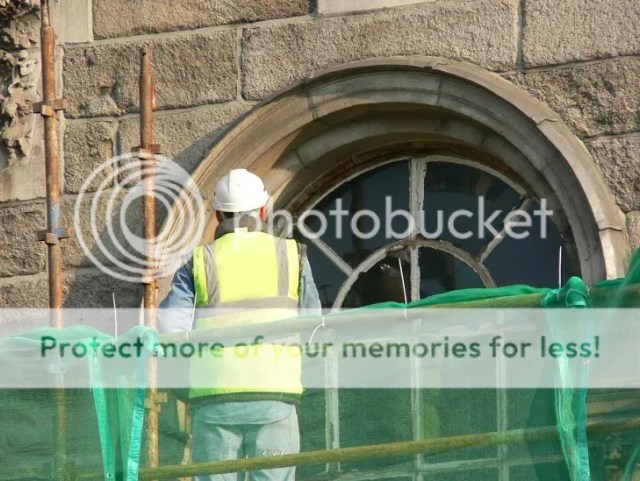
(thought I’d better airbrush out the contractor’s name ;))
Work was only getting started above, so there’d be no evidence of glass replacement here either way.ParticipantSome of the Trinity windows below. The majority of the West Front’s old panes, certainly in the non-restored windows, seem to be an early form of cylinder glass, with that typical wrinkled and warped texture like the skin that forms on hot milk:
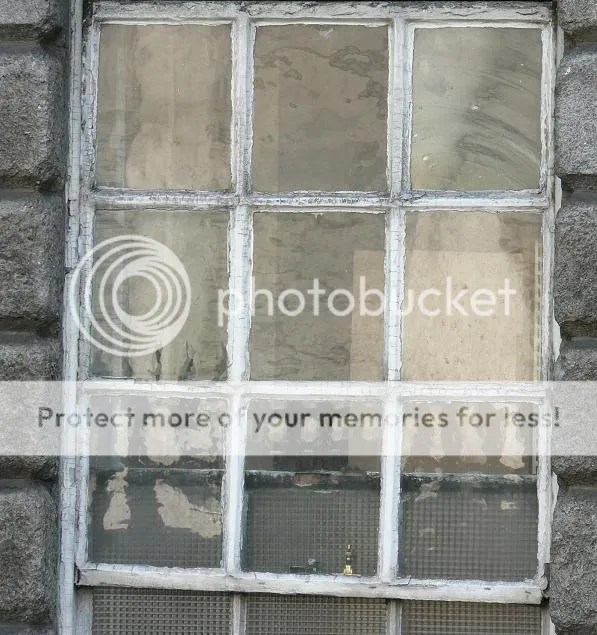
The only pane of 1750s crown glass above is that in the very top right corner with the very apparent swirls.
The crown glass featured in ‘The Legacy of Light’ seems to be the exception rather than the rule right across the entire 1750s Parliament Square complex incl the West Front. Many non-restored windows also appear to feature quite an amount of modern glass too, though it’s difficult to say how much such was the light at the time. This un-restored W F window seems to feature nearly all modern glass, with only two single panes of cylinder in opposing corners:
Otherwise though, un-restored windows with lots of modern glass do not seem to be that common.
This restored window on the W F features entirely modern glass which is very wavy in appearance, with the exception of a single surviving cylinder pane in the lower sash.

All of the other few windows that have been restored here so far also seem to feature lots of this strange glass. I don’t know if it was here before the restoration. Here’s another example, though this time a lot more cylinder:

Moving inside to the Front Square and the northern block, and again a mixture of cylinder and modern wavy stuff in this restored window:
Pretty much all of these windows in the northern wing feature exactly the same mixture of modern wavy and old cyclinder. No evidence of crown at all. Many of the upper windows in the northern block also feature 1830s horns which might explain the early cylinder in the older sashes below such as that pictured.
So all in all, a difficult one to call without examining all the glass exceptionally closely. There appears to be a difference between very flat modern glass in some windows and more wavy modern glass in others as pictured. If this difference could be confirmed, and the wavy glass distinguished as being only in restored sashes, then there could well be something fishy going on. Either way that wavy modern stuff isn’t very attractive – gives the impression of bendy plastic sheeting. Still, it does seem all of this was there before the restoration, and in the windows I looked at I didn’t come across any really dodgy stuff like that you pictured Devin.
Admittedly crown can look like plastic too in certain light – here’s some lovely stuff surviving high up in the side elevation of the Chapel. Note the blatently modern pane in the top left and the cylinder pane in the bottom left:

Also some stunning cylinder above the central doorway of the northern block:
April 13, 2006 at 10:22 pm in reply to: Replacing aluminium windows with timber sash windows #776593ParticipantThat’s interesting about another house having identical sashes – are they precisely identical?
One thing to bear in mind is that Victorian joinery workshops mostly worked to set designs, often from pattern books, or just favoured designs that they came up with themselves and used over and over again, so many houses ended up with the same windows, even replacement houses.
And just like PVC windows today, once one house got sheet glass installed, it spread down streets like wildfire inside a few years (only not quite with the disasterous results we’re seeing today :(). Similarly, neighbours no doubt recommended manufacturers to each other so that may well explain the house down the road having similar windows.One thing you could do Echium is check the rear of the houses on your road and see if there’s any Georgian sashes left there – again it was as common as anything to replace only the front windows with expensive sheet sashes, and leave the Georgians to the rear. Uptairs bedroom windows are also often revealing.
Another option is to look at the modern replacement frames on your road and see if any of them have mock-Georgian grids which are usually an accurate indication of what was there before, as are windows divided into two-over-two etc.
And a third way of doing things if you’re really hung up on the matter is to ask various neighbours who have replacement windows what design they had before – usually a wealth of information 🙂ParticipantYep – there they are 🙂


They also swept by on College Green in December last year!

The GPO clock was being hoisted into position late this afternoon – it looks truly fabulous in its restored state. Images (especially those taken in the rain :o) just cannot do it justice: the texture and sheen off the copper is magnificent, and the face a vivid turquoise, contrasting beautifully with the deep tones of the surrounding metal. You really have to see it in real life!

Before

The lanterns still have to go up. In their case it’s interesting that the lantern arms are in fact just crude iron or steel arms that project from the building. It is these that hold the lanterns up structurally, while the quality brass arms (or maybe copper given the new appearance of the clock!) that we see are simply two moulded pieces of cladding that clip round the metal like a cast! Simple blocks of wood attached to the metal arms taper the cladding to make it look more substantial.
ParticipantVery few sources on the internet which is disappointing.
Looked a bit like Tellytubbyland on the News this evening – I’m sure it’s much less dull in real life 🙂ParticipantThanks for the pic Echium – yes almost without a doubt they are later frames, evidenced as much by the little hoopy hooks as by the fairly decorative horns, the former of which also tended to be later additions (though am not sure what they were used for, maybe suspending the sashes when decorating?).
Your horns are quite restrained all the same, typical of 1850s and early 1860s windows, crossing the line between the basic 1830s/40s style and later post-1860 building boom where they become very rounded and bulky.To give you an idea of the basic nature of 1820s to 1850s horns, here’s one of the 1844 windows at Connolly Station:

Yes they do feature hoops too, but I imagine them to be later additions, or even the first of their kind, especially considering the Connolly windows are something of an imported style.
So to attempt to sum up your house :), it looks like what were originally Georgian sashes were replaced in the early/mid-1860s with sheet glass windows, going by a) the sheet glass, b) the relatively elaborate horns, and c) the hoops on the underside of the sashes which are so characteristic of post-1850 windows.
However it is just conceivable that the frames you have are still the original Georgian ones – it was very common to cut out the old gridded panes from the main frame and simply insert a clean single sheet of glass rather than going to the expense of fitting entirely new windows. Have a good scan of the sash frames and see if there’s any evidence of filled-in holes! The horns are just about basic enough to maybe scrape it into 1838, though I wouldn’t bank on it!
It’s also possible that the windows may date from much later, maybe even the 1920s when a host of horn styles were in fashion, but I doubt that was the case here: most people jumped at the chance to change out-dated 1830s/40s Georgian grids as soon as it became affordable, especially in scenic areas like Dun Laoghaire.Are there any other examples of older windows on your street, or modern replacements that give a clue as to what was there before? As for what to do now, a tricky one. It’s very possible Georgian sashes were removed in order to install the aluminiums in the basement – but obviously also possible that Victorian sheets were taken out. If you can find out for certain about the 1838 windows, then personally I’d go with Georgian grid replacements. If you can contact the previous owners, even better!
ParticipantSo did you get all your windows replaced in the past by Ventrolla then Echium, or just some of them?
The horns on the windows will tell all – in an instant in fact. If they are long and curved with a dent in the middle as above, then the window frames are at least 1850s, if not later. If they’re only little basic curves, they could well be the original frames but with later replacement glass. Either way it’s likely that you had two-over-twos originally, though I’d still say Georgian sashes are nearly gauranteed to have been there!
Even the rest of the whole street/terrace would not have had sheet glass to start off with – the fashionability of replacing Georgians with sheet in the 1860s cannot be underestimated, especially in Dun Laoghaire!ParticipantThere was a exciting atrmosphere on the street today, what with the building works at full speed, groups of people wandering about on the roof of the GPO…


…the Military Police in a van on the road (an 05 one for the public of course), the Army practicing hoisting a ginormous Tricolour…

…and more forces down on the street:

You can see the group of big wigs there in their overcoats, discussing various plans including “roigsht, will we drop the drummer or not then” amongst other topics.
The bronze and brasswork of the building was also being polished, and a cherry picker was up, hopefully to erect the great lanterns and clock which have yet to be reinstated.
ParticipantWere these windows like this before the restoration though?
- AuthorPosts


