
GrahamH

Forum Replies Created
- AuthorPosts
GrahamH
ParticipantCool! I take it back! 😀
ParticipantYes I’ve been watching these going up with interest – rather odd looking development.
Not sure what to make of the trees either. Certainly at night they add greatly to the area, to what is an otherwise dingy, soulless and featureless, sodium-lit urbanscape. Though in all honesty it’s more the injection of crisp white light into the area that is so refreshing – it makes the world of difference. Hopefully when all the new lampposts are installed the area will be transformed after dark.
Otherwise I hope the trees don’t end up splitting the street in two – must take a walk along soon and get a feel for them. As the Corridor suggests, like everyone else I’m rarely out of the car on that route 🙁Good points made hutton regarding properties. At the end of the day it’s only public domain works that have taken place, and very very recently at that. Negligible improvement has happened on the property front. Most of it is still an 80s timewarp.
I see the ghastly red ‘Golf Corner’ Georgian has had that notorious billboard removed recently, revealing a giant panel of stock brick 🙂
The building is currently up for letting, so hopefully…ParticipantAbsolutely.
What an ugly, bog standard drainage channel cover – could something more elegant and befitting of this location not be concocted?
It also highlights how striking this curve would be if executed as a lighting strip, marking out the plaza area at night and neatly merging old and new. A little more innovation is in order,ParticipantThe Watchtower is an apt description – a place to look out from, not something to look at. The top is awful, and the glazing generally uninspiring.
What a missed opportunity 🙁The new look Point by contrast sounds fantastic; the capital will finally have a decent large scale performance venue. The seating sounds very similar in arrangement and capacity to the Globe Arena in Stockholm.
 Participant
Yeah grey was the only one that I got 😮 – but agreed with Seamus that the stating of a location (‘here’) in the clue led us too far astray. “Munching sheep, as long as they aren’t white, or black. (5)” might be more appropriate…
Fantastically cryptic first clue, but I think you also unintentionally led us astray with this, ctesiphon, when you suggested the Liffey theory to be “far closer than you might think” – when you were in fact really talking about the reflection. Saying that, I was wary of this, as given your usual concise self, Newmarket is hardly an accurate reflection of the Dominican complex across the Liffey, so it kinda had to be something else. The level of elusiveness employed here was also a little inconsistent with the other clues, so it didn’t really encourage one to delve much deeper.
But all in all a very testing round 🙂 – nice neat final clue too.No cryptic hints regarding the below, only to say that there is no open sky in this photograph. It’s not the Museum Building alas Phil, though i see how the frilly edging resembles its string course detailing.

Just because it’s within sight of the rugby pitch doesn’t actually mean it’s an educational building…
ParticipantIndeed! Not even knowing the building in the first instance tends to generate difficulties 😮
A great one ctesiphon, and a striking picture too of your ladies in red – don’t think it’s been mentioned.
So what of this place – what was it built for and when? A very odd looking affair; surely they’re not Portland dressings are they? I stand by the 50s-60s estimate 🙂Nope Mr O’G – that earlier picture wasn’t Luce Hall in TCD 😉
Not a million miles away though. Something of a love it or loathe it edifice.Participant🙂
Yeah ctesiphon, your colleague speaks wise words – bail us out here would ya?
The Dominican clue would indeed appear to suggest a mirror image site on the opposite side of the Liffey, which fits Newmarket rather nicely, near which there is another convent according to my Dublin map (
ParticipantHere is the new corner as nearing completion:

Most impressive, if the left-hand facade rather flimsy looking in comparison. Still, its thin, suspended appearace when viewing the sweep as a whole is elegant.
The acknowledgement of the Victorian’s storeys and parapet with graceful curved floors integrates the two quite well.
Very striking forms created – I think this is a good example of where the use of expansive glazing is not a lazy choice, as is increasingly the case of late.
When one compares this comparitively minor scheme with the prominent site beside City Hall, it paints even more starkly the leaden, stodgy, cumbersome monolith that crucial site has been dealt.
Participant
I just love the ‘roof terrace’ – the very essence of sopistication.
What planner had the audacity to wave this monster through?Participant25/10/2006
It’s coming down.


The new vista down South King Street:


Good riddance.
ParticipantGo on then – do your worst 🙂
Yes I’d have assumed it to be in the Dublin 8 area alright – still for the life of me can’t think were.
Must take a wander about soon. Still trying to work out the aforementioned building that it’s close to as well!ParticipantWhat a dismal proposal. Of course the irony is that if these ranges were established residential streets, the blocks would be struck out outright for being insensitive, domineering and overshadowing of the terraces below. And this would be a street were houses weren’t even protected structures!
Not sure I quite understand why ABP has to let some development through; if they see fit it can be fully rejected. Or is it inevitable that politics plays a part – appeasing the authority’s critics?
Beautiful photographs btw Devin.
ParticipantAs was noted on the other thread, it’s not 100% clear, but it’s nearly definite that this was built:

because:
1. The original interior cast iron columns extend into the 1960s part roughly to the depth of the tower.
2. The 1960s part is wider at the front that the back, to the depth of a tower.
3. Various photographs we’ve seen suggest the tower as being there.
4. A photograph in the IAA to the best of my knowledge clearly shows the western tower fully extant.
5. This map from 1936 depicts the tower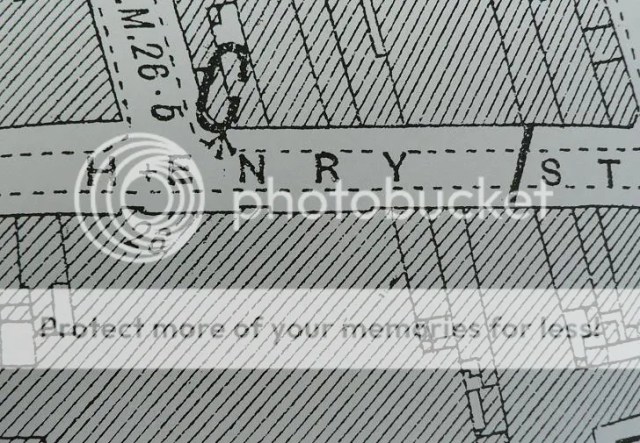
The store was extended in 1904, so it’s possible the western pavilion wasn’t built till then, perhaps when it was realised that the entire proposed scheme couldn’t be built/funded.
If you’re serious about researching C.H., go to the Irish Architectural Archive on Merrion Square for us, head straight for the photographs bookcase, look up Henry Street, and see if there’s a 1930s-50s picture clearly showing the building with western pavilion. I’m nearly sure they have one. 🙂
ParticipantYes, that’s it exactly. It immediately transforms it into a blocky Edwardian affair, with strong flat-topped projecting tower. Very sturdy and surprisingly purpose-designed in character – it will work very well even minus the spires. It’s bizarre how the removal of the spires turns it from a Victorian into an Edwardian building!
Unfortunately the new building proposed for the opposing corner is really going to compromise it, being taller than Arnotts’ tower. If that gets through there’d be absolutely not point in erecting the spires at all. Indeed even as planned the tower’s prominence on the streetscape is swallowed up.
ParticipantNope, nor the pavilion spires, but that image if pretty spot on Paul, including the new corner pillar (though obviously a single pillar). A setback storey needless to say is also proposed for behind the parapet. It is very low indeed, so presumably won’t be noticed from steet level.
Participantheheh – apparently there was 500 people queuing outside the building at 10 o’clock this morning 😀
ParticipantYes Morlan it wraps directly around the corner. The tower becomes a new central feature, with its current elevation with oriel window etc being replicated on the newly exposed corner.
It is proposed also that a brand new replica terminating tower/pavilion will be added to the end of the repositioned facade, mirroring the current arrangement on Henry Street to the left of the tower.
I’ll send you a pic.Goodness knows what happened to the tower after it was removed – indeed sledgehammers were probably used to get it down 🙁
ParticipantThat’s a good point. Frank McDonald’s infamous 1984 critical observations on the mirrored glass have generally entered the collective consciousness at this stage, and he did have a point regarding the elegant transparency of old.
But the mirrored glass also has a quality in itself in how it reflects the sky, and in particular when in late afternoon, especially winter, the bright sun spectaularly catches on the southern and western elevations, lighting up the city. It looks even better against the black sky we so often get for half the year. A magnificent view observed from the quays, and Millenium and Ha’penny bridges.It’s a toss-up really – the mirrored glass looks crap up close, but great from a distance.
Ad of course staff hate working in the place The Denouncer – who would want to work in an office space that hasn’t been tocuhed for forty years. The whole point of the tower retention option is that it would be completely refurbished.ParticipantYes it’s very disappointing news – the worst possible outcome really. There’s a lot of wriggle room on site to increase density without affecting the tower. Also the basement of the complex, itself a fascinating 1960s timewarp, could be redeveloped.
It’s notable that a national executive decided on this. Obviously either way a committee was going to make a decision in the interests of the union, but it is a uniquely Dublin landmark they’re meddling with.
ParticipantHmmm – the ramp in renderings is very discreet indeed at street level, even in spite of what appear to be toughened green glass railings around it. Not as bad as you might expect – it’s very steep so it disappears quite quickly. Unfortunately Luas precludes Middle Abbey St from being used…
Saw the planning application today, all eight stone of it. The elevations to Liffey St are quite pleasant, as are various parts on Abbey St. The 1990s infill is being retained throughout – it’s funny, just like one of Morlan’s photoshop jobs, they’re simply going to be stretched upwards to take in an extra storey on Liffey and Abbey streets. Talk about the transient nature of modern retail architecture.
The new street and square elevations are pretty typical commercial stuff, with an emphasis on deep modelled, layered facades. The new vista from the rear of the current Hector Greys (which will be the westernmost part of the square) all the way over to the GPO and beyond is most impressive. There’s a real sense of permanence and solidity – not gimmickry, with old running into new and the odd fully matured specimen tree.The new street from Henry St is also aided hugely with this by virtue of the ‘new’ Victorian Arnotts facade – it wraps round and extends down into the new street like the street has always been there, just as the GPO does linking the square to Princes St. And I have to say the remodelled Arnotts looks exceptionally well. It is well proportioned, wonderfully sturdy and solid in stance, and projects an air of confidence on its new corner site. The limestone oriel window and dressings will replicated on the new tower elevation, while the current five western bays will be dismantled and re-erected on the new street, terminating in a new-build small tower to match the one on Henry Street. It is expected that in excess of 80% of the five bays’ material can be salvaged, while bricks required for replication will be specially commissioned to match the Victorian stock, and the limestone dressings (presumed to be Ardbraccan but no longer quarried) will be sourced elsewhere and sandblasted if necessary to match the original. A grand stone pier matching the pilasters either side of the main entrance will stand on the corner supporting the tower (like a traditional Dublin pub entrance). I presume the store’s water tank is no longer housed at the top!
People might be interested to know that the application authors clearly sourced information from the Arnotts thread on Archiseek, and indeed lifted a few images directly from the site, including Paul’s tower montage. However they have come to what can only be an entirely incorrect conclusion regarding the western tower, claiming the tower presented in this image to be ‘fictitious’:
It is claimed the building on the bag was the intended design, including a ‘second phase’ that was to be added on later, and hence the small western tower was never built in order to accommodate this extension at a later date. However we can be nearly certain that that tower was built, because:
1. The original interior cast iron columns extend into the 1960s part to the depth of the tower.
2. The 1960s part is wider at the front that the back, to the depth of a tower.
3. Various photographs we’ve seen suggest the tower as being there.
4. A photograph in the IAA to the best of my knowledge clearly shows the western tower fully extant.
5. This map from 1936 included in the same feckin application shows it as existing!There’s little doubt that this tower was built, albeit at a later date when it was realised the funds wouldn’t be there to construct the full scheme. It is mentioned in the application that the store was extended in 1904: its probably safe to assume it was built then.
And yet oddly in another document in the application, presumably written by someone else, reference is made to the ‘demolished’ western part of Arnotts and to the 1960s curtain wall, when referring to the Henry St elevation – indirectly acknowledging that the tower had been built. Hmmm…The new 12 storey residential tower is clad in zinc. At first it suggests that hideous grey cladding of Ivy Exchange on Parnell Street in renderings, but presumably it’s a quality material with a depth and texture to it. Anyone know of comparable examples?
Also to clarify, Arnotts as we know it is gone. The entire store migrates to the south western corner of the site at the corner of Liffey and Middle Abbey street in the form of a giant building over six levels in places. The Victorian Arnotts will become an independent retailer of some kind, presumably still owned by Arnotts.- AuthorPosts


