
the work of J.J. McCarthy
- This topic has 70 replies, 10 voices, and was last updated 12 years ago by
Praxiteles.
- AuthorPosts
- January 16, 2006 at 4:57 am #775161
Paul Clerkin
KeymasterSt. Joseph’s, Carrickmacross, Co. Monaghan,
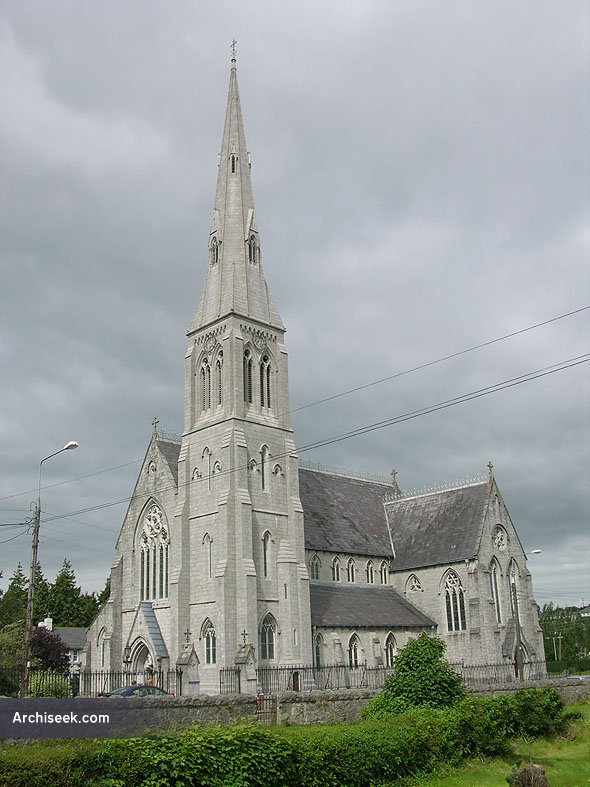
https://archiseek.com/2009/1867-st-josephs-church-carrickmacross-co-monaghan/#.VBhEXvldXG4
January 16, 2006 at 7:40 pm #775162Praxiteles
ParticipantMaynooth College Chapel, JJ. McCarthy (1875-1880), interior completed by Hague.
Among many notable features, the most important of the internal features is the oak Choir stalls.
The interior has survived except for the Lady Chapel which had the mensa of its altar removed from the rerdos by the Ramta specialist former president Michael Ledwith. This was to facilitate the “active participation” of American benefactors who hear Mass in the small chapel in pairs.


 January 16, 2006 at 10:55 pm #775163Participant
St. Saviour’s, Dominick St., Dublin, JJ. McCarthy (1852)
This was probably JJ. McCarthy’s finest Dublin church.
This is what the interior has been reduced to:


 January 17, 2006 at 5:36 pm #775164Participant
St. Kevin’s Church, Glendalough, Co. Wicklow, JJ. McCarthy, 1846


 January 18, 2006 at 1:47 am #775165Participant
St. Michael’s, Ballinasloe, Co. Galway, by JJ. McCarthy (1846) consecrated by Cardinal Wiseman in 1858.
Therailing and gates in front of the church by W.G. Byrne, Dublin, 1919.
Damaged by fire in July, 2001 and subsequently restored but I am not certain what that might mean. I am inclined to suspect the worst.


A la recherche du temps retrouvé !
Cardinal Wiseman in Ballinasloe
From a Contemporary Record By Samuel J. Maguire
Preparations for VisitOn Tuesday morning, the 24th August, 1858, Cardinal Wiseman left the Broadstone terminus for Ballinasloe, accompanied by the Right Rev. Dr. MacNally, Bishop of Clogher; the Bishop of Elphin, the Bishop of Cloyne, the Rev. E.L. Clifford, the Hon. and Right Rev. Monsignor Talbot, Mr. Wiseman the Rev. William Derry, P.P., Eyrecourt; theRev. Mr. Bannon, Captain Bellew, and several other clergymen and gentlemen, who intended to be present at the consecration of the Church of St. Michael, Ballinasloe. Anxious preparation had been made by the Bishop of Clonfert and by the Town Commissioners. At almost every station along the line, crowds of people gathered who cheered loudly, and evinced the utmost happiness at seeing the Cardinal.
“On the approach of the train to Ballinasloe, the interposition of the clergy became necessary to moderate the enthusiasm of the people, who pressed forward, not without danger to their lives, and, as the train rolled slowly alongside the platform, the cheering was vehement.”
Among these on the platform were:- The Lord Bishop of Clonfert; Rev. Sir Christopher Bellew, Bart., S.J.; Rev. Malachy Green, P.P., Clontuskert; Rev. Wm. Manning P.P., Aughrim; Rev. Mr. Mc Gauran, P.P., Ahascragh; Rev. Mr. Kirwan, R.C.A., Ballinasloe; Rev. Dr. O’ Brien, President of St. Jarlath’s College, Tuam; Rev. M. Walsh, P.P.,Lusmagh; Rev. MR. Egan, P.P., Cloghan; Rev. W. King, P.P., Rev. Mr. Mc Namara, C.C., Rev. Garrett Dillon, Castleblakeney; Rev. W. Larkin; Rev. J. Moone, P.P.; Menlo; Rev. John Macklin, P.P., Rev. James Hynes; Rev. Michael Callahan, P.P., Kiltulla; Rev. M. Galvin, C.C., Rev. Mr. Pelley; Dr. Burke, ex-chairman, Town Commissioners of Ballinasloe; George Crowe, Esq., Aughrim; Robert Bodkin, Esq.; William Hynes, T.C.; Michael Finnerty T.C.; Timothy Egan, T.C.; John O’ Shaughnessy, Esq., Birchgrove; Hugh O’ Kelly, Esq., Woodmount; Francis E. Madden Esq., William Costelloe, Esq., Junius Horan, Esq.,Jeffrey Prendergast Esq., Dr. Colahan; Thomas Hyde, Esq., Solicitor, T.C.; Patrick Ward, T.C.; John Heenan T.C.; Wm. O’ Shaughnessy, Merchant; Robert N. Smith, Esq., T.C. (Western Star); Thomas Carroll, T.C.; William Laghey, Merchant; Garrett Larkin Esq., Cruagh House. Also on the platform were several Protestant gentlemen of the town.
The carriage of Captain Bellew was in waiting and His Eminence, having been conducted to it by the Bishop of Clonfert and Mr. Bellew, took his seat with the Bishop of Clogher and Monsignor Talbot, amid incessant cheering. The carriage went at a slow pace in the direction of the town, proceeded by the multitude carrying flags and green boughs, and followed by a long line of carriages and vehicles of various descriptions. The windows of almost every house in the line of route were occupied by ladies, who waved handkerchiefs and banners as His Eminence passed. When the procession had reached about half way into the town, the horses were removed from the carriage in which His Eminence sat, and he was drawn in triumph through the streets. At various points large poles were elevated, from which floated banners and ribbons; and across the street in which Gill’s hotel is situated, garlands of green boughs were suspended, intertwined with flowers, from a central point of which hung a banner bearing the inscription “Welcome Cardinal Wiseman, to Ballinasloe.”
Opposition to Visit
The displeasure of the Irish Church Mission Society at the triumphant visit of the Cardinal, and the violent efforts of the parties composing it to do something to make an appearance, were manifested by various ludicrous circumstances. Walking through the town, the attention of a stranger was attracted by observing here and there on the walls large placards setting forth in imposing type that the society would give the sum of 40,000 to any person or persons who would prove the Catholic rule of faith, and specially inviting His Eminence to claim that sum by complying with this requirement of the society. Members of the society, well know for their controversial harangues in Townsend-Street (Dublin), came down specially. A letter signed by sixteen Protestant clergymen, challenging him to a public discussion, was forwarded to him.An incident which occurred on the arrival of His Eminence at the railway station is worthy of mention as indicating the dismay which the visit of His Eminence caused in the minds of a few, who are not at all sympathized with by the respectable Protestants of the place. As the Cardinal was proceeding from the train to the carriage which was in waiting for him, amidst the cheers of the crowd, there appeared at the window of a second class carriage a pale face, every feature of which was quivering with emotion. It was that of a person who judging from his general appearance was a clergyman of the Church of England, and who was understood to protest, in the most excited manner, “as a British subject, and a member of the church as by law established, against the introduction into this country of Popish ceremonies.” The gentleman continued to talk a great deal, and to shake his head very energetically, as if he felt what he said; but, fortunately for himself, nobody, save one or two who were pressed by the crowd against the carriage which he occupied, heard a word of his address. The multitude passed on, cheering as they went, and in a second, that very foolish gentleman was left alone … It is proper however, to state that the respectable Protestants of the neighbourhood altogether disclaimed any connection with such offensive proceedings.
The streets were crowded by the inhabitants, not only of the town but of the country around. Numbers of respectable persons came from distant places in order to attend the ceremony next day. The town was brilliantly illuminated, and although a few houses were in darkness, they were so few that the circumstance served to show, more strikingly, the universality of this tribute of respect to His Eminence. The majority of the windows were also decorated with flowers … Chinese lamps were hung out at favourable points in the open air, and thousands continued in the street through the town till near midnight. Several more prelates arrived, including the Archbishop of Tuam and the Bishop of Galway.
Consecration of the Church of St. Michael
The consecration of the Church of St. Michael, Ballinasloe, took place on Wednesday 25th August, 1858, and from the nature of the circumstances connected with it, was perhaps the most remarkable religious ceremonial in this country for over three hundred years. The Church, to the erection of which the faithful people of the district had contributed from their humble means during several years, is a graceful structure. Many bishops and hundreds of clergy came from various parts of the country to assist at the rite of consecration; the people gathered in thousands, and an illustrious member of the Sacred College – the first of that body who had been enabled to officiate in this country for centuries, made the occasion memorable by his presence. On the morning of the ceremony, from an early hour, the roads leading into Ballinasloe were thronged by carriages and by foot passengers. The streets were so crowded that it was with difficulty a man could make his way from one point to another. The shops were closed and all business was suspended. Special trains were run on the Midland Railway.The ceremony of consecration, which is not of frequent occurrence in Ireland, is lengthy and impressive. It was performed by the Bishop of Clonfert. The general congregation was not admitted until eleven o’clock. The arrangements were excellent, and were efficiently carried out by the gentlemen who acted as stewards at the different doors and throughout the interior. The bishops present were: The Archbishop of Tuam, the Bishop of Clonfert, the Bishop of Elphin, the Bishop of Ardagh, the Bishop of Clogher, the Bishop of Cloyne, the Bishop of Kilmacduagh, the Bishop of Ross, the Bishop of Galway, and the Coadjutor Bishop (elect) of Killaloe. There were nearly four hundred clergy present, including M. L’Abb Cruise of Paris, one of the Emperor’s (Napoleon III) chaplains (the Abbe was connected by birth with Ballinasloe).
There was a very large assemblage of the Catholic gentry of the county in the nave. Among those present were:- Lord Ffrench; Pierce Joyce, Esq., High Sheriff; Sir Thomas Burke, Bart M.P.;Sir Thomas N. Redington, K.C.B. and Lady Redington, Charles Farrell, J.P., Dalystown; James Smith, Esq., Masonbrook; Captain Thomas Bellew; Robert D’Arcy, J.P. Woodville; Oliver Dolphin, Jun., Tervoe; Edmund Donnellan, Esq., Hillswood; P. M. Lynch, Renmore Park; Captain Eyre; Edward Brown, Coloo; D., Bodkin, Esq., Annagh; The High Sheriff of the Town of Galway. J. Daly, Esq., Castledaly; Cornelius O’Kelly, Esq., Gallagh; James Blake, Esq., Ardfry; Ambrose O’ Kelly, Esq., Fairfield; Charles Bianconi, Esq.,Patrick O’ Kelly of Craron; John Blake, Esq., Cregg, Richard Kelly, Esq., J.P., Chairman of the Town Commissioners, Tuam; P. Blake, Esq., Bayview; John M. O’ Hara Esq., Sub-Sheriff; Matthew Ryan, Esq., Mullagh, Thomas Macklin, Esq., Loughrea; Garett Larkin, Esq., Coolanny; Major Cruise; Michael Mc Dermott, Rahamore; John Blake; Esq., Fertagh; John Blake Esq., J.P., Tintrim; J. O’ Kelly, Gurtray; Thomas Coen, Esq., Manchester; Geoffrey Prendergast, Esq., William Costelloe.
Ilaria’s Mass was sung by a choir of clergymen, “assisted by some accomplished amateur vocalists,” under the direction of C.B. Lyons, Esq., Secretary to the Archbishop of Dublin. The choir included the Rev. Geroge Harold, Dublin; Rev. Mr. Hampson, Lusk; Rev. Michael Mullaly of St. Mary, Star of the Sea; Rev. Mr. McManus, St. Nicholas of Myra, Francis-street; Rev. Mr. Daniel, St. Catherine’s, Meath-street; the Very Rev. Dr. Dunne, President of Carlow College; Rev. Dr. McManus of St. Laurence O’ Toole’s Seminary, Harcourt-street; and Rev. Mr. Beardwood.
A year after his visit to Ireland the Cardinal stated:
“It may be well, in order to remove prejudice, and correct some false impressions, to state why I went to Ireland. And the narrative will be very brief and very simple. In the course of last spring, I received a letter from a bishop in the West of Ireland, telling me that in a town in his diocese, in a town circumstanced as many others are in Ireland, with its whole property belonging to an adverse landlord, but where the population was almost to a man Catholic, a large and beautiful church had been raised, almost entirely by the unaided efforts of the people; that he thought this was an occasion when the appearance of a bishop from another country, and one circumstanced as I happen to be, would be encouraging to those poor people; that it would give them a feeling of additional satisfaction in the efforts which they had made; and that it would somewhat encourage them to bear up against the constant opposition which they met with in all their efforts to raise their heads a little above the level to which they had been depressed. I reflected and soon concluded that this was an occasion worthy of any one’s embracing, who loved to do good among the poor….”
January 18, 2006 at 3:21 pm #775166ParticipantChurch of St. Alphonsus Liguori, Kilskyre, Co. Meath, by JJ. McCarthy (1847-1854)
Eamonn Hedermann architect for recent “renovations and alterations to the existing church”. I am not sure what that means.
 January 18, 2006 at 3:42 pm #775167Participant
St. Mary and St. Michael’s, Rathdrum, Co. Wicklow, JJ. McCarthy (1856-1858)
 January 18, 2006 at 3:51 pm #775168Participant
St. Mary’s, Thomastown, Co. Kilkenny, JJ. McCarthy (1860-1862)

 January 18, 2006 at 7:21 pm #775169Participant
St. Patrick’s Church, Portlaw, Co. Waterford, JJ. McCarthy (1858-1860)

 January 18, 2006 at 7:32 pm #775170Participant
Church of the Holy Cross, Tramore, Co. Waterford, by JJ. McCarthy (1856-1862)
The interior of the church was wrecked beyond recognition by Ray Carroll in 1970s
It seems as though it also lost its original doors in 1995.
 January 18, 2006 at 7:46 pm #775171Participant
The Church of Sts. Quan and Broghan, Clonea, Co. Waterford, by JJ. McCarthy (1860)
This is a highly decorted church but the spire was never built.
The windows are by the Harry Clarke studio.
By some miracle, it still seems to be intact.
 January 18, 2006 at 8:03 pm #775172Participant
St. Mary’s Church, Keadew, Co. Roscommon, by JJ. McCarthy (1860-1862)
 January 19, 2006 at 12:58 am #775173Participant
St. Senan’s church, Foynes, Co. Limerick, by JJ. McCarthy (1868)
St. Senan’s is another example of the unfettered vandalism visited on JJ. McCarthy’s oeuvre: in the 1970s a cheap concrete extension was added tot he south wall which was then demolished and the original church “converted” into a chancel. This piece of hooliganism must surely rank after the assault on Dingle parish church.


 January 19, 2006 at 1:19 am #775174Participant
The Franciscan Friary of the Most Holy Trinity, Killarney, Co. Kerry, att. JJ. McCarthy (or E.W. Pugin) 1864.


 January 19, 2006 at 1:26 am #775175Participant
St. Vincent’s, Ballyferriter, JJ. McCarthy (c.1865).
 January 19, 2006 at 2:09 am #775176Participant
St. Agatha’s Church, Glenflesk, Co. Kerry, JJ. McCarthy (1862)
Small Gothic Revival church built out of local stone, sited at the start of a mountain pass from Kerry to Cork. Tower never completed.
January 19, 2006 at 3:38 pm #775177ParticipantSt. Michael’s, Lixnaw, Co. Kerry, in the hiberno-romanesque style, by JJ. McCarthy (1861).
January 19, 2006 at 7:50 pm #775178ParticipantSt. Mary’s Church, Ballingarry, Co. Limerick, by Jj. McCarthy (1872).
By a miracle of providence the church seems to have escaped the ravages of vandalism and looks mostly intact.


 January 19, 2006 at 8:03 pm #775179Participant
St. Patrick’s, Dungannon, Co. Tyrone, by Jj. McCarthy (1870-1876), interior completed by CJ. McCarthy in 1889.


J J McCARTHY
[Extract from J J McCarthy and the Gothic Revival in Ireland, by Jeanne Sheehy, published by the Ulster Architectural Heritage Society in 1977.]St Patrick’s, Dungannon
The church was begun about 1870, and by 1871 was well under way. The contractor was Mr. Thomas Byrne of Belfast. The building was dedicated on Trinity Sunday 1876. The interior,
however, remained unfinished, and the High Altar, reredos, side altars, and painted decoration were added, to the design of C.J.McCarthy (who succeeded to his father’s practice) about1889. The church was designed to accommodate about 4,000 persons.St. Patrick’s is one of McCarthy’s ambitious town churches, not usually so successful as his smaller country ones. It has a nave with aisles, a chancel, eastern chapels, a sacristy at the south eastern corner, and a tower,whose base serves as a porch, in the north western corner.
The tower and spire are very tall, and dominate the building, which is fairly elaborate on the outside. The east end has two two-light windows, with a buttress between and a rose window above. There are buttresses clasping south corners of the east end, topped with pinnacles and crosses, and the sacristy, at the south-eastern corner, has a corner round tower with a conical cap. The west front, with a rose window set in a pointed frame, a canopied west doorway with a trumeau figure and carved tympanum, many buttresses, and the tall tower and spire, is no less elaborate.
Inside, the pointed nave arcade is carried on cylindrical pillars with carved capitals. The second capital on the south side represents earth, air, fire and water, and includes a monkey. There is an open timber roof, and no chancel arch.
The style is ‘French Gothic of the 13th century’ and the building material ‘the fine warm-coloured yellow sandstone of the district’ . This has been very roughly dressed for the outside walls, which, in combination with the quantity of ornament and carved detail, makes for a very fussy appearance.
Refs: RHA Catalogue 1870; Builder 4 March 1871, pp.166-67; Building News 23 June 1876, p.636; Irish Builder, 1 May 1889, p.115; UAHS Dungannon & Cookstown no.63, p.19.
January 19, 2006 at 8:19 pm #775180ParticipantChurch of St. Anne, Bohernabreena, Co. Dublin, JJ. McCarthy (1868-1870), foundation laid by Paul Cardinal Cullen, Archbishop of Dublin, and consecrated by his nephew Patrick Cardinal Moran, Archbishop of Sydney.


“The foundation stone of St Anne’s church was laid in 1868 by one of the most distinguished Irish churchmen of his time, his Eminence Cardinal Cullen who had been archbishop of Dublin prior to his appointment as the first of Ireland cardinals in 1866. To this day the people of Bohernabreena and surrounding districts have many reasons to be proud of this fine church which stands looking down on the peaceful valley. It was built in the thirteenth century, French gothic style. The exterior stone used in the building is granite which was cut and dressed on the Glassa mucky mountain between Cunard and Featherbed. All the work was carried out voluntarily by the parishioners. The stained glass window behind Our Lady’s Altar shows the Blessed Virgin on one side holding the Infant Jesus and on the opposite side stands St Joseph. The people of Bohernabreena remain very proud of their fine church which was built by their fathers and grandfathers.”
- AuthorPosts
- You must be logged in to reply to this topic.


