
reorganisation and destruction of irish catholic churches
- This topic has 7,926 replies, 103 voices, and was last updated 9 years, 6 months ago by
Praxiteles.
- AuthorPosts
- May 2, 2010 at 10:57 pm #773896
Praxiteles
ParticipantA Gothic revival chasuble designed by A.W.N: Pugin:

A. W. N. Pugin, 1840s, John Hardman Powell, c.1853–54
Made by Mrs Lucy Powell and the Misses L. and W. Brown, Birmingham, 1854. [Re-lined and collar of chasuble restored by the Carmelite nuns, Launceston, Tasmania 1977]
Silk, velvet, gold braid, metal thread, waxed card, pastes, glass beads, gold metal cord and paillettes
119.5 x 111.0 cm.
Archdiocese of Hobart Museum and Archives
Photograph: Simon Cuthbert, Tasmanian Museum and Art GalleryMay 2, 2010 at 11:00 pm #773897ParticipantA.W:N: Pugin,
A chalice veil designed c. 1850.
 May 2, 2010 at 11:13 pm #773898Participant
A.W.N. PUGIN
Green chasuble from Rammsgate, 1848:
 May 2, 2010 at 11:22 pm #773899Participant
A.W: N: Pugin
An orphery from Ramsgate
 May 2, 2010 at 11:26 pm #773900Participant
A.W.N. Pugin
A Gothic revival cope:
 May 2, 2010 at 11:29 pm #773901Participant
A.W. N. Pugin.
A cope from Ramsgate:
 May 3, 2010 at 9:37 pm #773902Participant
Returning to the question of crucifixion iconography in Irish sources, here we present Codex Bodmer 68, foglio 154v, kept now in the Martin Bodmer foundation in Cologny. the codex originally belonged to the Canons of the Jakobusberg bei Mainz. The Codex came into the Bodmer collection on 24 June 1969 when it (no. 39) was bought from the Chester Beaty Collecton in Dublin.
The Codex is entitled: Institutio canonum Aquisgranensis seu Amelarius Trevirensis and dates from about 860.
Here we have the crucifixion:
 May 3, 2010 at 9:48 pm #773903Participant
Of interest are the two figures over the arms of the Cross. One, on the left, is Sol and the other, Luna – or Sun and Moon representing day and night. Source of light and reflected light. In this instance, these are figurative representations of the New testament and of the Old Testament.
May 4, 2010 at 12:34 pm #773904pandaz7
Participant:confused:
Why write it in a language you know or suspect that most people will not ever understand?? What really is the purpose of this decoration and for whose benefit is it being written? The (very) few elite latin scholars that might wander in? Go with what Jesus would have done and write in a language that people understand.
May 4, 2010 at 5:10 pm #773905apelles
Participant@pandaz7 wrote:
:confused:
Why write it in a language you know or suspect that most people will not ever understand?? What really is the purpose of this decoration and for whose benefit is it being written? The (very) few elite latin scholars that might wander in? Go with what Jesus would have done and write in a language that people understand.
Hey there Pandaz. . .How’s she cutting?. . This might help make things a bit clearer for you.
Response by FReeper Romulus to the following statement:
“Latin is a dead language”.
Which is why it’s so well-suited for liturgy. The words don’t change. Meanings don’t change. Ministers won’t muck it about.
The Church is our mother too, and Latin is her language.
In most cultures and at most times in history, the norm has been that people have had at least a nodding acquaintance with more than one language. Till quite recently, the English-speaking world has been a curious exception. Perhaps because of the enormous land mass of North America and the island nature of Britain, New Zealand, and Australia, we haven’t had the experience of regular dealings with other languages and dialects. Maybe this has made us a bit selfish and forgetful of what’s normal to the rest of the world. Whatever the reason, much of the rest of the world has at least a basic competence in more than one language. Till forty or so years ago, so did American Catholics. No, we weren’t all classics scholars, but we could say our prayers. At Mass we could sing some hymns and give the responses assigned to us. What we once had can be recovered more quickly than most of us realize.
One concrete way we make our home in the midst of divine mystery is through the use of sacred language – speech set aside for the worship of God. Liturgical language, chiefly Latin in the Catholic Church, is well-suited to sacred liturgy for a great many reasons:
• Latin doesn’t change. Unlike vernacular tongues, Latin doesn’t evolve over time, so it imparts stability to liturgy that guarantees the durability and integrity of the Faith as it’s handed from one generation to the next.
• Latin is traditional. In other words, Latin’s not just a comfortable habit Catholics are used to; it’s the tongue of our ecclesial heritage. Latin puts us in touch with the writing and worship of the Church from her earliest centuries; Latin allows us to enter the times and minds of our ecclesial ancestors and know them unfiltered and unmediated.
• Latin is supra-national. It doesn’t belong to any country or ethnic group; it’s something that is available to all without giving preference to any. Latin makes the stranger at home wherever he finds himself. It’s a mark of catholicity, of universality, in the Church whose mission territory is the whole world.
• Latin is a sign of communion. Latin is one more way for Catholics to live out their unity, not only across international boundaries, but across the centuries. The use of living prayers that were ancient in the mouths of saints a thousand years ago strengthens our bonds with them and strengthens our understanding of the timelessness of God. It’s a witness to the world about the true meaning of the “communion of saints â€.
• Latin is holy. This isn’t to say the language is sacred by its very nature, but it’s holy in the sense that it has no daily use except the worship of God. It’s set aside for worship, honoring a human impulse that transcends time and cultures, that establishes numerous liturgical languages including Hebrew, Arabic, Greek, Old Church Slavonic, and Sanskrit.
• Latin ensures authenticity. Vernacular liturgies tempt some priests to experiment with novelties, to inject their own creativity and personality. Latin makes that all but impossible, ensuring that the people receive the authentic liturgy that’s their right and protecting the priest from the temptation to grandstand.
Seen this way, the use of Latin in the Mass is about far more than just being old-fashioned or perversely obscure or exclusive and elitist. The Second Vatican Council ordered that “the use of Latin is to be preserved in the Latin rites” and that “steps are to be taken to ensure that the faithful are able to say and sing together, also in Latin, those parts of the Ordinary of the Mass that pertain to them”. The Council ordered this not for shallow reasons of atmospherics or antiquarianism but because it understood that the universal Church needs a universal language. Most Catholics are still waiting for their schools, priests, and bishops to comply with this Council directive, a delay that has gravely disrupted their ability to live fully Catholic lives.
If Catholics had retained the regular use of the language the Council promised them, and if the two generations born since the Council had enjoyed the education and regular intended for them, Latin would not be seen today as something alien and exotic and slightly scary. The Holy Father’s motu proprio derestricting the older form of the Mass is not a nostalgic old man’s dreamy bid to put the clock back to the “good old daysâ€, it’s a program for renewal and the future. The Traditional Latin Mass is the real Youth Mass.
16 posted on Wed 19 Aug 2009 11:09:14 AM PST by Romulus (“Ira enim viri iustitiam Dei non operatur”)
May 4, 2010 at 8:29 pm #773906Participant@Praxiteles wrote:
Of interest are the two figures over the arms of the Cross. One, on the left, is Sol and the other, Luna – or Sun and Moon representing day and night. Source of light and reflected light. In this instance, these are figurative representations of the New testament and of the Old Testament.
The Sun and Moon representing day and night are also clearly visible on Raphael’s – Mond Crucifixion or Crocifissione Gavari from 1502–3.
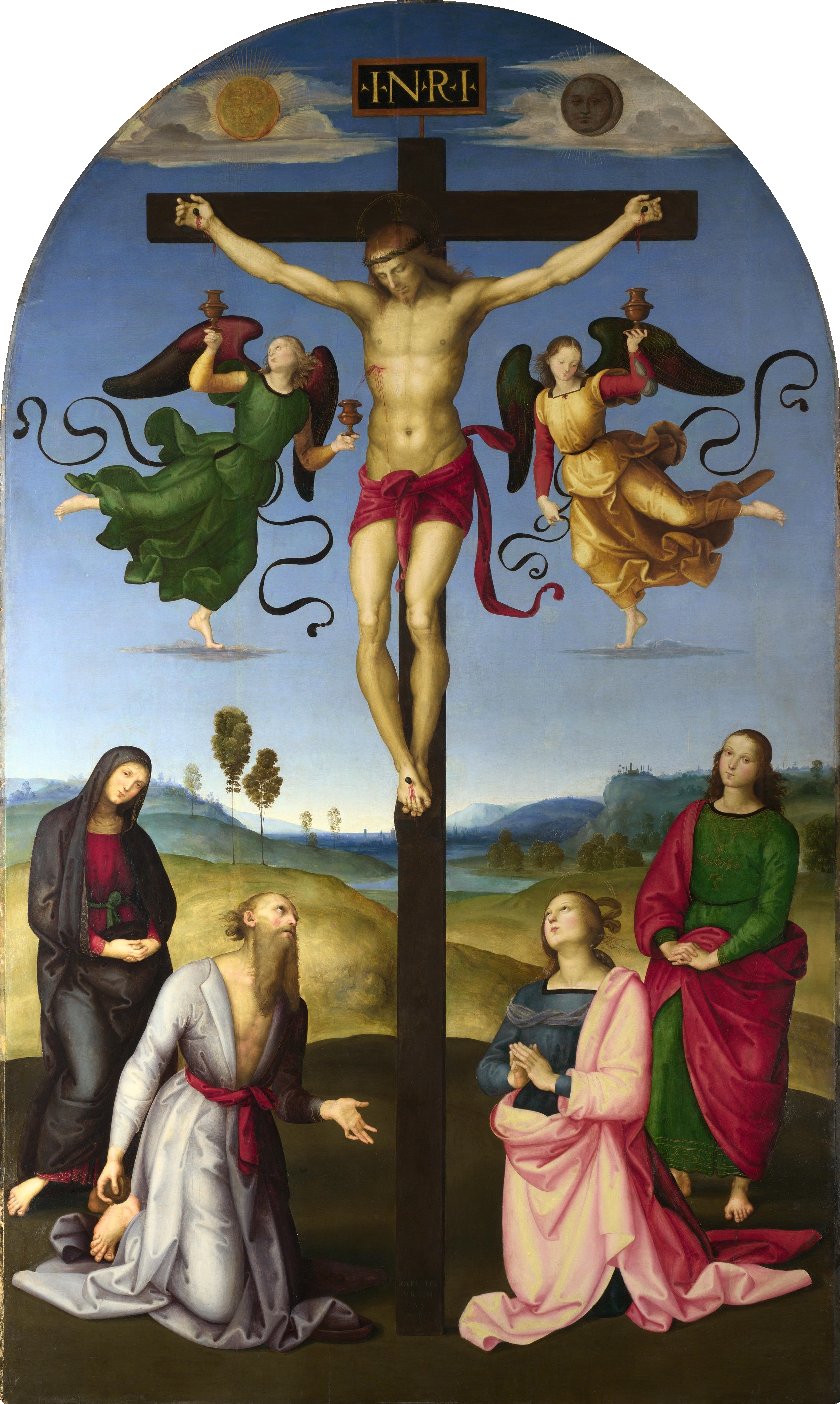
At the foot of the cross is the inscription RAPHAEL/ VRBIN / AS /.P.[INXIT] (“Raphael of Urbino painted this”) in silver letters.
May 4, 2010 at 8:49 pm #773907Participant@pandaz7 wrote:
:confused:
Go with what Jesus would have done and write in a language that people understand.
Unless Praxiteles has missed something, we have no record that Jesus wrote anything, except in the case of the woman caught in adultery and in that case what he wrote, and the language in which he wrote, have not survived since it was written in the sands. So, whence the monitum?
May 4, 2010 at 8:58 pm #773908Participant@apelles wrote:
The Sun and Moon representing day and night are also clearly visible on Raphael’s – Mond Crucifixion or Crocifissione Gavari from 1502–3.
At the foot of the cross is the inscription RAPHAEL/ VRBIN / AS /.P.[INXIT] (“Raphael of Urbino painted this”) in silver letters.
Interestingly, Our Lady is depicted at the side of the New Testament, Christ’s right hand side, while St John is depicted on the left hand side, the Old Testament side, apparently because he was the one who remained outside of the tomb on Easter morning awaiting the arrival of St Peter who was first to enter.
May 4, 2010 at 9:05 pm #773909ParticipantCodex Sangal. 51, foglio 266 the Quattor Evangelia from about 750
Here we have the earliest Irish representation of the Crucifixion and the Sol et Luna motive is explicit in that two angels hold the two testaments:
 May 5, 2010 at 9:50 pm #773910Participant
And here are those two angles again representing the two Testaments, this time on a bronze plaque from Clonmacnois dating to around 1100 -despite the absence of the figures of Our Lady and St John and the continuing the earlier tradition of St Longinus and Stephaton alotted to their traditional placed beneath the Cross. The garment worn by Christ is typically Byzantine and, once again, four nails are used . On the basis of the iconography, this plaque is either earlier than thought or something of an old fashioned piece when made.
May 5, 2010 at 10:03 pm #773911ParticipantThe Chudlev Psalter from c. 850 showing Christ in a similar (though sleeved) garment:
May 6, 2010 at 9:26 pm #773912ParticipantAnd here we have another exaple of the two angles on the arms of the Cross representing the Old and New Testaments.
This time the image is that of the west face of Muiredach’s Cross ay Monasterboice in Co Louth and dating from c. 850
May 7, 2010 at 11:03 pm #773913ParticipantA must for bodies such as the Cloyne HACK – it even has a glossary of terms (i.e. a list of explained hard words) for the hypereducated :
By Denis McNamara, a professor at the Liturgical Institute in Mundelein, Catholic Architecture and the Spirit of the Liturgy

Here is the publisher’s description:
This unique book delves into the deep meanings of liturgical art and architecture, and by association, the Sacred Liturgy itself. It is meant to help pastors, architects, artists, members of building committees, seminarians, and everyone interested in liturgical art and architecture come to grips with the many competing themes which are at work in church buildings today. The object of Catholic Church Architecture and the Spirit of the Liturgy is help the reader to drink deeply from the wells of the tradition, to look with fresh eyes at things thought to be outdated or meaningless, and glean the principles which underlie the richness of the Catholic faith.
* Part one presents an emerging area of study: Architectural Theology
* Part two introduces the readers for the first time to the scriptural foundations of church architecture
* Part three focuses on the classical tradition of architecture
* Part four examines iconography as eschatological flash and
* Part five concludes with a discussion of the Twentieth Century and where we are now in the Age of the Church.Catholic Church Architecture and the Spirit of the Liturgy is a foundational sourcebook for studying, designing, building, and renovating Catholic churches, this book is intended to find the middle of the road between differing and sometimes conflicting theories of liturgical architecture. It will give architects and building committees the theological language and tools to understand the elements of church design by examining past architecture and will help decision makers link these principles to their current building projects.
May 7, 2010 at 11:11 pm #773914ParticipantAnd a perusal of this book might be an illumination on how to produce non-porous buildings:
George Myers: Pugin’s Builder
Patricia Spencer-Silver
George Myers was one of the great Master Builders of the Victorian Age, and the rock on which Augustus Welby Pugin built the Gothic Revival. Myers executed many of Pugin’s finest buildings, such as the cathedrals in Birmingham, Newcastle, Nottingham and Southwark and the Medieval Court for the Great Exhibition of 1851. He undertook work for nearly 100 architects, including the original camp at Aldershot, Broadmoor Hospital and restoration at the Tower of London. Following recent discovery of forgotten family papers this critically acclaimed biography has been fully revised and updated.
978 085244 184 8 320 pages Illustrated £20.00May 8, 2010 at 12:59 am #773915gunter
ParticipantLooks like some interesting reading there.
Some people will say that the renewed interest in the re-use of historical styles in current religious architecture constitutes something of a whacky sub-culture and that the practice of forging [or revealing] connections between historical revivalist architecture and liturgy or spirituality is little more than an attempt at retrospective justification.
Other people might say that exploring classical models and reviving historical styles is a legitimate response to some godawful modern church architecture that expensively failed to evoke the essence of a religious building and wantonly disregarded tradition without offering anything new that was of anything approaching equal value.
The fact is however that these extreme positions are not the full story. Some architects have made the leap to modernity and created striking contemporary church architecture that does evoke the valuable connection with tradition.
This is the ‘church of the autostrada’ outside Florence by Giovanni Michelucci, built 1960 – 64 [concurrent with Vatican 2].

The church is a sort of wayside chapel constructed to mark the completion of the major north/south motorway in Italy, and also as a way to commemerorate the construction workers who had died in the course of the road construction.
The exterior is less successful, but the interior is powerful and evocative. I can’t find any decent pictures on the web, this b+w pic comes from Venturi’s Complexity and Contradiction, still the best book on architecture ever written.
Does this architecture not move Praxiteles?
- AuthorPosts
- You must be logged in to reply to this topic.


