
reorganisation and destruction of irish catholic churches
- This topic has 7,926 replies, 103 voices, and was last updated 9 years, 7 months ago by
Praxiteles.
- AuthorPosts
- March 21, 2010 at 9:44 pm #773796
samuel j
ParticipantApologies if this link has been put up before but just in case
March 21, 2010 at 10:40 pm #773797apelles
ParticipantI hadn’t seen that on here before Samuel. . BTW if you copy the Embed code next to a video & paste that into your post then the video itself appears in the post. . saves viewers leaving the page.
March 21, 2010 at 10:57 pm #773798Participant
St. Henry, Ohio. Architect J. Anton Decurtins. Construction was finished in 1897.

Then the disaster struck. . The seventies, a seriously bad decade for Church makeovers & hairstyles.:eek:

I know, lets just dump this organ where the reredos used to be. . no one ‘ll notice.
March 21, 2010 at 11:01 pm #773799Participant@apelles wrote:
I hadn’t seen that on here before Samuel. . BTW if you copy the Embed code next to a video & paste that into your post then the video itself appears in the post. . saves viewers leaving the page.
Have edited/updated the post 🙂
March 21, 2010 at 11:14 pm #773800gunter
Participant@Praxiteles wrote:
An article from the Wall Street Journal on the work of Duncan Stroik published on 18 March 2010:
By CATESBY LEIGH
. . . . Duncan Stroik, a 48-year-old, Yale-educated professor at Notre Dame’s architecture school . . . . has labored long and hard to reconnect Catholic artistic patronage with its ancient heritage.
Tireless labouring . . . or shameless plundering of architecture’s back catalogue? :rolleyes:
Speaking of which, that High Altar at the church of San Paolo Fuori Mura in Rome, posted by Praxiteles, looks a tad familiar.


the original 13th century gothic alter canopy on the left and the gothic revival Albert memorial on the right.
Apparently there was controversy at the time [1860s] over the Albert Memorial, because of the similarities in the design to that of the Albert Memorial in Manchester.
However, writing in his Recollections, the architect George Gilbert Scott suggested his own design was original:
“My idea in designing the Memorial was to erect a kind of ciborium to protect a statue of the Prince; and its special characteristic was that the ciborium was designed in some degree on the principles of the ancient shrines. These shrines were models of imaginary buildings, such as had never in reality been erected; and my idea was to realise one of these imaginary structures with its precious materials, its inlaying, its enamels, etc. etc. … this was an idea so new as to provoke much opposition.”
Yeah right :rolleyes:March 21, 2010 at 11:29 pm #773801ParticipantYeah, well there’s definitely some very delusional people out there!
March 22, 2010 at 7:12 pm #773802Praxiteles
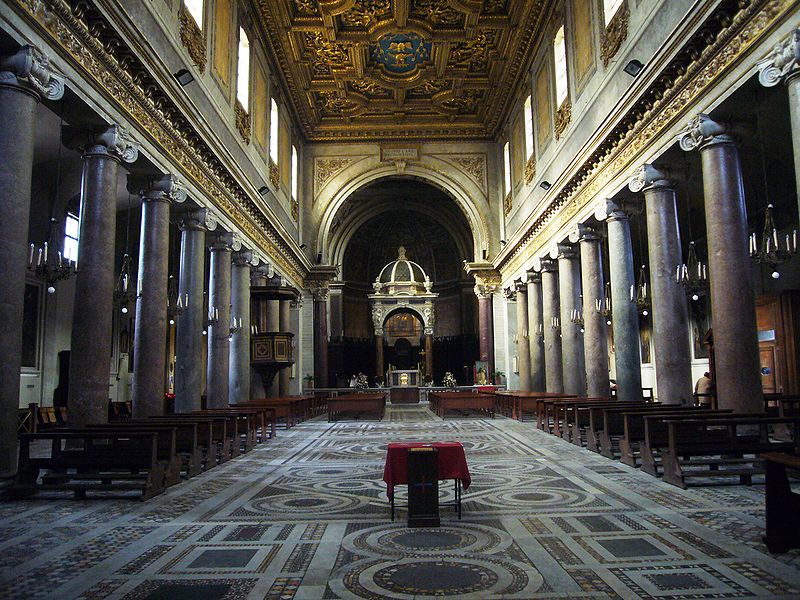
ParticipantThe baldichino in San Chrisogono in Trestevere in Rome with its magnificent Cosmati floor:
 March 22, 2010 at 7:21 pm #773803Participant
@apelles wrote:
Yeah, well there’s definitely some very delusional people out there!
As far as Praxiteles can recollect the first Papal condemnation of masonism is to be found in the Bull In eminenti, Published by Clement XII on April 28 1738 from Santa Maria Maggiore.
It seems a trifle slow to have have awaited a elapse of almost 600 years between the construction of Notre Dame in paris and the condemnation of masonism!!
March 22, 2010 at 7:22 pm #773804Participant@gunter wrote:
Tireless labouring . . . or shameless plundering of architecture’s back catalogue? :rolleyes:
Speaking of which, that High Altar at the church of San Paolo Fuori Mura in Rome, posted by Praxiteles, looks a tad familiar.
the original 13th century gothic alter canopy on the left and the gothic revival Albert memorial on the right.
Apparently there was controversy at the time [1860s] over the Albert Memorial, because of the similarities in the design to that of the Albert Memorial in Manchester.
However, writing in his Recollections, the architect George Gilbert Scott suggested his own design was original:
“My idea in designing the Memorial was to erect a kind of ciborium to protect a statue of the Prince; and its special characteristic was that the ciborium was designed in some degree on the principles of the ancient shrines. These shrines were models of imaginary buildings, such as had never in reality been erected; and my idea was to realise one of these imaginary structures with its precious materials, its inlaying, its enamels, etc. etc. … this was an idea so new as to provoke much opposition.”
Yeah right :rolleyes:Gunter,
Many thanks for this posting. Praxiteles had not made the connection between these two monuments.
March 23, 2010 at 10:23 pm #773805Participant[align=center:ns9om6cj]

 [/align:ns9om6cj]
Review of ‘The Sacred Made Real’ at the National Gallery of Art. Sunday, February 28, 2010
[align=center:ns9om6cj] [/align:ns9om6cj]
Before he started work on a religious piece, the Spanish sculptor Gregorio Fernández would pray, fast and repent for his sins — and practice some self-flagellation. When his statue of a naked, beaten Jesus was put up in a parish church around 1621, it was agreed that 15 masses would mention the artist’s name each year, forever, to cut his time in purgatory. Working on the piece, the artist made sure that every inch of it, even the parts in back no one might ever see, did an equally good job of capturing Christ’s bruised and bloodied skin. Fernández so cherished the reality and truth of Christ’s embodiment in flesh that he made his naked Jesus anatomically correct, even though he immediately hid that correctness, forever, under a glue-hardened loincloth.
Fernández must have believed in the worth of his art, as art. But it was the things his art pointed to that made it worth making at all. A sculpture could never grant you a parole from limbo; only the divinity it showed could do you that favor.
When we modern museum-goers admire a certain kind of old religious art for what it looks like, I think we get it wrong. Its look only helps it point to a reality beyond its surfaces, which counted as infinitely more important than the work of art itself.
“The Sacred Made Real: Spanish Painting and Sculpture, 1600-1700,” a groundbreaking exhibition that just touched down at the National Gallery of Art, should help us get back to this older and very different artistic understanding. If it does, this touring show, organized by curator Xavier Bray of the National Gallery in London, will turn out to have been one of the most substantial, important events our Washington museum has hosted. (In London, the show was a sleeper hit. Bray says they were expecting something like 25,000 aficionados. Instead they got four times that many visitors, including at one point “four punks and 50 nuns, intermingling.”)[align=right:ns9om6cj]
 [/align:ns9om6cj]
“The Sacred Made Real” gives us an important push away from our modern tendency to value painting over any other medium. Well into the Middle Ages and beyond, painting was the poor stepchild of deluxe, more durable materials such as tapestry or metal or marble. In 17th-century Spain, the balance had already shifted to make 3-D and 2-D art about equal, but while Spanish painters such as Diego Velázquez and Francisco de Zurbarán are now famous figures, before this show, their sculptor colleagues have never got equal time.
The exhibition also gets us away from our strange notion that great Old Master paintings should be fully colored and highly realistic, whereas classic sculpture, to count as art rather than kitsch, needs to be all white or wood- or bronze-colored, like statues from ancient Greece and Rome. (Which were once fully colored, anyway, but lost their paint over the millennia.) In fact, until quite recent times, uncolored sculpture has been the exception rather than the rule in Western art. In baroque Spain, specialist “polychromers” were still paid to take a sculptor’s carvings and meticulously paint them to resemble scenes from life. Putting the color back into sculpture, says Bray, is “one of the big aims of this show.”[align=center:ns9om6cj]
 [/align:ns9om6cj]
This show’s colorful art includes hideous gore, heart-wrenching pathos and lots of frankly histrionic emotion. Yet the problem isn’t that these works press too many buttons, too hard. It’s that for your average secular art lover, their subjects themselves don’t have the heft that they once did, and that risks leaving us distracted by aesthetics. In fact, however, this is a moment when the features that we modern aesthetes count as most “artistic” in a figurative work, such as medium, scale, finish and pose, could count as almost incidental.
In 17th-century Spain, a single saint or holy man could, for instance, be equally well commemorated in carved wood or painted canvas. In this show, there’s a highly realistic sculpture of a Jesuit named Francis Borgia, made to celebrate the priest’s beatification in 1624. It was carved by the master sculptor Juan MartÃnez Montañés and then colored by the painter Francisco Pacheco, who taught Velázquez and others. And that sculpture is almost perfectly matched by a deluxe painting of the same figure, from the same year, at the same size, by a talented Pacheco student named Alonso Cano. If a work of art brings viewers close to their hero, it’s almost as though it doesn’t matter what material it’s made from.
Scale could also matter much less than it does now. In this show, Zurbarán’s boldly painted canvas of a standing Saint Francis of Assisi, from around 1640, shows the friar large as life. Twenty years later, Pedro de Mena made a fastidiously carved and colored version of the same figure in precisely the same pose but at about half-size, crafted with a hobby-shop accuracy that includes glass eyeballs and real human hair for eyelashes. The similarities between the painting and the sculpture — the shared access that they give us to the holy man — might once have mattered infinitely more than their differences in size and technique. All this is hard to grasp for 21st-century art lovers, trained to believe that the God of art is in the smallest of observable details.
Seventeenth-century thinkers and mystics such as John of the Cross, a Spaniard who was himself apprenticed in a sculptor’s shop, emphasized the importance of realistic art in encouraging religion — but only so long as it was very clear that all worth resided in the subject of the image, not in the object itself.
One canvas by Zurbarán is almost an illustration of the equivalence of painting and sculpture — as though by deliberately confusing the two mediums, it can force us to fall back on the reality behind them both. The small oil we now call “Saint Luke Contemplating the Crucifixion” shows a painter equipped with palette and brushes — is he in fact Saint Luke, who was said to have been a painter, or Zurbarán himself? — gazing at Jesus hanging on the cross. Or is the artist contemplating a colored sculpture of that subject, perhaps one that he’s just polychromed? The National Gallery has hung a real polychromed crucifix beside Zurbarán’s picture; it is so nearly identical in scale and look to the cross in the painting that you have to imagine that Spanish viewers, surrounded by such objects in their daily lives, would have seen one in this painting. Or maybe what Zurbaran is actually showing us is a proud artist standing in front of a painting of his crucified Lord — there are hints that the head of Zurbarán’s brush-wielding figure is casting shadows onto the skyscape behind him, as though it’s a painted surface right nearby rather than an open space in the distance. It certainly makes more sense to imagine a painter holding paint-filled brushes in front of one of his works than outside on Mount Golgotha. I don’t think Zurbaran wants us to choose between one or another of these readings. He wants us to acknowledge how fraught art is, compared to the certainties of religious truth and faith that are the real subject of his work.
[align=center:ns9om6cj][align=center]
 [/align:ns9om6cj][/align]
In Spain circa 1650, two works might present a single sacred subject in quite different ways, with the same figures shown in varied poses or viewed from one side rather than another, and yet these different versions might count as being pretty much the same, and as equally successful art. In this show, look at how the painting that Velázquez did around 1628 of Christ collapsed after his flagellation seems to give Jesus precisely the same face as Fernández did, at the start of that decade, in his gory sculpture of the beaten, nearly naked Jesus standing. It’s almost as though we’re seeing the same scene, but at a slightly different moment, from a somewhat different angle, and just by chance in two dimensions rather than three. (The angel and Christian child that Velázquez shows looking at their tortured savior could almost be us, contemplating Fernández’s statue. As Bray points out in his informative catalogue, Velázquez decorously allows them to see a bleeding back that the art of painting lets him turn away from us. A sculptor didn’t have that option for controlling our viewpoint.)
Sometimes the details with the least artistic significance might make the biggest difference between two works. Today, we might be tempted to see a stunningly three-dimensional painting of the crucified Christ, done by Zurbarán in 1627 and praised in its day for looking so much like a sculpture, as very close kin to a quite similarly posed and colored carving of the same subject, made by the great master Montañés in 1617, which hangs beside it in this show. In fact, however, for an observer who cared, one tiny detail might have made them count as almost contradictory images: The painting shows Christ’s feet crucified with separate nails, while the sculpture drives a single nail through both, an issue of “accuracy” fiercely debated at the time among both artists and priests.[align=right:ns9om6cj]
 [/align:ns9om6cj]
As evidence for the one-nail-per-foot thesis, the painter Pacheco himself cited a 9th-century silver crucifix that had once belonged to Charlemagne, as well as a medieval Italian image that in Pacheco’s day was still thought to have been carved around the time of Christ, by the artist-apostle Saint Luke. That means that we might want to think of Zurbarán’s fine painting as having more in common, in important ways, with those crude and vastly older objects than it had with an almost look-alike sculpture done just a few years earlier. Though separated by centuries, three very different looking works point to the same “reality” of a savior crucified using four nails, rather than to a different, perhaps faulty, version of the truth where three nails were all he got.
The Sacred Made Real: Spanish Painting and Sculpture, 1600-1700 runs through May 31 in the East Building of the National Gallery of Art, on the north side of the Mall at Fourth Street NW.
March 24, 2010 at 10:19 pm #773806ParticipantThose painted curtains on the apse wallare quite spectacular:
March 24, 2010 at 10:28 pm #773807ParticipantThe Annunciation by Murillo (1655)
Sine early times (and it is still the case among the Oriental Churches) the image of the Annunciation depicting the primordia of Salvation always occupied a prominent place on, near or at the main entrance to the sanctuary of Christian churches. Needless to say, with the almost complete obfuscation of its theological and liturgical significance it has all but disappeared in modern church architecture and “artistic” representation. Here are some examples of the subject drawn from eastern and western sources:
 March 24, 2010 at 10:31 pm #773808Participant
As represented in the eastern tradition:
 March 25, 2010 at 1:17 pm #773809
johnglas
ParticipantOh yawn, not more ‘secret’ codes; the medieval free masons were not freemasons; if the triple gate motif is virtually universal and its origins are unknown, how can it be ‘masonic’? As for the two towers, weren’t medieval cathedrals supposed to have towers at all the cardinal points, i.e. 8 or even 9 in a cruciform church. And what of the twin towers (‘Jachin and Boaz’) that actually became steeples?
However, the papacy’s condemnation of masonry has as much to do with power games as theology; plus ca change…
March 25, 2010 at 5:51 pm #773810ParticipantAn annunciation from the apse mosaic of the Basilica of St Euphrasius in Porec, Croatia:
 March 26, 2010 at 9:12 pm #773811Participant
Byzantine annunciation from Constantinople c. 1320:
 March 26, 2010 at 9:15 pm #773812Participant
13th centy annunciation in the apse of Santa Maria Maggiore in Rome:
 March 26, 2010 at 9:21 pm #773813Participant
The 5th century annunciation in Santa Maria Maggiore, Rome
 March 27, 2010 at 3:10 pm #773814Participant
An annunciation mosaic in Westminster Cathedral:
March 27, 2010 at 3:18 pm #773815ParticipantGhirlandaio’s Annunciation over the Porta della Mandorla, Florence Cathedral, dating from 1490 and showing many influences taken from Leonardo:

- AuthorPosts

- You must be logged in to reply to this topic.


