
reorganisation and destruction of irish catholic churches
- This topic has 7,926 replies, 103 voices, and was last updated 9 years, 5 months ago by
Praxiteles.
- AuthorPosts
- March 1, 2010 at 11:27 pm #773736
Praxiteles
ParticipantHere is the description of the bedroom at Mount Stuart on the Isle of Bute. Unfortunately the desciption is flawed by thye jumbling of astronomy and astrology and even the use of the term horoscope:
The Horoscope Room
A marvellously eccentric room, the Horoscope Room and Conservatory was once the 3rd Marquess’s sitting room.The room takes its name from the astrological ceiling which shows the exact position of the planets at the time of his birth of 12th September 1847. The original design on canvas, complete with tissue paper stars and planets, was very badly damaged and in the 1980s Tom Errington was commissioned to paint a replica onto the ceiling. This copy is exact in every way save for the addition of Pluto, which had yet to be discovered when the original had been painted 100 years earlier.
A fascinating insight into the tastes of the 3rd Marquess, the room also features a frieze of miniature castles and brightly coloured exotic birds and flowers.
March 2, 2010 at 8:51 pm #773737ParticipantVierzehnheiligen
March 2, 2010 at 9:02 pm #773738ParticipantAlthough various English language aricels refer to the Viezehnheiligen as the the fourteen helpers, it is more accurate to refere to them as the fourteen holy patrons. Here is the list from Vierzehnheiligen with the various ailments and situations against which their help and intercession are invoked:
The altar of the Vierzehnheiligen
The fourteen saints represented in the altar are:Achatius (or Acacius) (May 8), martyr, invoked against headache
Barbara (December 4), virgin and martyr, invoked against fever and sudden death
Blaise (also Blase and Blasius) (February 3), bishop and martyr, invoked against illness of the throat
Catherine of Alexandria (November 25), virgin and martyr, invoked against sudden death
Christopher (Christophorus) (July 25), martyr, invoked against bubonic plague
Cyriacus (Cyriac) (August 8), deacon and martyr, invoked against temptation on the death-bed
Denis (Dionysius) (October 9), bishop and martyr, invoked against headache
Erasmus (Elmo) (June 2), bishop and martyr, invoked against intestinal ailments
Eustachius (Eustace, Eustathius) (September 20), martyr, invoked against family discord
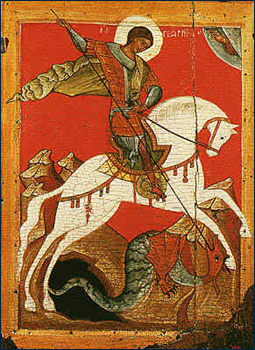
George (April 23), soldier-martyr, for the health of domestic animals
Giles (Aegidius) (September 1), hermit and abbot, invoked against plague, for a good confession
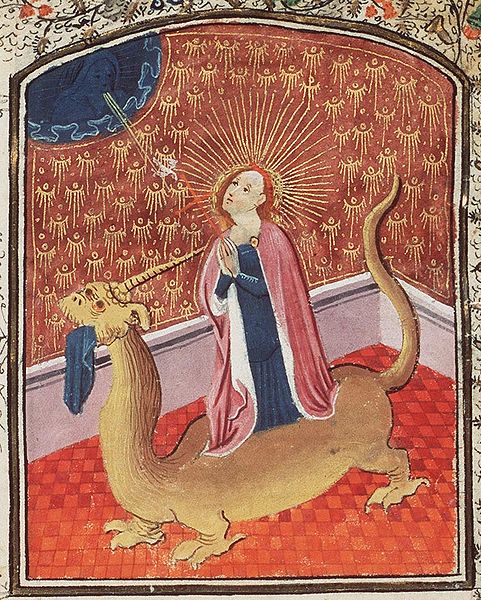
Margaret of Antioch (July 20), virgin and martyr, invoked in childbirth
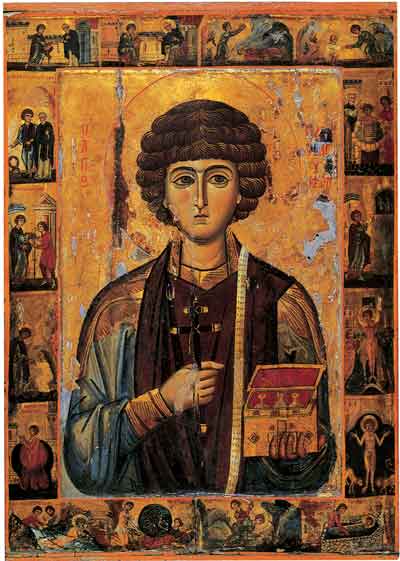
Pantaleon (July 27), bishop and martyr, for physicians
Vitus (also known as Saint Guy) (June 15), martyr, invoked against epilepsy1. St. Agathius http://en.wikipedia.org/wiki/Agathius
2. St. Barbara http://en.wikipedia.org/wiki/Saint_Barbara
3. St. Blaise http://en.wikipedia.org/wiki/Saint_Blaise
4. St. Catherine of Alexandria http://en.wikipedia.org/wiki/Catherine_of_Alexandria
5. St. Christopher http://en.wikipedia.org/wiki/Saint_Christopher
6. St. Cyriacus http://en.wikipedia.org/wiki/Saint_Cyriacus
7. St. Denis http://en.wikipedia.org/wiki/Denis
8. St. Erasmus http://en.wikipedia.org/wiki/Erasmus_of_Formiae
9. St. Eustace http://en.wikipedia.org/wiki/Saint_Eustace_(legend)
10. St. George http://en.wikipedia.org/wiki/Saint_George
11. St. Giles http://en.wikipedia.org/wiki/Saint_Giles
12. St. Margaret of Antioch http://en.wikipedia.org/wiki/Margaret_of_Antioch
13. St. Pantaleon http://en.wikipedia.org/wiki/Saint_Pantaleon
14. St. Vitus http://en.wikipedia.org/wiki/Saint_Vitus
March 2, 2010 at 9:15 pm #773739ParticipantIconography of ST Vitus:
 March 2, 2010 at 9:17 pm #773740Participant
Iconography of St Pantheleon
 March 2, 2010 at 9:18 pm #773741Participant
Iconography of St Margaret of Anthioch
 March 2, 2010 at 9:21 pm #773742Participant
Iconography of Giles
 March 2, 2010 at 9:24 pm #773743Participant
Iconography of St George
 March 2, 2010 at 9:27 pm #773744Participant
Albrech Duerer’s iconography of St Eustace:
 March 2, 2010 at 9:30 pm #773745Participant
Iconography of St Erasmus
 March 2, 2010 at 9:32 pm #773746Participant
Henri Bellechose’s iconography of St Denis of Paris
 March 2, 2010 at 9:36 pm #773747Participant
Iconography of St. Cyracius
 March 2, 2010 at 9:40 pm #773748
gunter
Participant@Praxiteles wrote:
St. Denis (Dionysius) (October 9), bishop and martyr, invoked against headache

a slightly extreme cure for headache 🙂
sorry for interrupting
March 2, 2010 at 9:44 pm #773749Participanticonography of St Christopher (Hieronomous Bosch)
 March 2, 2010 at 9:47 pm #773750Participant
Iconography of St Catherine of Alexandria (Caravaggio)
 March 2, 2010 at 9:51 pm #773751Participant
Iconography of St Blaise (Oriental)
 March 2, 2010 at 9:54 pm #773752Participant
Iconography of St Barbara (Jan van Eyck)
 March 2, 2010 at 9:56 pm #773753Participant
Iconography of St Agathius:
 March 3, 2010 at 10:38 am #773754
apelles
ParticipantDon’t suppose you’d have access to Iconic or indeed any representations of these chaps Prax. .
The Twelve Apostles of Erin
By this designation are meant twelve holy Irishmen of the sixth century who went to study at the Clonard in Meath. About the year 520 St. Finian founded his famous school at Cluain-Eraird (Eraird’s Meadow), now Clonard, and thither flocked saints and learned men from all parts of Ireland. In his Irish life it is said that the average number of scholars under instruction at Clonard was 3,000, and a stanza of the hymn for Lauds in the office of St. Finian runs as follows:
Trium virorum millium,
Sorte fit doctor humilis;
Verbi his fudit fluvium
Ut fons emanans rivulis.The Twelve Apostles of Erin, who came to study at the feet of St. Finian, at Clonard, on the banks of the Boyne and Kinnegad Rivers, are said to have been St. Ciaran of Saighir (Seir-Kieran) and St. Ciaran of Clonmacnois; St. Brendan of Birr and St. Brendan of Clonfert; St. Columba of Tir-da-glasà (Terryglass) and St. Columba of Iona; St. Mobhà of Glasnevin; St. Ruadhan of Lorrha; St. Senan of Iniscathay (Scattery Island); St. Ninnidh the Saintly of Loch Erne; St. Lasserian mac Nadfraech, and St. Canice of Aghaboe. Though there were many other holy men educated at Clonard who could claim to be veritable apostles, the above twelve are regarded by old Irish writers as “The Twelve Apostles of Erin”. They are not unworthy of the title, for all were indeed apostles, whose studies were founded on the Sacred Scriptures as expounded by St. Finian. In the hymn from St. Finian’s office we read:
Regressus in Clonardiam
Ad cathedram lecturae
Apponit diligentiam
Ad studium scripturae.The great founder of Clonard died 12 December 549, according to the “Annals of Ulster”, but the Four Masters give the year as 548, whilst Colgan makes the date 563. His patronal feast is observed on 12 December.
And a translation of the above latin hymns would also be greatly appreciated. . .
March 3, 2010 at 4:25 pm #773755Participant@apelles wrote:
Don’t suppose you’d have access to Iconic or indeed any representations of these chaps Prax. .
The Twelve Apostles of Erin
By this designation are meant twelve holy Irishmen of the sixth century who went to study at the Clonard in Meath. About the year 520 St. Finian founded his famous school at Cluain-Eraird (Eraird’s Meadow), now Clonard, and thither flocked saints and learned men from all parts of Ireland. In his Irish life it is said that the average number of scholars under instruction at Clonard was 3,000, and a stanza of the hymn for Lauds in the office of St. Finian runs as follows:
Trium virorum millium,
Sorte fit doctor humilis;
Verbi his fudit fluvium
Ut fons emanans rivulis.The Twelve Apostles of Erin, who came to study at the feet of St. Finian, at Clonard, on the banks of the Boyne and Kinnegad Rivers, are said to have been St. Ciaran of Saighir (Seir-Kieran) and St. Ciaran of Clonmacnois; St. Brendan of Birr and St. Brendan of Clonfert; St. Columba of Tir-da-glasà (Terryglass) and St. Columba of Iona; St. Mobhà of Glasnevin; St. Ruadhan of Lorrha; St. Senan of Iniscathay (Scattery Island); St. Ninnidh the Saintly of Loch Erne; St. Lasserian mac Nadfraech, and St. Canice of Aghaboe. Though there were many other holy men educated at Clonard who could claim to be veritable apostles, the above twelve are regarded by old Irish writers as “The Twelve Apostles of Erin”. They are not unworthy of the title, for all were indeed apostles, whose studies were founded on the Sacred Scriptures as expounded by St. Finian. In the hymn from St. Finian’s office we read:
Fate would have [him]
the humble teacher of
three thousand men,
[on whom] he poured out the river of the Word,
as a spring [pours warter] into many rivuletsRegressus in Clonardiam
Ad cathedram lecturae
Apponit diligentiam
Ad studium scripturae.The great founder of Clonard died 12 December 549, according to the “Annals of Ulster”, but the Four Masters give the year as 548, whilst Colgan makes the date 563. His patronal feast is observed on 12 December.
And a translation of the above latin hymns would also be greatly appreciated. . .
An interesting hymn, Appelles. Have you the complete text and Where does it come from? It is not included in the Propria Quorundum Hiberniae Sanctorum published in Dublin in 1792.
A rough translation would run:
Fate would have [him]
the humble teacher of
three thousand men,
[on whom] he poured out the river of the Word,
as a spring [pours warter] into many rivuletsReturning to Clonard,
to his teaching chair,
he diligently applied (himself)
to the study of Scripture.A search for iconographic descriptions of these saints wouèld require a search of available sources. A challenge.
- AuthorPosts
- You must be logged in to reply to this topic.


