
reorganisation and destruction of irish catholic churches
- This topic has 7,926 replies, 103 voices, and was last updated 9 years, 6 months ago by
Praxiteles.
- AuthorPosts
- September 22, 2009 at 10:25 pm #773116
Praxiteles
ParticipantThe pulpit in the Cathedral of Mechelen in Belgium designed by Michiel Vervoort and built between 1720-1730. the pulpit was originally built for the church of the Premonstratensian Canonesses at Liliendal but was transferred here following the Napoleonic wars. The scene depicts the conversion of St Norbert (in very Pauline terms).


 September 22, 2009 at 10:59 pm #773117Participant
The pulpit in the Cathedral of St. Bavo in Ghent by Laurent Delvaux dating from 1745 “represents Truth revealing the Christian Faith to astonished Paganism (figured as an old and outworn man)” .


And as it was in 1907:
 September 23, 2009 at 12:48 am #773118
apelles
ParticipantSt Andrews Church, Hastings
The Bishop of Chichester opened St Andrews Church in Queens Road 30th November 1870. Robert Tressell,(real name Robert Noonan) was born in Dublin on the 18 April 1870, at 37 Wexford Street. He was author of the “Ragged Trousered Philanthropistsâ€, which was the semi-fictitous story of a group of builders & decorators working in Hastings at the time and the conditions in which they toiled. At the age of forty he died in the Royal Liverpool Infirmary (workhouse) hospital his cause of death was bronchial pneumonia and he was buried in a pauper’s grave, in Walton Cemetery. He never had the satisfaction and pleasure of seeing his book published.
He had painted a huge mural inside the church in 1904.
Demolition of the church began in August 1970. It had become dangerous and a group of people trying to save the Robert Tressell mural were threatened with eviction for being uninsured. Only one panel of the mural was saved and it is now on show at the Hastings Museum along with other mementoes of Robert Tressell. Demolition of St Andrews Church was completed in September 1970.September 23, 2009 at 6:36 pm #773119johnglas
Participantapelles: That’s a truly sad tale; everyone should read The Ragged Trousered Philanthropists – worth any number of sermons from any number of overwrought Baroque (or should it be Rococo?) pulpits (sorry, Prax). Surely a case of the media overwhelming the message.
September 23, 2009 at 7:09 pm #773120Participant@johnglas wrote:
apelles: That’s a truly sad tale; everyone should read The Ragged Trousered Philanthropists – worth any number of sermons from any number of overwrought Baroque (or should it be Rococo?) pulpits (sorry, Prax). Surely a case of the media overwhelming the message.
Rather, Praxiteles should have thought, a case of immediacy – the word being fulfilled before the very eyes of the beholders be it in terms of conversion or fish catching or “animating” the the Great Western Doctors etc. Not too dissimilar from Atlas’ re-employment as the bearer of the new universe of the Word at Bitonto!
September 23, 2009 at 10:51 pm #773121ParticipantThe pulpit in Antwerp Cathedral, built in 1713,formerly belonged to the Abbey of St Bernard but was installed here in 1803:


“This oak pulpit, which was made by Michiel van der Voort (1667-1737) in 1713 for the St Bernard Abbey in Hemiksem, is richer in meaning than some sermons. It has been in the Our Lady’s Cathedral since 1804.
The banisters in the form of stems, branches and twigs, as well as the trees that hold up the sound-board that covers the casket, look very realistic. Indeed, so do the birds (among which are a parrot, a crane and a small owl) and other animals who have found a place in the lush vegetation. According to St Bernard, nature was an important source of inspiration for the faithful, and the pulpit recalls it vividly.
The base on which the casket rests consists of four female figures, each embodying a continent: Europe, Asia, America and Africa. Indeed, the word of God was to be spread across the whole of the then-known world. On the baroque casket itself the faces of Christ, Mary and St Bernard are depicted in relief. The cherubs at the edge of the sound-board in rococo style create the impression that they carry the board up with them. In a halo of light the Holy Ghost, present as a white dove, spreads its wings, while at the very top a large angel trumpets the Joyous Message. In spite of the mix of styles – naturalism, baroque, rococo – this pulpit forms an unmistakable whole that belongs to the pinnacle of Flemish sculpture”.September 24, 2009 at 9:47 pm #773122ParticipantThe pulpit in the Cathedral of St. Salvator in Bruges:

 September 24, 2009 at 9:56 pm #773123Participant
The relatively modest pulpit in the Cathedral of Tournai:


 September 26, 2009 at 7:59 pm #773124Participant
Sts. Peter and Paul’s Cork
The High Altar designed by G.C. Ashlin
 September 26, 2009 at 8:46 pm #773125Participant
Sts. Peter and Paul’s, Cork
The pulpit:

And while in use by a man who has something to say:

 September 26, 2009 at 8:51 pm #773126
gunter
Participant
The very theatrical interior of St. Paul’s, Arran Quay.
Never been in this church before, but then ‘Culture Night’ 🙂 comes along and you find yourself in the strangest places.
The primary red and yellow on the ceiling is startling, but weren’t original Greek temples garishly painted too?
September 27, 2009 at 1:03 pm #773127Participantgunter: you certainly don’t get more ‘theatrical’ than that, but all in the best possible taste (give me that over theatrical rococo puplits any day). Is this church officially ‘closed’? That wouls be a real loss and let’s hope an appropriate alternative use can be found for it.
The ancient Greeks certainly did and I seem to remember from my only visit to Athens that there is a recconstruction of a stoa that is brightly coloured, but the colours were reds and blues and golds against that stunning pentelic marble and in bright sunshine, and it all seemed to work. The reds and yellows in St Paul’s might be a bit over the top, but paint can be changed; trick is to avoid the ‘jobbing painter’ or the ‘Schull effect’, which techniques owe more to Technicolor than good taste.September 27, 2009 at 1:55 pm #773128Paul Clerkin
KeymasterThats a new colour scheme – my photos
http://ireland.archiseek.com/buildings_ireland/dublin/northcity/quays/arran/stpauls.html
September 27, 2009 at 6:14 pm #773129ParticipantThe chancel in St. Paul’s Aran Quay is closely modelled on St. Mary’s Moorfields in London. As with that church, it was originally supplied with a large fresco of the Crucifixion on the wall behind the High Altar. The Crucifixion was replaced in 1862 by a copy of of one of Rubens compositions on the conversion of St. Paul. This copy was executed by F. S. Barff of Dublin – who provided glass for the East window of St Catherine’s Meath Street.
The bad news is that the original, dating from 1616/1617, was destroyed in the burning of the Flakturm in Friedrickshain in 1945. Ante 1806, it belonged to the collection of the Marquis de Montesquieu. It was sold by Philips in London in 1806 for A. Delehante and by Philips in London for Hasting-Elwin in 1810 where oit was bought by G. Harris who sold it to R. Harte-Davies. It was again sold at auction, by Christies, in 1884 for Sir Philip Miles of Leigh Court near Bristol, and again in 1899 where it was bought by on Agnew. It was with Sedelmyer in Paris in 1901 where it was bough by W. von Bode for the Imperial German government. Friedlaender maintains that it was in large measure the work of Ruben’s bottega and that in this picture Rubens re-worked an Italian mannerist idea deriving from Zuccari or Salviati. So, the Dublin copy is more significant than might be imagined and greater care should be taken of it.
September 27, 2009 at 6:39 pm #773130ParticipantSt Mary’s Moorfields, London
A print from 1864 showing the interior of St. Mary’s Moorfield, London.

It is at this point that we have to try to imagine what St. Paul’s looked like before the iconaclastic vandals got at it in the 1970s.
This is the rebuilt ST. Mary’s.

Again, too late, I am afraid:
“The first chapel was opened in 1686, but suspended in 1689. Two further chapels were built the first destroyed in the Gordon Riots before a large Classical church in Finsbury Square was built in 1820.
The architect John Newman used a continental prototype for his design which concealed the source of light that came from above the main altar. This was made necessary by the dense buildings surrounding the Church. The plan consisted of nave, aisles and apsidal sanctuary. On the back wall was a remarkable painting of Mount Calvary by Angelo Aglio containing over fifty figures. The church, part of the first wave of building that succeeded the 1791 Catholic Relief Act, was probably the finest in structure and decoration. It served as Cardinal Wiseman’s pro-cathedral from 1850 to 1869.
In 1899 the construction of the Metropolitan Line meant that this church was pulled down and replaced by the present church in Eldon Street, which was opened on 25th March 1903. The present church incorporates many of the features of the pro-cathedral including the marble columns and the effect of a top lit sanctuary. Though smaller in scale something of the grandeur of the pro-cathedral can be seen.”
This is the present sanctuary. But, alas, all that marble sheeting conveys nothing of the dramaticità of Rubens, Salviati or Zucchari:
 September 27, 2009 at 7:07 pm #773131Participant
Prax: maybe not, but these two churches are interesting examples of another ‘type’: not romanesque nor gothic nor baroque, but of a kind of academic classicism often described as ‘cold’ or ‘sterile’ but which in fact is aesthetically very pleasing and has stood the test of time. (I think the activities of the wreckovators can easily be reversed.)
Fascinating background to the ‘Conversion’ mural – it certainly needs to be protected before it is vandalised by accident or design. Is the church still open? I’m reminded of that other great ‘Conversion’, Caravaggio’s in S. Maria del Populo. It was likened to ‘an accident in a blacksmith’s’ because of the prominence given to the horse’s rear end, but along with the crucfixion of St Peter in the matching chapel on the other side of the sanctuary, it is one of the most stunning displays of ecclesiastical artwork anywhere.PS I notice that St Mary’s still has what looks like the ‘original’ altar (from 1820?), which must be a rare survival.
September 27, 2009 at 7:26 pm #773132Participant@Praxiteles wrote:
The chancel in St. Paul’s Aran Quay is closely modelled on St. Mary’s Moorfields in London. As with that church, it was originally supplied with a large fresco of the Crucifixion on the wall behind the High Altar. The Crucifixion was replaced in 1862 by a copy of of one of Rubens compositions on the conversion of St. Paul. This copy was executed by F. S. Barff of Dublin . . . .
The bad news is that the original, dating from 1616/1617, was destroyed in the burning of the Flakturm in Friedrickshain in 1945.. . . . . Friedlaender maintains that it was in large measure the work of Ruben’s bottega and that in this picture Rubens re-worked an Italian mannerist idea deriving from Zuccari or Salviati. So, the Dublin copy is more significant than might be imagined and greater care should be taken of it.
Archiseek rocks:)
September 27, 2009 at 7:45 pm #773133Participant@johnglas wrote:
Prax: maybe not, but these two churches are interesting examples of another ‘type’: not romanesque nor gothic nor baroque, but of a kind of academic classicism often described as ‘cold’ or ‘sterile’ but which in fact is aesthetically very pleasing and has stood the test of time. (I think the activities of the wreckovators can easily be reversed.)
Fascinating background to the ‘Conversion’ mural – it certainly needs to be protected before it is vandalised by accident or design. Is the church still open? I’m reminded of that other great ‘Conversion’, Caravaggio’s in S. Maria del Populo. It was likened to ‘an accident in a blacksmith’s’ because of the prominence given to the horse’s rear end, but along with the crucfixion of St Peter in the matching chapel on the other side of the sanctuary, it is one of the most stunning displays of ecclesiastical artwork anywhere.PS I notice that St Mary’s still has what looks like the ‘original’ altar (from 1820?), which must be a rare survival.
It did strike me that that the altar probably comes from the earlier church – if not from the first chapel. The design is very similar to that in the chapel of Wardour Castle – designed by Valadier, if memory serves one correctly.
September 27, 2009 at 10:21 pm #773134Participant@johnglas wrote:
Prax: maybe not, but these two churches are interesting examples of another ‘type’: not romanesque nor gothic nor baroque, but of a kind of academic classicism often described as ‘cold’ or ‘sterile’ but which in fact is aesthetically very pleasing and has stood the test of time. (I think the activities of the wreckovators can easily be reversed.)
Fascinating background to the ‘Conversion’ mural – it certainly needs to be protected before it is vandalised by accident or design. Is the church still open? I’m reminded of that other great ‘Conversion’, Caravaggio’s in S. Maria del Populo. It was likened to ‘an accident in a blacksmith’s’ because of the prominence given to the horse’s rear end, but along with the crucfixion of St Peter in the matching chapel on the other side of the sanctuary, it is one of the most stunning displays of ecclesiastical artwork anywhere.PS I notice that St Mary’s still has what looks like the ‘original’ altar (from 1820?), which must be a rare survival.
These churches were, if one is not mistaken, at the time, regarded as being in the “Greek manner” as opposed to the neo palladian which had been fashionable in the late 18th early 19th centuries. This was dealt with in connection with Brother Michael Augustine Riordan.
September 27, 2009 at 10:44 pm #773135Participant@johnglas wrote:
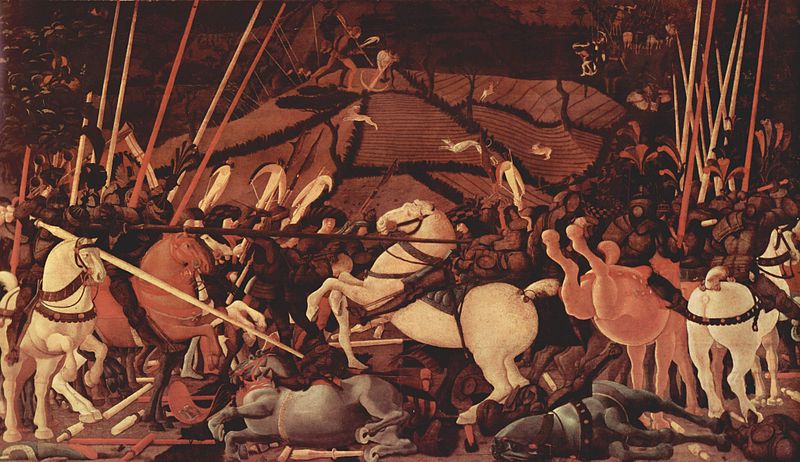
Prax: ….Fascinating background to the ‘Conversion’ mural – it certainly needs to be protected before it is vandalised by accident or design. Is the church still open? I’m reminded of that other great ‘Conversion’, Caravaggio’s in S. Maria del Populo. It was likened to ‘an accident in a blacksmith’s’ because of the prominence given to the horse’s rear end, but along with the crucfixion of St Peter in the matching chapel on the other side of the sanctuary, it is one of the most stunning displays of ecclesiastical artwork anywhere.
Praxiteles wonders whether the commentator mentioned above was familiar with Paolo Ucello’s Battle of San Romano:
- AuthorPosts
- You must be logged in to reply to this topic.


