
reorganisation and destruction of irish catholic churches
- This topic has 7,926 replies, 103 voices, and was last updated 9 years, 6 months ago by
Praxiteles.
- AuthorPosts
- May 12, 2009 at 11:04 pm #772736
Praxiteles
ParticipantHere is a little item that migh bear exploration:
http://fr.wikipedia.org/wiki/Th%C3%A9ologie_de_la_Lumi%C3%A8re
May 12, 2009 at 11:08 pm #772737ParticipantSt. Denis
A fairly comprehensive picture gallery can be found here:
http://www.gotik-romanik.de/Saint-Denis%20Thumbnails/Thumbnails.html
May 12, 2009 at 11:13 pm #772738ParticipantThe disposition of the Choir and sanctuary of St Denis before the Revolution:
 May 12, 2009 at 11:16 pm #772739Participant
From Viollet-le-Duc’s Dictionnaire raisonné a drawing of the morning Altar on which is the famous Suger’s Cross mentioned by Gunter.
 May 12, 2009 at 11:23 pm #772740Participant
The chalice of Suger:
 May 13, 2009 at 8:33 pm #772741Participant
And here we have a translation of Suger’s account of his administration of St Denis. At chapter 32 we can read of the Cross:
May 13, 2009 at 9:49 pm #772742ParticipantAn Bord Pleanala has posted the inspector’s Report in elation to a proposed developemnt opposite St. Peter and Paul’s Church in Cork. The Bord disagreed with the assessment made by the inspector, Martin Durkan:
May 13, 2009 at 10:52 pm #772743gunter
ParticipantYour Abbot Suger, is an absolutely fascinating character. Clarke describes him as; ”one of the first men of the middle ages whom one can think of in modern terms”.
On reflection, I’m not sure to what extent it was suggested that Suger knowingly contrived in cutting and pasting various achievements and attributes onto the shoulders of his abbey’s (and France’s) patron saint, but that account (in the introduction), of how the legends of three separate historical figures came to be amalgamated into one formidable ‘St. Denis’, each bringing very useful attributes to the party, does seem to illustrate the accommodating workings of the medieval mind.
Is it fair to say that Suger had set his sights on achieving great works, architecturally, artistically, politically and religously, and to accomplish great works it helped to have a great story?
What seems clear from even a brief reading of your links and Clark’s ‘Civilisation’ is that, under the influence of men like Suger, mid 12th century France was a fountainhead of energy and ideas and one of the most enduring of these ideas was Gothic architecture.
I’m not equiped to debate this subject on theological gounds, and while I don’t doubt that faith and the glorification of God played a part in all of this, it’s the other forces; the mastery of material, the inter-urban competitive dynamic, the sheer will on the part of the tiny community of master-masons to push construction knowledge and craft to the limit, that strike me as possibly the more critical factors in the development and evolution of the movement.
I don’t know, I could be completely wrong.
May 14, 2009 at 2:01 pm #772744Participant@gunter wrote:
Your Abbot Suger, is an absolutely fascinating character. Clarke describes him as; ”one of the first men of the middle ages whom one can think of in modern terms”.
On reflection, I’m not sure to what extent it was suggested that Suger knowingly contrived in cutting and pasting various achievements and attributes onto the shoulders of his abbey’s (and France’s) patron saint, but that account (in the introduction), of how the legends of three separate historical figures came to be amalgamated into one formidable ‘St. Denis’, each bringing very useful attributes to the party, does seem to illustrate the accommodating workings of the medieval mind.
Is it fair to say that Suger had set his sights on achieving great works, architecturally, artistically, politically and religously, and to accomplish great works it helped to have a great story?
What seems clear from even a brief reading of your links and Clark’s ‘Civilisation’ is that, under the influence of men like Suger, mid 12th century France was a fountainhead of energy and ideas and one of the most enduring of these ideas was Gothic architecture.
I’m not equiped to debate this subject on theological gounds, and while I don’t doubt that faith and the glorification of God played a part in all of this, it’s the other forces; the mastery of material, the inter-urban competitive dynamic, the sheer will on the part of the tiny community of master-masons to push construction knowledge and craft to the limit, that strike me as possibly the more critical factors in the development and evolution of the movement.
I don’t know, I could be completely wrong.
And I think you are completely correct in identifying this element in a complex combination of elements driving the cultural whirlwind of the period.
May 14, 2009 at 2:15 pm #772745ParticipantAnd here a spectacular rendition of ST Denis:
 May 14, 2009 at 9:38 pm #772746Participant
Zurbaran’s picture of the Proto Martyr of the Carthusians, St John Haughton, will immediately bring to mind the painter’s work at the Hierominian abbey of Guadalupe in Spain and also the series of frecoes in the atrium of the Charter House of San Martino in Naples also depicting the martyrdom of the London Charter House.
 May 14, 2009 at 10:39 pm #772747Participant
Francesco de Zurbaran, the Tepmtations of St Jerome at Guadalupe
 May 14, 2009 at 10:41 pm #772748Participant
Francesco de Zurbaran, The Flagellation of St Jerome
 May 14, 2009 at 10:44 pm #772749Participant
The Real Monasterio de Santa Maria Virgen de Guadalupe in the Extremadura:
 May 14, 2009 at 10:46 pm #772750Participant
The Monasterio de Guadalupe:
 May 14, 2009 at 10:48 pm #772751Participant
The real Monasterio de Santa Maria Virgen de Gudalupe
 May 14, 2009 at 10:50 pm #772752Participant
The Real Monasterio de Santa Maria Vergin de Guadalupe
 May 14, 2009 at 10:52 pm #772753Participant
Francesco de Zurbaran, The Charity of Fra Martin de Viscaya in the sacristy of Guadalupe
 May 14, 2009 at 10:54 pm #772754Participant
Francesco de Zurbaran, The Tepmtation of Fra Diego de Orgaz
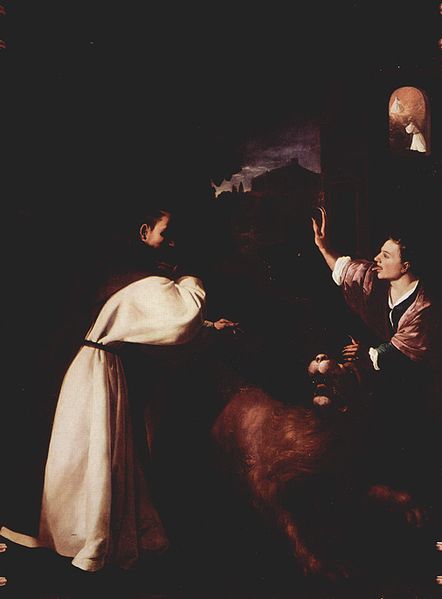 May 14, 2009 at 10:56 pm #772755Participant
Francesco de Zurbaran, portrait of the Sacristan of Guadalupe, Fra Gonzalo de Illescas (1639)

- AuthorPosts
- You must be logged in to reply to this topic.


