
reorganisation and destruction of irish catholic churches
- This topic has 7,926 replies, 103 voices, and was last updated 9 years, 6 months ago by
Praxiteles.
- AuthorPosts
- May 11, 2009 at 12:24 pm #772716
Praxiteles
ParticipantThe Theology and Metaphysics of the Gothic Cathedral – part 4 & conclusion
by Br Lawrence Lew, O.P.Conclusion
As we have seen, claritas is one of the central qualities of beauty, and it was embodied in the stained glass window, which glowed with colour like precious stones as light shone through it. Abbot Suger considered the beauty of this coloured light to have transported him to “some strange region of the universe which neither exists entirely in the slime of the earth nor entirely in the purity of Heavenâ€. His church thus became a bridge between earth and heaven, a veritable porta caeli. Moreover, the great stained glass windows clearly evoked Revelation 21:19, which spoke of the heavenly City as being “garnished with all manner of precious stonesâ€. As such, the stained glass re-iterated that the church building was a symbol of the new Jerusalem.

One element in the Gothic cathedral combines the ‘requirements’ of beauty which we have been discussing thus far. It may be said to be a summation of the medieval architect’s vision, and this is the rose window. The circle is an image of the cosmos – both spiritual and material, thus the rose window alludes to the entire cathedral itself as a model of the ordered arrangement of creation. The circle is also complete, considered by Aristotle to be a symbol of perfection, and thus it has perfect integrity. The rose window was also constructed using a complex combination of geometry and number to produce perfect proportion and harmony. The finest example of this is arguably the north rose window in Chartres. As Cowen writes: “Everything in the window is generated from the properties of the square within the circle… This series of squares can also be related to the Golden Section [and their arrangement on a spiral is] governed by the Fibonacci series (a series in which each term is the sum of the two preceding ones)â€. Interestingly, the Fibonacci series had only been published thirty years before this window was made and the series also “governs the system of growth in a number of flowers – notably the sunflower, daisies and in a related but more complex way the roseâ€. Thus, one sees in this use of geometry something of the natural order that the divine geomancer has written into creation. Finally, the stained glass in the window is aglow with luminous colour and brightness. Therefore, beauty is communicated in the rose window, which is itself a microcosm of the entire cathedral itself which strains upwards towards God and is a symbol of he who is Beauty. Subordinate to this form of beauty in the Gothic cathedral, and so also with the rose window, is the theological scheme of the ‘lights’ in the window which may be read as a biblia pauperum. At Chartres, Christ the divine Logos is at the centre of each of the cathedral’s three rose windows: the Last Judgment is depicted in the west rose, the Parousia is in the southern rose, and the Incarnation in the northern rose. Given that the circular windows are an allusion to the cosmos, that light is a symbol of creation, the rose windows place Jesus Christ at the centre of all creation and the order of the universe. For it is by the divine Logos that the world was made and arranged, and it is also by the Incarnation, death and resurrection of the Word that the world was re-made and order was restored to the chaos introduced by sin. As we saw at the beginning of this essay, then, all these elements which are unified in the rose window and ‘read’ from it are also unified in the Gothic cathedral which is a symbol of the entire cosmos and its past, present and future, governed by Christ and centred on the Eucharist which is, of course, the living heart of the Church.

The medieval cosmology that the Gothic cathedral represents helps us to understand why the medievals built these wonders of Christian civilization. As Günther Binding says, “During the course of the 13th century… a general striving was becoming evident, in all areas [of medieval Europe], to determine the exact place of mankind both in terms of his reason and his nature, within the harmonious, well-proportioned cosmos of creation, in other words in the perfect forms in which God reveals Himself. Efforts were made to understand the secret of the world and to point out the innate divine order within itâ€. Mâle had noted the medievals’ “passion for order†and this is seen in the intellectual work of the universities and religious orders. However, this same passion was reflected in the Gothic cathedral which stands as a symbol of the medieval vision of the cosmos. These buildings stand as a witness to the truth which the Scholastics perceived and taught. They stand as a symbol of the Church and her revealed truths, and within her walls the saints are taught and fed, and glimpse their heavenly homeland. Their beauty is an eloquent invitation to us today, who no longer perceive the truth as clearly as the medievals did, to rediscover the veritatis splendor which they communicate. As Auguste Rodin once said: “If we could but understand Gothic art, we should be irresistibly led back to truthâ€.
May 11, 2009 at 10:21 pm #772717ParticipantA useful article on the papal palace at Avignon;
May 11, 2009 at 10:39 pm #772718ParticipantThe frescoes in the Chapel of St Martial in the Tour St Jean of the Papal Palace at Avignon. These are the work of Matteo Giovanetti 1344-1345. Those on the vault depict the early life of St. Martial:
 May 11, 2009 at 10:42 pm #772719Participant
The chapel of St. Jean, which is below the chapel of St Martial and immediately connceting to the Hall of the Consistory, was also decorated by Matteo Giovenetti 1347-1348 with scenes from the life of St John the Baptist and from the life of St John the Evangelist:
 May 11, 2009 at 10:46 pm #772720Participant
Something of the Grande Chapelle, deicated to Sts. Peter and Paul:
May 11, 2009 at 10:50 pm #772721ParticipantThis gives a better idea of the stupendous proportions of the Grande Chapelle of the Papal Palace in Avignon. The chapel is in seven bays, three occupied by the sanctuary [the first by the altar, thes econd by the Papal Throne, the third by the assisting papal chapel. The remaining 4 bays lay below the chancel gate [as in the Sixtine in Rome]. As with teh Sixtine in Rome, this chapel is also built to the specification for the Temple in Jerusalem contained in the Old Testament:
 May 11, 2009 at 10:55 pm #772722Participant
The lower bays of the chapel:
 May 11, 2009 at 11:00 pm #772723Participant
The entrance to the Grande Chapelle of the Papal Palace at Avignon:
 May 11, 2009 at 11:16 pm #772724Participant
Some shots of the Abbaye de Ste. Madelaine du Barroux, near Avignon, founded in 1983:
http://vids.myspace.com/index.cfm?fuseaction=vids.individual&videoid=36517041
May 11, 2009 at 11:56 pm #772725gunter
Participant@Praxiteles wrote:
Abbot Suger, who was responsible for what is often recognized as the first Gothic church, said that his abbey church of St Denis transformed “that which is material to that which is immaterial”.
Kenneth Clark (the art historian, not the politician) had some interesting things to say on this subject.
It turns out that Abbot Suger was not averse to accumulating ‘material’, his great gold cross at St. Denis, for example, was reportedly 24 feet high and encrusted with jewels and precious crystals. Suger also seized on a Greek philosophical text called ‘The Heavenly Hierarchies’ had it translated and put it about that it had been written by the Athenian convert to Christianity with, conveniently, the same name as the saint to whom his abbey was dedicated, to justify, and give a sacred/philosophical foundation to, his passion for beautiful things.
Suger himself gave an account (recorded by Clark) of how he releaved a bunch of unworldly Cistercian of a valuable bequest of jewels for considerably under the market rate, as they appeared not to understand the monetary value of their baubles.
Add to the fact that Suger was a fervent nationalist, possibly in the Jean Marie Le Pen mould, and was capable of navigating through the cut and thrust of politics as Regent of France for seven years, the picture emerges of a man who may have had more than God on his mind.
In considering the magnificence of Gothic architecture, ‘material’ is a useful word to keep in mind for another reason also:
Whatever about the inspiration behind the emergence of the Gothic style, and Suger’s undoubted role in it, to my mind, the real engine driving the movement was the almost obsessive exploitation of a material; stone. You can’t explore the progress of Gothic architecture without realizing that, close to the root of it must have been a burning desire to push stone to the limits of it’s capabilities. I presume that the mystique of the master mason, which is a known legacy of the middle ages, arose at this time from their ability to conceive and build incredible structures and presumably in the process challenge each other to go one better.

St Sebalduskirche in Nurnberg. A late Gothic hall church where the purity of the architectural forms are not even interrupted by capitals as the ribs of the columns merge with the ribs of the vaulting, as if the stonework was extruded!Raising the funds to pay for these incredible structures is where the spirituality of the whole exercise is inclined to break down for me.
Who knows what was going on in the medieval mind, but I suspect that if true spirituality was at play, the places of worship may have ended up a tad more humble, and the worship of beauty may have found some more simple expression.
Obviously from an architectural point of view, this would have been a pity, to say the least.
May 12, 2009 at 10:17 am #772726ParticipantOn Suger, I have been trying to locate a recension of Erwin Panofski’s book but so far can only come across this one in Italian, which touches on several of the points raised by Gunter and sets them in an historico-philosophico-theological context. Here is teh text in Italian while awaiting somethng in English:
Suger fu abate dal 1122 al 1151 dell’antica abbazia parigina di Saint-Denis, uomo perciò di Chiesa e di governo, se pensiamo al ruolo che questo monastero ha svolto nella storia della monarchia francese. In tale condizione, Suger riuscì a combinare il servizio di Dio con la fedeltà al re in forza di grandi capacità diplomatiche e amministrative e di una singolare tenacia. In questa prima metà del secolo XII, così ricca di fermenti di ogni genere, Suger è l’anti-Bernardo, almeno nella vita attiva. Dalla più influente personalità religiosa del tempo lo distingueva quasi tutto, compreso un certo disinteresse per problemi di dottrina o di regola. Su questo fra Suger e Bernardo ci fu una polemica, ma è significativo che l’altro e ben più famoso avversario di Bernardo, Abelardo, che ebbe l’ardire un po’ altezzoso di smontare il mito di san Dionigi l’Areopagita proprio quando era ospite all’abbazia, non venga preso in considerazione da Suger che per sistemare la faccenda piuttosto imbarazzante della sua appartenenza alla congregazione di Saint-Denis. Ma a opporre Suger a Bernardo e ai cistercensi è soprattutto l’aspirazione alla bellezza e al fasto dei luoghi sacri, l’uso dell’arte e dell’architettura in servizio della gloria di Dio. Sono stati questi la vera passione di Suger, passione tanto più forte in quanto fondata sull’opera di quel Dionigi al quale era intitolata l’abbazia. Dionigi (pseudo-Dionigi per noi, forse un anonimo siriano che scrive fra IV e V secolo) inserisce nella sua teologia una metafisica della luce, che combina elementi neoplatonici e cristiani. La luce discende dall’Uno alla materia terrestre, che, pur oscurata, ne conserva qualche parte; la luce presente nel mondo è così guida e ascesa al divino come le materie che la possiedono: l’oro, le gemme, le vetrate. La luce è poi anche luce architettonica, ampiezza e altezza della costruzione: in questo modo il nuovo coro di Saint-Denis inaugura l’arte gotica dell’×l e-de-France. Suger restò sempre profondamente convinto dell’utilità dell’impresa e del suo valore religioso e celebrativo; forse intuì anche la modernità di certe soluzioni artistiche e architettoniche: lo dimostra il libello che egli ha lasciato sull’opera di ricostruzione di Saint-Denis. Che poi a questo si accompagnasse anche un’autocelebrazione, un rinascimentale desiderio di perpetuazione, è l’ipotesi improbabile quanto suggestiva.
May 12, 2009 at 12:37 pm #772727ParticipantItalian! Praxiteles . . . . how vulgar:)
May 12, 2009 at 2:20 pm #772728Paul Clerkin
KeymasterMore on St Sebalduskirche in Nurnberg
http://germany.archiseek.com/bavaria/nuremberg/st_sebaldus_interior.html
May 12, 2009 at 2:37 pm #772729ParticipantTo be honest, the nave and the west end of St. Sebalduskirche (most of those pictures, except no. 6) isn’t great, the real glory of the church is the ‘German Hall Church’ choir added in the 14th century, (I think). I might have more pictures. The exterior of the east end butts onto the main street leading up to the Kaiserburg, totally spectacular!, but usually covered in scaffolding.
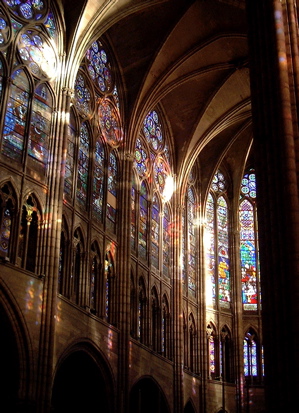
May 12, 2009 at 10:38 pm #772730ParticipantSuger’s Choir at St. Denis:
 May 12, 2009 at 10:39 pm #772731Participant
The Choir at St Denis at sunset:
 May 12, 2009 at 10:42 pm #772732Participant
The Abbaye de St. Denis, the Choir windows:
 May 12, 2009 at 10:48 pm #772733Participant
St. Denis, one of the rose windows:
 May 12, 2009 at 10:52 pm #772734Participant
St Denis, choir and south transpt:
 May 12, 2009 at 10:55 pm #772735Participant
St Denis, extereur:

- AuthorPosts
- You must be logged in to reply to this topic.


