
reorganisation and destruction of irish catholic churches
- This topic has 7,926 replies, 103 voices, and was last updated 9 years, 6 months ago by
Praxiteles.
- AuthorPosts
- April 29, 2009 at 4:22 pm #772696
Praxiteles
ParticipantThe Pope today gave an interesting discourse on beauty and its effects on ecclesiastical art, architecture and worship. Here is the Italian text with an English synopsis:
CATECHESI DEL SANTO PADRE IN LINGUA ITALIANA
Cari fratelli e sorelle,
il Patriarca Germano di Costantinopoli, del quale vorrei parlare oggi, non appartiene alle figure più rappresentative del mondo cristiano orientale di lingua greca e tuttavia il suo nome compare con una certa solennità nella lista dei grandi difensori delle immagini sacre, stesa nel Secondo Concilio di Nicea, settimo ecumenico (787). La Chiesa Greca celebra la sua festa nella liturgia del 12 maggio. Egli ebbe un ruolo significativo nella storia complessa della lotta per le immagini, durante la cosiddetta crisi iconoclastica: seppe resistere validamente alle pressioni di un Imperatore iconoclasta, cioè avversario delle icone, quale fu Leone III.
Durante il patriarcato di Germano (715-730) la capitale dell’impero bizantino, Costantinopoli, subì un pericolosissimo assedio da parte dei Saraceni. In quell’occasione (717-718) venne organizzata una solenne processione in città con l’ostensione dell’immagine della Madre di Dio, la Theotokos, e della reliquia della Santa Croce, per invocare dall’Alto la difesa della città . Di fatto, Costantinopoli fu liberata dall’assedio. Gli avversari decisero di desistere per sempre dall’idea di stabilire la loro capitale nella città simbolo dell’Impero cristiano e la riconoscenza per l’aiuto divino fu estremamente grande nel popolo.
Il Patriarca Germano, dopo quell’evento, si convinse che l’intervento di Dio doveva essere ritenuto un’approvazione evidente della pietà mostrata dal popolo verso le sante icone. Di parere completamente diverso fu invece l’imperatore Leone III, che proprio da quell’anno (717) si insediò quale Imperatore indiscusso nella capitale, su cui regnò fino al 741. Dopo la liberazione di Costantinopoli e dopo una serie di altre vittorie, l’Imperatore cristiano cominciò a manifestare sempre più apertamente la convinzione che il consolidamento dell’Impero dovesse cominciare proprio da un riordinamento delle manifestazioni della fede, con particolare riferimento al rischio di idolatria a cui, a suo parere, il popolo era esposto a motivo dell’eccessivo culto delle icone.
A nulla valsero i richiami del patriarca Germano alla tradizione della Chiesa e all’effettiva efficacia di alcune immagini, che venivano unanimemente riconosciute come ‘miracolose’. L’imperatore divenne sempre più irremovibile nell’applicazione del suo progetto restauratore, che prevedeva l’eliminazione delle icone. E quando il 7 gennaio del 730 egli prese posizione aperta in una riunione pubblica contro il culto delle immagini, Germano non volle in nessun modo piegarsi al volere dell’Imperatore su questioni ritenute da lui determinanti per la fede ortodossa, alla quale secondo lui apparteneva proprio il culto, l’amore per le immagini. In conseguenza di ciò, Germano si vide costretto a rassegnare le dimissioni da Patriarca, auto-condannandosi all’esilio in un monastero dove morì dimenticato pressoché da tutti. Il suo nome riemerse in occasione appunto del Secondo Concilio di Nicea (787), quando i Padri ortodossi decisero in favore delle icone, riconoscendo i meriti di Germano.
Il Patriarca Germano curava molto le celebrazioni liturgiche e, per un certo tempo, fu ritenuto anche l’instauratore della festa dell’Akatistos. Come è noto, l’Akatistos è un antico e famoso inno sorto in ambito bizantino e dedicato alla Theotokos, la Madre di Dio. Nonostante che dal punto di vista teologico non si possa qualificare Germano come un grande pensatore, alcune sue opere ebbero una certa risonanza soprattutto per certe sue intuizioni sulla mariologia. Di lui sono state conservate, in effetti, diverse omelie di argomento mariano e alcune di esse hanno segnato profondamente la pietà di intere generazioni di fedeli sia in Oriente che in Occidente. Le sue splendide Omelie sulla Presentazione di Maria al Tempio sono testimonianze tuttora vive della tradizione non scritta delle Chiese cristiane. Generazioni di monache, di monaci e di membri di numerosissimi Istituti di Vita Consacrata, continuano ancora oggi a trovare in quei testi tesori preziosissimi di spiritualità .
Creano ancora adesso stupore anche alcuni testi mariologici di Germano che fanno parte delle omelie tenute In SS. Deiparae dormitionem, festività corrispondente alla nostra festa dell’Assunzione. Fra questi testi il Papa Pio XII ne prelevò uno che incastonò come una perla nella Costituzione apostolica Munificentissimus Deus (1950), con la quale dichiarò dogma di fede l’Assunzione di Maria. Questo testo il Papa Pio XII citò nella menzionata Costituzione, presentandolo come uno degli argomenti in favore della fede permanente della Chiesa circa l’Assunzione corporale di Maria in cielo. Germano scrive: “Poteva mai succedere, santissima Madre di Dio, che il cielo e la terra si sentissero onorati dalla tua presenza, e tu, con la tua partenza, lasciassi gli uomini privi della tua protezione? No. E’ impossibile pensare queste cose. Infatti come quando eri nel mondo non ti sentivi estranea alle realtà del cielo, così anche dopo che sei emigrata da questo mondo non ti sei affatto estraniata dalla possibilità di comunicare in spirito con gli uomini… Non hai affatto abbandonato coloro ai quali hai garantito la salvezza… infatti il tuo spirito vive in eterno né la tua carne subì la corruzione del sepolcro. Tu, o Madre, sei vicina a tutti e tutti proteggi e, benché i nostri occhi siano impediti dal vederti, tuttavia sappiamo, o Santissima, che tu abiti in mezzo a tutti noi e ti rendi presente nei modi più diversi…Tu (Maria) ti riveli tutta, come sta scritto, nella tua bellezza. Il tuo corpo verginale è totalmente santo, tutto casto, tutto casa di Dio così che, anche per questo, è assolutamente refrattario ad ogni riduzione in polvere. Esso è immutabile, dal momento che ciò che in esso era umano è stato assunto nella incorruttibilità , restando vivo e assolutamente glorioso, incolume e partecipe della vita perfetta. Infatti era impossibile che fosse tenuta chiusa nel sepolcro dei morti colei che era divenuta vaso di Dio e tempio vivo della santissima divinità dell’Unigenito. D’altra parte noi crediamo con certezza che tu continui a camminare con noi” (PG 98, coll. 344B-346B, passim).
E’ stato detto che per i Bizantini il decoro della forma retorica nella predicazione, e ancora di più negli inni o composizioni poetiche che essi chiamano tropari, è altrettanto importante nella celebrazione liturgica quanto la bellezza dell’edificio sacro nel quale essa si svolge. Il Patriarca Germano è stato riconosciuto, in quella tradizione, come uno di coloro che hanno contribuito molto nel tener viva questa convinzione, cioè che bellezza della parola, del linguaggio e bellezza dell’edificio e della musica devono coincidere.
Cito, per concludere, le parole ispirate con cui Germano qualifica la Chiesa all’inizio di questo suo piccolo capolavoro: “La Chiesa è tempio di Dio, spazio sacro, casa di preghiera, convocazione di popolo, corpo di Cristo… E’ il cielo sulla terra, dove Dio trascendente abita come a casa sua e vi passeggia, ma è anche impronta realizzata (antitypos) della crocifissione, della tomba e della risurrezione… La Chiesa è la casa di Dio in cui si celebra il sacrificio mistico vivificante, nello stesso tempo parte più intima del santuario e grotta santa. Dentro di essa si trovano infatti il sepolcro e la mensa, nutrimenti per l’anima e garanzie di vita. In essa infine si trovano quelle vere e proprie perle preziose che sono i dogmi divini dell’insegnamento offerto direttamente dal Signore ai suoi discepoli” (PG 98, coll. 384B-385A).
Alla fine rimane la domanda: che cosa ha da dirci oggi questo Santo, cronologicamente e anche culturalmente abbastanza distante da noi. Penso sostanzialmente tre cose. La prima: c’è una certa visibilità di Dio nel mondo, nella Chiesa, che dobbiamo imparare a percepire. Dio ha creato l’uomo a sua immagine, ma questa immagine è stata coperta dalla tanta sporcizia del peccato, in conseguenza della quale quasi Dio non traspariva più. Così il Figlio di Dio si è fatto vero uomo, perfetta immagine di Dio: in Cristo possiamo così contemplare anche il volto di Dio e imparare ad essere noi stessi veri uomini, vere immagini di Dio. Cristo ci invita ad imitarLo, a divenire simili a Lui, così che in ogni uomo traspaia di nuovo il volto di Dio, l’immagine di Dio. Per la verità , Dio aveva vietato nel Decalogo di fare delle immagini di Dio, ma questo era a motivo delle tentazioni di idolatria a cui il credente poteva essere esposto in un contesto di paganesimo. Quando però Dio si è fatto visibile in Cristo mediante l’incarnazione, è diventato legittimo riprodurre il volto di Cristo. Le sante immagini ci insegnano a vedere Dio nella raffigurazione del volto di Cristo. Dopo l’incarnazione del Figlio di Dio, è diventato quindi possibile vedere Dio nelle immagini di Cristo ed anche nel volto dei Santi, nel volto di tutti gli uomini in cui risplende la santità di Dio.
La seconda cosa è la bellezza e la dignità della liturgia. Celebrare la liturgia nella consapevolezza della presenza di Dio, con quella dignità e bellezza che ne faccia vedere un poco lo splendore, è l’impegno di ogni cristiano formato nella sua fede. La terza cosa è amare la Chiesa. Proprio a proposito della Chiesa, noi uomini siamo portati a vedere soprattutto i peccati, il negativo; ma con l’aiuto della fede, che ci rende capaci di vedere in modo autentico, possiamo anche, oggi e sempre, riscoprire in essa la bellezza divina. E’ nella Chiesa che Dio si fa presente, si offre a noi nella Santa Eucaristia e rimane presente per l’adorazione. Nella Chiesa Dio parla con noi, nella Chiesa “Dio passeggia con noi”, come dice San Germano. Nella Chiesa riceviamo il perdono di Dio e impariamo a perdonare.
Preghiamo Dio perché ci insegni a vedere nella Chiesa la sua presenza, la sua bellezza, a vedere la sua presenza nel mondo, e ci aiuti ad essere anche noi trasparenti alla sua luce.
[00660-01.01] [Testo originale: Italiano]
Sintesi della catechesi in lingua inglese
Dear Brothers and Sisters,
In our catechesis on the early Christian writers of East and West, we turn to Saint Germanus, Bishop and Patriarch of Constantinople, whose feast day is celebrated in the Greek Church on 12 May. In 717, while Constantinople was under siege by Saracen armies, Germanus led a procession with the venerated image of the Theotokos, the Mother of God, and relics of the Holy Cross. The siege was lifted, convincing him that God had responded to the people’s devotion. Some time later however, Emperor Leo III initiated his campaign against the use of sacred images, judging them to be a source of idolatry. When Germanus opposed the Emperor publicly in 730 he was forced to retire in exile to a monastery, where he later died. His memory was not forgotten, and in the Second Council of Nicea, which restored devotion to sacred images, his name was honoured. The writings of Germanus, steeped in an ardent love of the Church and devotion to the Mother of God, have had a wide influence on the piety of the faithful both of the East and the West. He promoted a solemn and beautiful Liturgy and is also known for his insights in Mariology. In homilies on the Presentation and the Dormition of the Virgin Mary, Germanus extols her virtue and her mission. A text which sees the source of her bodily incorruption in her virginal maternity was included by Pope Pius XII in his Apostolic Constitution Munificentissimus Deus. I pray that through the intercession of Saint Germanus we may all be renewed in our love of the Church and devotion to the Mother of God.
I offer a warm welcome to all the English-speaking pilgrims and visitors from England, Scotland, Ireland, Denmark, Finland, Japan, Canada and the United States. Upon all of you I cordially invoke the Lord’s Easter blessings of joy and peace!
April 29, 2009 at 10:14 pm #772697ParticipantAnd here we have a short historical note on Germanus of Constantinople:
St. Germanus I
tt=24
Patriarch of Constantinople (715-30), b. at Constantinople towards the end of the reign of Emperor Heraclius (610-41); d. there 733 or 740. The son of Justinianus, a patrician, Germanus dedicated himself to the service of the Church and became a cleric at the cathedral of the metropolis. Some time after the death of his father, who had filled various high official positions, at the hands of the nephew of Heraclius, Germanus was consecrated Bishop of Cyzicus, but the exact year of his elevation is not known. According to Theophanes and Nicephorus, he was present in this capacity at the Synod of Constantinople held in 712 at the insistance of the new emperor, Philippicus, who favoured Monothelitism. The object of the council was to re-establish Monothelitism and to condemn the Acts of the Sixth General Council of 681. Even Germanus is said to have bowed to the imperial will, with the majority of the Greek bishops (Mansi, Conc. Coll., XII, 192-96). However, immediately after the dethronement of Emperor Philippicus (713) his successor, Anastasius II, restored orthodoxy, and Monothelitism was now definitively banished from the Byzantine Empire. If Germanus really yielded for a short time to the false teachings of the Monothelites, he now once more acknowledged the orthodox definition of the two wills in Christ. John, Patriarch of Constantinople, appointed by Philippicus to succeed the deposed Cyrus, sent to Pope Constantine a letter of submission and accepted the true doctrine of the Church promulgated at the Council of 681, whereupon he was recognized by the pope as Patriarch of Constantinople. On his death Germanus was raised to the patriarchal see (715), which he held until 730. Immediately (715 or 716) he convened at Constantinople a synod of Greek bishops, who acknowledged and proclaimed anew the doctrine of the two wills and the two operations in Christ, and placed under anathema Sergius, Cyrus, and the other leaders of Monothelism. Germanus entered into communication with the Armenian Monophysites, with a view to restoring them to unity with the Church, but without success. Soon after his elevation to the patriarchal dignity the Iconoclastic storm burst forth in the Byzantine Church, Leo III the Isaurian, who was opposed to the veneration of images having just acceded to the imperial throne (716). Bishop Constantine of Nacoleia in Phrygia, who like some other bishops of the empire condemned the veneration of the pictures and images of Christ and the saints, went to Constantinople, and entered into a discussion with Germanus on the subject. The patriarch represented the traditional use of the Church, and sought to convince Constantine of the propriety of reverencing images. Apparently he was converted to the teaching of the patriarch, but he did not deliver the letter entrusted to him by Germanus for the Metropolitan of Synnada, for which he was excommunicated. At the same time the learned patriarch wrote to Bishop Thomas of Claudiopolis, another Iconoclast, and developed in detail the sound principles underlying the reverencing of images, as against the recent innovations. Emperor Leo III, however, did not recede from his position, and everywhere encouraged the iconoclasts. In a volcanic eruption between the islands of Thera and Therasia he saw a Divine judgment for the idolatry of image- worship, and in an edict (726) explained that Christian images had taken the place of idols, and the venerators of images were idolaters, since, according to the law of God (Exodus 20:4), no product of the hand of man may be adored. Immediately afterwards, the first Iconoclastic disturbances broke out in Constantinople. The Patriarch Germanus vigorously opposed the emperor, and sought to convert him to a truer view of things, whereupon Leo attempted to depose him. Germanus turned to Pope Gregory II (729), who in a lengthy epistle praised his zeal and steadfastness. The emperor in 730 summoned the council before which Germanus was cited to subscribe to an imperial decree prohibiting images. He resolutely refused, and was thereupon compelled to resign his patriarchal office, being succeeded by the pliant Anastasius. Germanus withdrew to the home of his family, where he died some years later at an advanced age. The Ecumenical Council of Nicaea (787) bestowed high praise on Germanus, who is venerated as a saint in both the Greek and the Latin Church. His feast is celebrated on 12 May. Several writings of Germanus have been preserved (Migne, P.G., XCVIII, 39-454), viz., “Narratio de sanctis synodis”, a dialogue “De vitae termino”, a letter to the Armenians, and three letters on the reverencing of images, as well as nine discourses in the extravagant rhetorical style of the later Byzantines. Of doubtful authenticity is the “Historia ecclesiastica et mystica”, also attributed to him (Migne, loc. cit., 383-454).April 29, 2009 at 10:18 pm #772698ParticipantA more ample English language account of the Pope’s discourse on germanus of Constantinople:
Benedict XVI on St. Germanus of Constantinople, defender of holy images
From Vatican Information Services:GERMANUS OF CONSTANTINOPLE: DEFENDER OF HOLY IMAGES
VATICAN CITY, 29 APR 2009 (VIS) – During his general audience this morning Benedict XVI dedicated his catechesis to St. Germanus of Constantinople, who “played an important role in the complex history of the battle for images during the so-called iconoclastic crisis, and was able to resist the pressure of an iconoclastic emperor, … Leo III.
“During Germanus’ patriarchate (715-730)”, the Pope added, “the capital of the Byzantine empire, Constantinople, was subject to a threatening siege by the Saracens. On that occasion (717-718) a solemn procession was organised and passed through the streets carrying the image of the Mother of God … and the relic of the Holy Cross to call upon the Most High to defend the city. In fact, Constantinople was freed from the siege”.
This event convinced the patriarch “that God’s intervention was to be interpreted as evident approval of the reverence people showed towards holy icons. Leo III on the other hand, who came to the throne in that year of 717, … began ever more openly to show his conviction that the consolidation of empire had to begin by reorganising expressions of faith, with particular reference to idolatry, a risk to which, in his view, the people were exposed by their excessive veneration for icons”.
The Holy Father went on: “Patriarch Germanus’ appeals to Church tradition and to the real effectiveness of certain images, unanimously recognised as ‘miraculous’, were all to no avail. The emperor became ever more intractable in implementing his policies of reform. … Germanus had no desire to bow to the emperor’s will in matters he considered vital to orthodox faith. … As a consequence he felt obliged to resign as patriarch, condemning himself to exile in a monastery where he died in obscurity. Nonetheless his name re-emerged at the Second Nicean Council … of 787 where his merits were recognised”.
Of Germanus’ works “certain homilies on Marian themes have survived, of which some have had a profound influence on the piety of entire generations of faithful, both in the East and the West”, including one which Pope Pius XII “set like a pearl in the 1950 Apostolic Constitution ‘Munificentissimus Deus'”, dedicated to the Assumption of the Virgin Mary.
Benedict XVI went on to recall the “great contribution” this saint made to the Byzantine tradition in which “the rhetorical forms used in preaching, and even more so in hymns and poetical compositions, … are as important to the celebration of the liturgy as the beauty of the sacred building in which it takes place”.
The Holy Father concluded by considering three aspects in which St. Germanus still has something to say to modern man. Firstly, in the need to recognise “the visibility of God in the world and in the Church”, because “God created man in His image but that image was covered with dirt and sin” and the Creator “could almost no longer see it. Thus the Son of God became man and … in Christ, the true image of God, we too can … learn to see ourselves as His image”. If, to prevent idolatry and the danger of pagan images, God prohibited the Israelites from creating His image, yet “when He became visible in Christ through the Incarnation it became legitimate to reproduce the face of Christ. … Holy images teach us to see God in the face of Christ, … of the saints and of all human beings”.
Secondly, Germanus shows us “the beauty and dignity of the liturgy”, which must be celebrated “with an awareness of the presence of God and with a beauty and dignity that enable us to glimpse His splendour”.
The third aspect is that of “love for the Church”, the Pope concluded. “It may be that in the Church, as in ourselves, we see sin and other negative things, yet with the help of faith … we can always rediscover divine beauty in the Church. In the Church, God offers Himself to us in the Eucharist, He speaks to us, … He forgives us and He teaches us to forgive. Let us pray that God may teach us to see His presence and His beauty in the Church, to see His presence in the world”.
• Benedict XVI on the other Ambrose (April 22, 2009)
April 30, 2009 at 11:01 pm #772699ParticipantSome shots of Duncan Stroik’s masterpiece -the recently comnpleted chapel of Aquinas College at Santa Paola in California:
http://www.stroik.com/portfolio/ourladyofthemostholytrinity/
April 30, 2009 at 11:24 pm #772700ParticipantAnd his other great classical masterpiece: Ou Lady of Guadalupe
http://www.traditional-building.com/Previous-Issues-08/DecemberProject08OLG.html
May 1, 2009 at 6:37 pm #772701ParticipantA note on Roger Scruton’s latest book on Beauty:
Friday, May 01, 2009
Roger Scruton on Beauty
by Shawn TribeWhile philosopher and thinker Roger Scruton is not a Catholic writer, he quite often has some very interesting and very Catholic things to say, even if we might also find some areas for civil disagreement as well.
He has produced some rather interesting titles; two such are On Hunting, which looks at some of the cultural and philosophical issues surrounding the hunt, and An Intelligent Person’s Guide to Modern Culture (both published by St. Augustine’s Press).
While reading the Arts and Letters Daily recently, I came across a reference to a new offering from Scruton, this time published by Oxford University Press, and on a subject that should be of particular interest to those with a philosophical bent and who are interested in the sacred liturgy.
The book is simply titled Beauty and is so described by the publisher:
“‘Beauty can be consoling, disturbing, sacred, profane,” writes Roger Scruton. “It can be exhilarating, appealing, inspiring, chilling. It is never viewed with indifference: beauty demands to be noticed; it speaks to us directly like the voice of an intimate friend.’ In a book that is itself beautifully written, renowned philosopher Roger Scruton explores this timeless concept, asking what makes an object–either in art, in nature, or the human form–beautiful. This compact volume is filled with insight and Scruton has something interesting and original to say on almost every page. Can there be dangerous beauties, corrupting beauties, and immoral beauties? Perhaps so. The prose of Flaubert, the imagery of Baudelaire, the harmonies of Wagner, Scruton points out, have all been accused of immorality, by those who believe that they paint wickedness in alluring colors. Is it right to say there is more beauty in a classical temple than a concrete office block, more beauty in a Rembrandt than in an Andy Warhol Campbell Soup Can? Can we even say, of certain works of art, that they are too beautiful: that they ravish when they should disturb. But while we may argue about what is or is not beautiful, Scruton insists that beauty is a real and universal value, one anchored in our rational nature, and that the sense of beauty has an indispensable part to play in shaping the human world.”
Not having read the volume, I can provide no commentary — either positive or critical — upon it. However, for certain, excerpts such as these certainly pique one’s interest:
Simply put, kitsch is a disease of faith… The Disneyfication of art is simply one aspect of the Disneyfication of faith -and both involve a profanation of our highest values. Kitsch, the case of Disney reminds us, is not an excess of feeling but a deficiency. The world of kitsch is in a certain measure a heartless world, in which emotion is directed away from its proper target towards sugary stereotypes, permitting us to pay passing tribute to love and sorrow without the trouble of feeling them.
Such a title will not be for everyone, but it is worth mentioning for the sake of those who already have a solid basis in the Catholic philosophical approach to the three trascendentals of the Good, the True and the Beautiful.May 2, 2009 at 10:01 am #772702gunter
ParticipantBut what if something is ugly and it’s not it’s fault? . . . . . or is it always it’s fault?
May 2, 2009 at 7:59 pm #772703ParticipantIf aesthetic praise or blame is to be apportioned, then it must also be apportioned to the maker.
May 2, 2009 at 8:13 pm #772704ParticipantThursday, April 30, 2009
A Look at the Architectural Work of Ethan Anthony and HDB/Cram and Ferguson
by Shawn TribeThe topic of sacred architecture has been raised here quite a bit of late, specifically as it pertains to the sanctuary and altar. However, recently I was reminded again of some work by the architect Ethan Anthony particularly, and HDB/Cram and Ferguson generally, which struck me. Specifically I am thinking of the architecture Syon Abbey in Virginia — an abbey that follows the Benedictine rule, but whose monks are not in full communion with Rome (and while I feel compelled to mention this, my sole concern is for the architecture).
HDB/Cram and Ferguson, who our own architectural correspondent, Matthew Alderman, has often made reference to, are to my mind a firm which has produced some of the very finest examples of modern day sacred architecture in traditional styles. I have been particularly pleased by their approach to mediaeval forms of ecclesiastical architecture. Indeed, too often post-gothic revival attempts at these styles come across rather poorly and blandly — no doubt for pragmatic reasons; namely the money made available for a project by those commissioning it. That is not the case here. (This said, I also want to be clear that I am not disparaging the other fine architects and architectural firms that exist, and which we have often featured here upon the NLM.)
If I were to analyze why these particular projects have been so successful, I believe a significant factor is the traditional materials they employ. Quality stone, as would be seen in traditional architecture of this variety, features prominently in these projects — stone of rather pleasing varieties which have a particular warmth and inviting quality to them I would add. In addition to this, there is a particular attention to the architectural details that made these styles so particularly appealing historically, be it in the details of the forms themselves or simply in the colours employed.
Of course, rather than simply discuss this, what seems best is to simply show you the projects in question, with these considerations in mind, letting you make your own considerations.
As I have often noted of recent, the project of giving consideration to why certain manifestations of the sacred arts and architecture are particular edifying is an important exercise, especially for those of you in a position to commission these things, or who might be in the future. I am hopeful that by bringing these various examples to you in the various realms of sacred art, it will assist you in your future projects and pursuits, giving you, even if only in a small way, some standard of judgement.
With that, the NLM is pleased to present to you three projects of HDB/Cram and Ferguson. (The descriptions come from the website of the architects.)
Syon Abbey, Copper Hill, Virginia
“Syon Abbey is a community of Benedictine monks located on the first ridge of the Blue Ridge Mountains in Virginia, near Roanoke. In early 2000, HDB was commissioned to design a Gothic Church and monastic buildings. The designs were inspired by our study of ruined English monasteries. Constructed from imported Spanish limestone, the monastery was completed in the fall of 2007.”

(Please note that this picture shows the building still as a work in progress, not yet complete. Note the stone and its warm tonality, and the detailing on the tower, the rose window and also above the door, as well as the proportions of the structure.)


 May 2, 2009 at 8:28 pm #772705Participant
A further project of Ethan Anthony of Cram Ferguson, Boston
Our Lady of Walsingham, Houston, Texas
“This recently completed new Gothic church in roughly hewn Texas limestone is located in the Spring Branch section of Houston, Texas, off Wirt Road. The church accomodates 300 worshippers and celebrants. One of the transepts houses a shrine to Our Lady of Walsingham and was built to the exact size of the legendary Walsingham Holy House, destroyed by Henry VIII during the Reformation. Carpentry and stonework are in the manner of medieval churches found near the site of the Walshingham miracle. Stained glass was made by the Willet Studio in Philadelphia. Gargoyles by local sculptors ward off evil spirits from the four corners of the tower.”

(Do again note the stone and the detailing around the doors and windows.)

(Note the timber roof.)
(The addition of a timber porch mounted with a cross was a nice touch.)
May 2, 2009 at 8:31 pm #772706ParticipantAnd a third project by Ethan Anthony of Cram Ferguson, Boston
St. John Neumann, Farragut, Tennessee
“St. John Neumann Catholic Church, a Romanesque-style Church that seats over 1,000, is currently in the final phase of completion. The building will include a Day Chapel and an Adoration Chapel. St. John Neumann Church is inspired by Romanesque churches of the Burgandy region in France, which saw the finest and earliest development of Romanesque architecture.”


(A beautiful Romanesque structure, again, with a very nice stone and the use of the orange tiled roof is another beautiful aspect of the building. The ornamental additions at the roofline as also an important inclusion.)May 3, 2009 at 10:33 pm #772707ParticipantFurther examples from the Cram Ferguson of Boston portfolio can be seen here:
May 6, 2009 at 6:10 pm #772708ParticipantGood news from An Bord Pleanala: The Bord has refused permission for the erection of a glass box opposite St. Peter and Paul’s in Cork City:
http://www.pleanala.ie/search/quicksearch.php?q=PL+28.230141&case_scope=all&include_reports_etc=1
May 7, 2009 at 4:19 pm #772709ParticipantSome further details in relation to the Patrick’s Street7Paul’s Street development in Cork:
May 9, 2009 at 4:31 pm #772710ParticipantThe Theology and Metaphysics of the Gothic Cathedral – part 1
by Br Lawrence Lew, O.P.The British philosopher Alain de Botton has written that “Any object of design will give off an impression of the psychological and moral attitudes it supports… in essence what works of design and architecture talk to us about is the kind of life that would most appropriately unfold within and around themâ€. Given this basis to our evaluation of all architecture, and especially sacred architecture, it seems to me vital that we pay attention to the cultural and philosophical milieux which give rise to various forms of architecture. For a beautiful building that transcends the merely functional is a work of art, which expresses deeper realities. An architect, then, is an artist whose art is that of organizing structures, giving it form, to create a beautiful space which can be enjoyed aesthetically. The beautiful space, so arranged by the art of the architect, is then enjoyed by those who walk through the space, so that it becomes, in a sense, a living and enduring work of art with which we interact. Thus the French philosopher Etienne Gilson says that “architecture is the art of that which is to last as music is the art of that which is to pass awayâ€. In what follows, I wish to discuss those metaphysical ideas that underlie a great Gothic cathedral, and consider the theology and weltanschauung that informed the medieval master mason.
The medieval vision & symbolism

St Thomas Aquinas famously said that “pulchra enim dicuntur quae visa placentâ€, ‘beautiful things are those which please when seen’. As such, beautiful things, which participate in God’s beauty and receive their proper beauty from him, was apprehended through the human senses, and especially through one’s sight. Sight is an important part of understanding the medieval world view, and the vision of God, by which St Thomas meant that the glorified human intellect can come to know God “as he isâ€, is central to Scholastic theology, for “the ultimate beatitude of man consists in the use of his highest function, which is the operation of his intellectâ€. Hence, St Thomas asserts that “the blessed see the essence of Godâ€. Thus, to know God – in so far as creatures are capable of doing so – is to ‘see’ God, just as we might say ‘I see’ when we mean that we have understood something. Therefore, Otto von Simson notes that “the Gothic age, as has often been observed, was an age of visionâ€.
Nevertheless, it is important to note that St Thomas affirms that “it is impossible for God to be seen by the sense of sight, or by any other sense, or faculty of the sensitive power†because God is incorporeal. Hence, God’s essence is not seen by our eyes. However, our eyes can “receive some form representing God according to some mode of similitude; as in the divine Scripture divine things are metaphorically described by means of sensible thingsâ€. Therefore, the medieval imagination is suffused with a ‘sacramental’ view of the world, so to speak, in which corporeal things represent incorporeal things, and it is through the material that we can perceive the spiritual. Abbot Suger, who was responsible for what is often recognized as the first Gothic church, said that his abbey church of St Denis transformed “that which is material to that which is immaterialâ€. This idea, which had been expounded by Blessed Dionysius the Areopagite, is firmly rooted in the Incarnation, and following in this tradition, St Thomas would say that, “our intellect, which is led to the knowledge of God from creatures, must consider God according to the mode derived from creaturesâ€, and, “signs are given to men, to whom it is proper to discover the unknown by means of the knownâ€. This is possible because created things participate in the truth, beauty and goodness of God. As St Thomas, commenting on Dionysius’ The Divine Names says, creaturely beauty is nothing other than the “likeness of divine beauty participated in thingsâ€. This fundamental idea, which permeates the practice of medieval art, is what lead Abbot Suger to say that “the dull mind rises to truth through that which is materialâ€, thus giving a strong symbolic, even ‘sacramental’ sense, to the arts. Émile Mâle, in his study of the religious art of thirteenth-century France, thus said that “mediaeval art was before all things a symbolic art, in which form is used merely as the vehicle of spiritual meaningâ€. The chief form of this symbolic art that dominates the landscape of the Middle Ages, is the cathedral, on which we shall concentrate in this essay.

We must first consider what is meant when we speak of medieval art as symbolic. Since the Middle Ages, the word ‘symbol’ has come to be used to indicate something that points to something else, or to indicate something, rather like a street sign or a traffic signal. As Von Simson notes, “for us the symbol is the subjective creation of poetic fancy†and, as Tillich notes, “much of what previously had symbolic power has become meaninglessâ€. However, for the medievals, and indeed as it ought to be for Catholics, “the concept of symbol has a deeper, more comprehensive sense, because it intends to present and describe a real means of communication between God and humanity under the aspect of signâ€. This is to say that the symbol – and in this case we mean the Gothic cathedral – is not just an earthly reminder or signpost of heavenly realities, but rather it is the ‘en-fleshing’ in worldly matter of heavenly realities. As in the Incarnation the eternal Word communicated with humankind in the flesh, so God continues to communicate his truth to us through material signs and visible means. For, Von Simson argues, the medievals understood that “the physical world as we understand it has no reality except as a symbol… symbol is the only objectively valid definition of realityâ€. This metaphysical sensitivity characterizes the medieval artistic vision, so that the Gothic cathedral is not to be primarily understood in functional or socio-economic or aesthetic terms, but in metaphysical and theological terms, and one has to ask what truth the cathedral symbolizes; how does God communicate with us in its beauty and form? Hence, Von Simson says, “the medieval artist was committed to a truth that transcended human existence. Those who looked at his work judged it as an image of that truthâ€.This strong symbolic sense, which is redolent of a Catholic understanding of sacramentals, the theology of the Incarnation, and the philosophical idea of participation, is central to any grasp of the Gothic cathedral and its architecture. I would argue that this was largely lost after the Reformation, and it needs to be re-discovered. For a church is not built just as a theatre for the sacred drama of Liturgy, nor merely as a badge of our cultural identity, nor even as a didactic ‘worship space’, but it is, as the medievals saw it, a transformation of space and matter so that the church building makes visible and truly communicated in its very physical form the metaphysical reality of redeemed Creation, which is sacramentally made visible in God’s holy Church.
Continued in Part 2: the Eschatological vision of the Gothic Cathedral
May 9, 2009 at 4:33 pm #772711ParticipantThe Theology and Metaphysics of the Gothic Cathedral – part 2
by Br Lawrence Lew, O.P.
Continued from here.The Church on earth as it is in heaven…
Nevertheless, the Gothic cathedral was not exclusively a symbol in this full sense, but also on a more basic catechetical and narrative level, so that the building’s decoration and its ornamentation may also have served as a biblia pauperum. As Mâle puts it: “Aware of the power of art over childlike and humble souls, the mediaeval Church tried through sculpture and stained glass to instill into the faithful the full range of her teaching. For the immense crowd of the unlettered, the multitude which had neither psalter nor missal and whose only book was the church, it was necessary to give concrete form to abstract thought.†Such a view assumes that the ordinary medieval Catholic was sufficiently familiar with Christian doctrine and writings so that he or she could, with relative ease, identify what the art was portraying. Nonetheless, there is more than a hint of functionalism in this viewpoint as it seems to imply that the sculpture, stained glass and images had to perform a consciously pedagogical function. However, one cannot fail to note that Gothic cathedrals often contained sacred images that one could not see with the un-aided eye. For example, the great east window in York Minster contains all of salvation history from creation to the eschaton, but it cannot be seen with ease, even with corrective lenses, from the ground level. How then could its narrative have a catechetical value? Kieckhefer thus suggests that these images “are there… most basically as reminders of the religious culture from which they derive, as witnesses to a history that could in principle be known… they fuse into a totality, a community of images, perceived only as a symbolic world of identities and meanings entered into easily but known only gradually and perhaps never fully†. Therefore, they work together as part of a larger symbol – the entire church building itself, and their ‘nett effect’, so to speak, is to “make metaphysical stirrings not only plausible but irresistible within even the soberest hearts”, as Alain de Botton says. The truth of this statement is borne out in the millions – Christian or not – who continue to marvel at the beauty and transcendence of the Gothic cathedral, even when other church buildings might leave them cold and unmoved.

York Minster
Mâle himself explains in detail the various ‘mirrors’ which reflect truth and reality in the Middle Ages to those who view the cathedral. Aspects of medieval life and work, nature, plant-life and animal-life, secular and sacred history are interwoven with Scriptural stories, moral virtues and vices, the lives of the saints, and the hope of the world to come. As such, past, present and future, are represented in the iconography of the Gothic cathedral so that all time and all peoples – the Catholica – are united in the church building which is a symbol of the Church herself, who is Mother of all humanity. Therefore, Augustine Thompson OP says that the cathedral was “a presentation of the whole order of the cosmos, the machina mundi. And its coordinated parts made it a representation of the ‘army of the people of God’. Taken as a whole, the cathedral made present the orders of the church, the society, and the commune. Medieval theologians saw in the Ecclesia Matrix the pattern of the heavenly Jerusalem come down to earth†. The Church is the sacrament of salvation, a sign to all people of creation redeemed by Christ and of divine order restored to a world disordered by sin. Thus, the church building, which was a visible symbol of the entire Church Suffering, Militant and Triumphant, embraced and ordered all of creation in its iconography and decoration, and it stood as a sacramental sign of the Church herself. As the Gradual from the Dedication of the Church put it: “Locus iste a Deo factus est, inaestimabile sacramentumâ€. This ecclesiological point is often missed by commentators who are all swift to cite Abbot Suger’s evocation of the celestial City in his new church. The Church, however, is – as the Vatican II document Lumen Gentium reminds us – both on pilgrimage here on earth, straining for her final glory with Christ and the saints, and also the already immaculate Bride of Christ united to her Head and Bridegroom.

This eschatological hope is, of course, vividly embodied in the Gothic cathedral. Von Simson states that “the church is, mystically and liturgically, an image of heaven†, particularly the vision presented in Revelation of the “holy city, the new Jerusalem coming down from God out of heaven†(21:2). The church’s many pinnacles, gables, niches and turrets evoke the “many mansions†in the Father’s house . Over the great west doors, a tympanum depicting Christ in Majesty and the Final Judgement, showed that one entered into the heavenly city having been judged by Christ as worthy. As such, those who entered the cathedral enacted and anticipated their own hoped-for entry into the new Jerusalem. Hence, to cite again from the Dedication liturgy of a church, the church building: “Hic domus Dei est, et porta coeliâ€. Of course, as Von Simson reminds us, a desire to evoke heaven and for the church to stand as a symbol of the new Jerusalem was not unique or new to Gothic architecture; one sees the same impulse in Byzantine and Romanesque buildings, and again very vividly in later Baroque architecture. However, “what distinguishes the cathedral of this epoch from preceding architecture is not the eschatological theme but the different mode of its evocation… it is not sufficient to ask what the Gothic cathedral represents [but] how the Gothic cathedral represents the vision of heaven†. So, we need to return to the metaphysical and theological principles that underline the Gothic imagination, and how that was given form in the Gothic cathedral.
Continued in part 3: The beauty and order of the Gothic cathedral
May 9, 2009 at 10:59 pm #772712Participant@Praxiteles wrote:
As Mâle puts it: “Aware of the power of art over childlike and humble souls, the mediaeval Church tried through sculpture and stained glass to instill into the faithful the full range of her teaching. For the immense crowd of the unlettered, the multitude which had neither psalter nor missal and whose only book was the church, it was necessary to give concrete form to abstract thought.â€
Von Simson states that “the church is, mystically and liturgically, an image of heaven†,
I don’t want to interrupt you, Praxiteles, when you’re in full flow, but I would suggest that the desire for aggrandizement may have had a significant role to play in cathedral architecture, as it does in most jaw-dropping architecture, and not necessarily aggrandizement of the guy who may, or may not, be above.
On a related matter, I would also suggest that it often wasn’t until the reformation that the purity of much gothic architecture was revealed. Stripped of multi-coloured stained glass and painted saints from every niche, and with the interiors given a good coat of whitewash, the soaring simplicity of the structural forms could be seen for the first time.
I note that your posted images of York Minster and Wells Cathedral illustrate, in part, the purifying effects of a good protestant make-over!
As someone who (as a ninteen year old), only finally resolved to find a route into architecture when stood in awe in Vierzehnheiligen, I am fully aware of the power of great ‘sacred’ architecture, but was it the spirit that moved Balthasar Neumann, or the art?
May 10, 2009 at 12:22 am #772713johnglas
Participantgunter: touche (accent omitted), but,equally, having had my soul deadened while contemplating the ‘purity’ of some Lutheran and (especially) presbyterian architecture (not to mention John Semple), it’s hard to know where to draw the line between simplicity and exuberance.
May 10, 2009 at 7:00 pm #772714ParticipantI shall be back to this shortly but I eblieve the inspiration for the Gothic as indeed for all Christian art is to be found in the Incarnation – here we have a God who is utterly beyond yet can communicate somethingof himself in spacio temporal realities. his is why iconoclasm -such as among the reformers of the 16th century- is not and cannot be a Christian option.
May 11, 2009 at 12:22 pm #772715ParticipantThe Theology and Metaphysics of the Gothic Cathedral – part 3
by Br Lawrence Lew, O.P.Beauty & Order in the Gothic Cathedral
St Thomas Aquinas has said: “ad pulchritudinem tria requirunturâ€, and these three requirements of beauty are integrity, right proportion or harmony, and claritas (brightness, vividness). Beauty was vital to the cathedral if it were to adequately symbolize the celestial City, and indeed beauty pointed to God who was the bestower of all created beauty and in whose Beauty all beautiful things participated. As such, if the Gothic church was to be a symbol of the new creation, redeemed and ordered by Christ, then it had to have beauty, and thus, it had to have integrity, harmony and brightness. These three elements are indeed central to the form of the Gothic cathedral, as we shall see. Moreover, as Von Simson notes, “the cathedral is perhaps best understood as a ‘model’ of the medieval universe [and] the intimation of ineffable truthâ€. Thus, it had to stand as a symbol of the beauty of both the created order, as well as the revealed order in which all creation is made new in Christ. This is clearly a tall order, but it was believed to be possible because there were certain requirements of beauty, chiefly proportion, of which the three elements we mentioned above are all a kind. As Von Simson says, then: “If the architect designed his sanctuary according to the laws of harmonious proportion, he did not only imitate the order of the visible world, but conveyed an imitation, inasmuch as that is possible to man, of the perfection of the world to comeâ€.
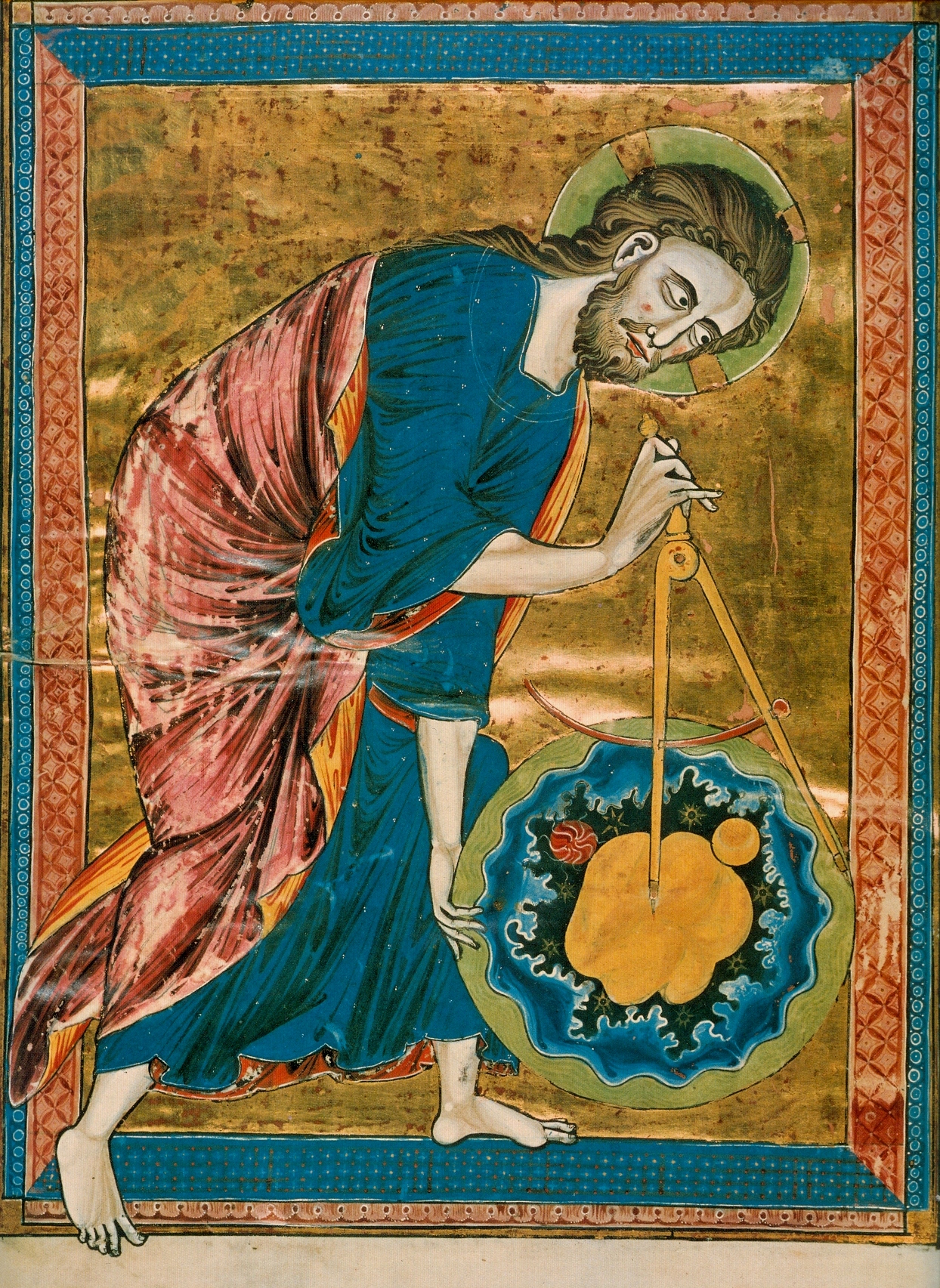
The Gothic cathedral, we have seen, is a model of the cosmos. This Greek word, κόσμος meaning order, harmonious arrangement, or even ornaments, gives us an indication of how the medievals saw the cathedral. The key to cosmic perfection, and thus to the perfection of the cathedral, was geometric proportion. Coming from Pythagoras’ geometry which influenced Plato (in particular his Timaeus, which was one of the few Platonic works known to the early medievals), the writings of St Augustine and Boethius emphasized the harmony of the universe and the ordering of the universe according to perfect Pythagorean proportions and ratios. This was taken up by the Platonic School of Chartres, such that Alan of Lille could say that God was the elegans architectus who constructed the universe and ordered it as the divine geomancer. In this regard, the medievals cited Wisdom 11:20, “You have arranged all things by measure and number and weightâ€. Hence, the cathedral architect who wished to construct a model of the universe had to employ geometry and Pythagorean proportions, so imitating the divine architect who had created the cosmos itself. In this way, the cathedral, with its carefully measured form, was a true symbol of the cosmos. The architect might also have had in mind the Old Testament account of the construction of Solomon’s Temple, for which God himself gave the measures and proportions. So too, the new Temples of God had to follow these proportions; an example of this being done is the Vatican’s Sistine chapel. Therefore, we see in the medieval architect’s love for perfect proportion, a desire for consonance and harmony – one of the ‘requirements’ of beauty – in their work.

The medievals also had a fascination with numerology and sacred numbers, for St Augustine had said that “The Divine Wisdom is reflected in the numbers impressed on all thingsâ€. For example, the number three, of course, was the number of the Trinity and consequently of the soul, and of all spiritual things. Therefore, complex combinations of geometry, perfect ratios, and number symbolism can be found throughout the Gothic cathedral although Mâle warns against making this kind of symbolism too ubiquitous in one’s interpretation of the church. Even so, there are clear instances of an interplay of geometry and beautiful proportions and sacred numbers which we have already mentioned. The façade of Milan cathedral is one such example, which relies on the proportions of the Pythagorean triangle. Even more perfect is Chartres cathedral of which Von Simson notes: “the elevation of Chartres cathedral is the supreme vindication of this philosophy of beauty†based on the perfection of proportions.
However, it is important to note too that the medieval architect’s preoccupation with ordered measurements was not at the expense of structural stability. Indeed, the use of proportion, mathematical ratio and geometry aided the stability and strength of the building, so that one sees in the Gothic cathedral a marriage of beautiful form and structural function, thus giving integrity – another ‘requirement of beauty – to the building. Hence Von Simson said that “architecture that is scientific and good must invariably be based on geometry; unless he obeys the laws of his discipline, the architect must surely fail… And it is taken for granted… that the stability and beauty of an edifice are not distinct values, that they do not obey different laws, but that, on the contrary, both are comprehended in the perfection of geometrical formsâ€. It may be that today we find the medieval ‘obsession’ with Pythagorean geometry and Platonic ideas of cosmic design and arrangement to be somewhat esoteric. However, one cannot argue that these buildings have stood the test of time, being both beautiful and fine structures, thus witnessing to the science, the recta ratio, right reasoning, indeed, that was the foundation of the architect’s art.
Metaphysics of Light
One of the major characteristics of the Gothic cathedral is its soaring height which, compared to the Romanesque church, is flooded with light, often mediated by beautiful stained glass windows aglow with colour. The Sainte Chapelle in Paris, and Chartres cathedral, are two of the most evocative Gothic churches on account of this ‘jewelled reliquary’ quality. St Thomas’ third ‘requirement’ of beauty is claritas, which he qualifies thus: “things are called beautiful which have a bright colourâ€. As such, Von Simson notes that for the medievals “stars, gold and precious stones are called beautiful because of this quality [of luminousity]â€. However, these things are beautiful because of the way they reflect and refract light. Light is of great importance because it is linked to the central notion of vision; light enables us to perceive beauty, and even, in some sense, to see God. As St Thomas says: “corporeal light is necessary as regards external sight, inasmuch as it makes the medium actually transparent, and susceptible of colourâ€. The Angelic Doctor also says that, “The created light is necessary to see the essence of God, not in order to make the essence of God intelligible, which is of itself intelligible, but in order to enable the intellect to understand†and again, “This light is required to see the divine essence, not as a similitude in which God is seen, but as a perfection of the intellect, strengthening it to see Godâ€. Indeed, Blessed Dionysius held that God himself was “an incomprehensible and inaccessible light†and that all creation is an act of divine illumination, so that all things participated in God’s light, and there was a hierarchy of perfection according to the illumination of the thing. Moreover, it seems that light was likened with being, so that for the Areopagite, “if light ceased to shine, all being would vanish into nothingnessâ€. As such, light – who is God – was necessary for the order of the universe, and for its being.

Consequently people like Abbot Suger believed that created light was the best created symbol by which to see and know God, and so he proclaimed: “Bright is the noble edifice that is pervaded by the new lightâ€. The lux nova is both Christ and the physical light that filled his new church, and its brightness is a reference to claritas, and so, to its beauty. Therefore, Von Simson says that “Light and luminous objects, no less than musical consonance, conveyed an insight into the perfection of the cosmos, and a divination of the Creatorâ€. Given such a metaphysics of light, it is no wonder that the Gothic age developed an aesthetics of light that is most beautifully expressed in the Gothic cathedral, for it is by the latter that we come to experience the former. Or as Von Simson put it, “corporeal light [was an] ‘analogy’ to the divine lightâ€. Light is thus a vital element in the Gothic worldview and vision, and it is characteristic of the symbol that is the Gothic cathedral.
Continued in part 4: the Rose Window & Conclusion
- AuthorPosts
- You must be logged in to reply to this topic.


