
reorganisation and destruction of irish catholic churches
- This topic has 7,926 replies, 103 voices, and was last updated 9 years, 4 months ago by
Praxiteles.
- AuthorPosts
- November 24, 2005 at 3:06 am #767414
Paul Clerkin
KeymasterI always photograph the doorways – especially in older churches and cathedrals, the doorways are often incredibly impressive.
November 24, 2005 at 8:44 am #767415Praxiteles
ParticipantHave you got one of Cobh Cathedral with the doors closed and of Fagan’s wrought iron hinges in all their glory?
November 24, 2005 at 12:17 pm #767416MacLeinin
ParticipantThis is the best I can do for the moment.
Baptistry Door. I have put is as an attachment also, as it appears to be very slow appearing on the page.

Main doors
 November 24, 2005 at 2:58 pm #767417Participant
To digress for a moment, encosed is an image of the drawings for the completion of the spire of Cobh Cathedral signed in 1911 by Bishop Robert Browne and the builder, John Maguire. On the right hand side the measurements are included: from the section above the windows to the base of the spire is 72 feet; and from the base of the spire to the base of the cross is 128 feet. To solve the question of the highest spire in Ireland requires merely the hight of the initial base of the spire tower and the hight of the Cross. Any takers?
November 24, 2005 at 3:18 pm #767418ParticipantA small treat for viewers on to-day’s Feast of St. Colman of Cloyne (c.530 -604)
The great West Window of Cobh Cathedral whose subject is the Vision of the Throne of God taken from the Apocalypse of St. John (4:1-11). The subject is Our Lord seated in glory, sourrounded by the elders, clad in white teguments and crowns of gold. Around the throne are the the four living creatures (symbolic of the found evangelists): the lion, the ox, the man, and the soaring eagle. As they cry out Holy Holy Holy is the Lord God Almighty Who was, Who is, and Who is to come , they cast down their crowns before the throne and pay homage to Christ. The inner circle depicts the twelve Apostles. The outer circle depicts the saints in glory.
 November 24, 2005 at 3:49 pm #767419Participant
Remarkably, this is the only image I can find of the West Portal of Cobh Cathedral showing Fagan’s wrought iron work to full effect.
The three figures in the porch are by George Smyth and were installed in 1912-1917.
November 24, 2005 at 8:42 pm #767420ParticipantRe message 192.
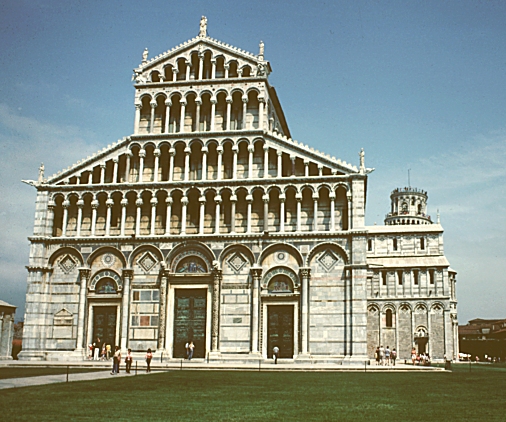
If the the 2003 renovations in Thurles Cathedral involved the installation of what appears to be a copper-pan baptistry in the side aise of the Cathedral, does anyone know what has happened to the free standing Baptistry which is based on Pisa? This is the only example of a free standing external Baptistry in an Irish Cathedral. Is it too much to hope that it is now a potatoe store or trinket shop?
November 25, 2005 at 1:36 am #767421Participant@Praxiteles wrote:
Does anybody know who the architects for the 1979 reordering of Thurles Cathedral were?
Is it not Prof. O’Neill who is responsible for Thurles? ]http://www.cashel-emly.ie/gallery/galleries/Cathedral%20of%20the%20Assumption/cathedral5.jpg[/IMG]
The green hued bottled aumbry is perhaps too suggestive of Biddy Early!!!! :rolleyes:
November 25, 2005 at 1:46 am #767422ParticipantPerhaps “three cascades of perlucid yellow……”
(pace Samuel Beckett, Murphy )
November 25, 2005 at 2:01 am #767423Gianlorenzo
ParticipantMore for Mosaic 1.
Some details of the Oppenheimer Mosaic’s in St. Colman’s.
1. Medallion on Predella in front of Pieta Chapel.
2, Detail of floor in Blessed Thaddeus Chapel
3. Detail of floor in Our Lady’s Chapel
4. Detail of floor in Sacred Heart Chapel
5. Detail of mosaic in Sacred Heart shrine.November 25, 2005 at 2:02 am #767424ParticipantOne final pic for Mosaic 1
Medallion on Predella in front of Sacred Heart Chapel
November 26, 2005 at 4:52 pm #767425ParticipantOnly came across this last night. Story in last Sunday’s Times concerning yet another ‘renovation’ to St. Mary’s Pro Cathedral. Maybe someone should suggest that they put in a hydraulic lift under the Cathedra eliminating in future the need for further readjustment. :rolleyes: 😀 :rolleyes:
http://www.timesonline.co.uk/article/0,,2091-1880124,00.html
November 26, 2005 at 5:20 pm #767426ParticipantRe hydraulic lift under the Pro Cathedral throne, I think that would be a wonderful idea and a very cost effective means of dealing with the declining or rising stature of the Dublin Archbishops. Looking at the fine job Cathal O’Neill did with the foot-bridge over the Dublin – Belfast railway line at Drogheda railway station with its dignified, symetrical and elegantly proportioned steel-cased lifts, I cannot think of a better person than himself to deal with this unexpected side-effect of his ruination of the sanctuary in the Pro-Cathedral.
Somebody, however, should tell the administrator of the Pro Cathedral that canopies, if not original or of artistic value, are not allowed by the post Vatican II liturgical rules. Even if a canopy were allowed, the colour should be an “ecclesiastical” colour (that is either red or green) and not some piece of raggady tribal totemism. After all, the Archdiocese of Dublin also includes the diocese of Glandalough – that is, large areas of Wicklow, Kildare, Carlow, Laois and even Wexford. The positioning of the Dublin colours overhead the present Archbishop does not seem to demonstrate much of the kind of diplomatic souplesse normally associated with major practioners of that particular art, such as the Cardinal D’Ossat, but perhaps gives the impression of a not too unconscious retreat to the Danborg and Dublin’s foreign ecclesiastical roots.
November 26, 2005 at 6:33 pm #767427Peter Parler
ParticipantThanks, Colman (#212), for that Sunday Times reference. It is consoling to note the interest of the foreign press in our predicament. And it is important not to miss the good news about the Dublin Pro-Cathedral: “The renovations yielded a surprise when workers came across the original sanctuary lamp of the cathedral, which has now been restored to its former glory.” That is clearly a luminous sign. But can anyone explain to us the ongoing significance of “The Pro”? Does it mean that they are still hoping to re-possess Saint Patrick’s Cathedral? And should we be grateful to Almighty God that they haven’t, as yet?
November 26, 2005 at 7:03 pm #767428ParticipantRe the former sanctuary lamp serendipidously happend on in the choristers’ gallery in the Pro- Cathedral in Dublin, I just happened to notice that in the photographs posted in # 149 there is no trace of a hanging sanctuary lamp. Since most of the sanctuary seem to be under the cupola, it is difficult see whence it could be hung – if not from the lantern of the cupola. The Lawrence collection photograph in #184 (taken last decade of the 19th century) does not show a hanging sanctuary lamp. Curiously, the 1847 print from the London Illustrated News showing the obsequies of Daniel O’Connell in the Pro-Cathedral does depict a hanging sanctuary lamp. Is it possible, if the depiction is accurate, that this was removed sometime between 1847 and 1890? In the event that it was this is an interseting discovery. But, having restored it, what are they going to do with it?
November 26, 2005 at 9:33 pm #767429ParticipantI add a picture of the magnificent Sanctuary Lamp of the Honan Chapel in Cork. It was commissioned by the Rev. Sir John O’Connell, to the glory of God, in memory of the Honan benefactors. It was designed by William Alphonsus Scott, first Professor of Architecture in the NUI, and executed by Edmond Johnson of Dublin.
The Sanctuary Lamp weighed 28 lbs. in sterling and consisted of a bowl of open-work interlace decoration embellished with blue enamel studs. It was suspended on chains.
Despite the dedicatory inscription which did not envisage the lamp being moved anywhere, it disappeared during the unfortunate (but reversable) 1980s re-ordering of the Honan Chapel. There is no liturgical justification for its removal. When placed in the Chapel in 1916, it was so placed in accordance with liturgical norm which found its way into the first Code of Canon Law published in 1917. The text of the 1917 canon on sanctuary lamps was transcribed practically verbatim into the 1983 Code of Canon Law which currently governs the positioning of sanctuary lamps. The assertion that the liturgical reform of Vatican II required the removal of the Sanctuary Lamp from the Honan Chapel is not only misleading but is positively mendacious.
The real reason for this bit of vandalism, I suspect, is to be found in an article by Gearoid O Suilleabhan entitled The re-ordering of the Honan Chapel in Verginia Teehan and Elizabeth Wincott-Heckett’s otherwise excellent monograph on the Collegiate Chapel The Honan Chapel: A golden vision , published in 2004 by Cork University Press. G. O Suilleabhan, aided by Richard Hurley and Vincent Ryan, reproduces a scanty potted version of the history of the Latin Rite for the past 2000 years. What is not mentioned, however, is that the historography employed in this potted history is that patronized by Odo Cassell and, the more notorious, Annibale Bugnini. This particular school posits a three fold division of the history of the liturgy: a primitive period: the golden age reached under Gregory the Great (d. 604); and a period of decline and degradation from the 7th century. In this school, the reform of the liturgy is seen in terms of an almost archeological restoration of the liturgy as celebrated at the time of Gregory the Great and a total jettisoning of any thing or practice to have arisen after that period. G. O Suilleabhan fails to tell us that this school of liturgical historiography was never completely accepted and has been even more eclipsed – if not indeed discredited- in liturgical research, especially over the past twent years. Alternative historical approaches, such as that advocated by Dom Alquin Reid, OSB, emphasise the continuity and organic development of the liturgy over a long period of time. That organic development sees the gradual emergence of new things and the demise of old things but excludes the kind of brutal caesura imposed on many Cathedrals and churches throughout the English speaking world in the name of the liturgical reforms of Vatican II.
I understand that plans are afoot to restore J.G. Mac Gloughlin’s grille to the west door of the Collegiate Chapel. Could it be too much to hope that such an important element in the decorative scheme of the Honan Chapel as the Sanctuary Lamp could not also be restored to its proper position.
I also include a picture of the High Altar of the chapel and would draw your attenton to the red altar light which is sitting on the mensa of the altar. It is surprising that the liturgists responsible for the removal of the Sanctuary Lamp (which should contain the light) did not seem to know that liturgical norms specifically prohibit placing anything of the like on an altar.
November 26, 2005 at 11:17 pm #767430ParticipantThe Cathedral of Santa Maria Assunta in Pisa (1063-1350) prototype for the Cathedral of the Assumption, Thurles.
 November 26, 2005 at 11:42 pm #767431Participant
The external Baptistry in Pisa
November 26, 2005 at 11:55 pm #767432ParticipantGreat photos Praxiteles 😀
November 26, 2005 at 11:57 pm #767433Participant@Peter Parler wrote:
Thanks, Colman (#212), for that Sunday Times reference. It is consoling to note the interest of the foreign press in our predicament. And it is important not to miss the good news about the Dublin Pro-Cathedral: “The renovations yielded a surprise when workers came across the original sanctuary lamp of the cathedral, which has now been restored to its former glory.” That is clearly a luminous sign. But can anyone explain to us the ongoing significance of “The Pro”? Does it mean that they are still hoping to re-possess Saint Patrick’s Cathedral? And should we be grateful to Almighty God that they haven’t, as yet?
Absolutely!! 😉
- AuthorPosts
- You must be logged in to reply to this topic.


