
Irish say no to PVC windows
- This topic has 340 replies, 64 voices, and was last updated 16 years, 1 month ago by
GrahamH.
- AuthorPosts
- May 11, 2007 at 3:00 am #744979
GrahamH
ParticipantIn Cork, Grants on Patrick’s Street was also built with slim line steel windows in the 1920s.

While one of the most elegant uses of that period was surely Manfield Chambers on Lower O’Connell Street in Dublin, with its gracious pivoting casements still surviving on some of the floors from c.1917-18, now also featuring secondary timber-framed glazing.
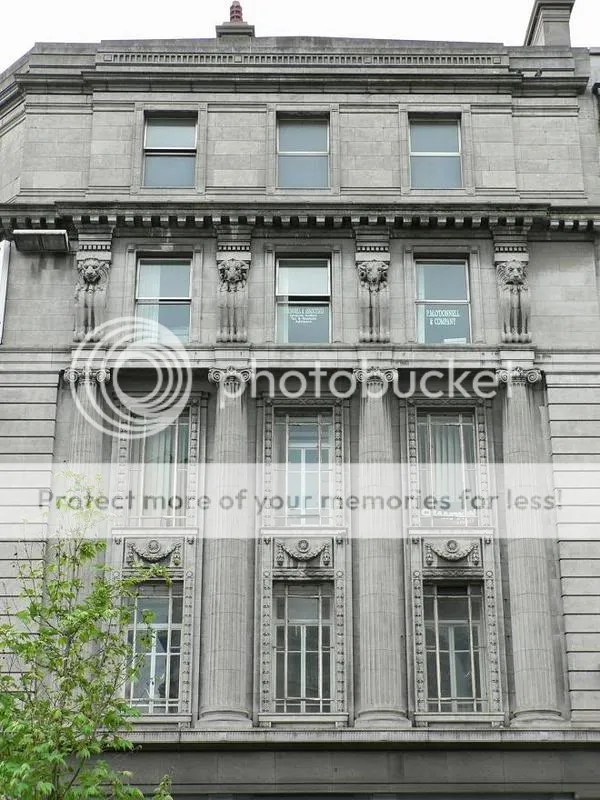
Alas the uppermost steels, in a similar style to those below, were removed around the 1970s.


More survive across the road from 1920.

The largest use of them, possibly in the country at that time for a commercial application, was in the rebuilding the Gresham Hotel c.1926-29. Alas none but the magnificent ground floor frames survive today, the upper floors having been replaced with aluminium about thirty years ago.
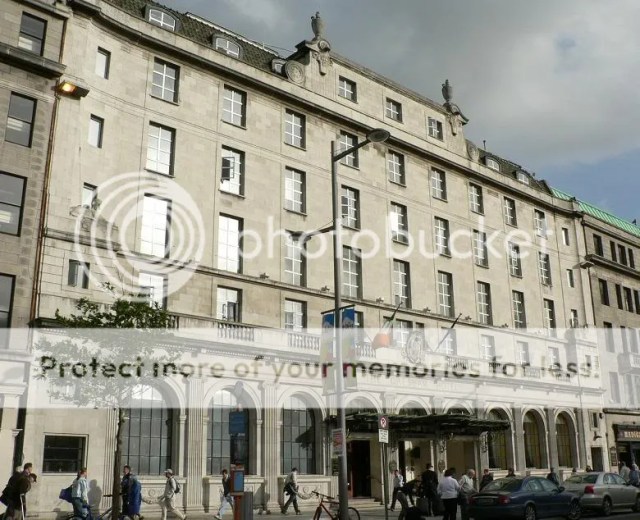

What grand survivors – thankfully they simply would have been too expensive to replace, and with little practical gain being in a public area.
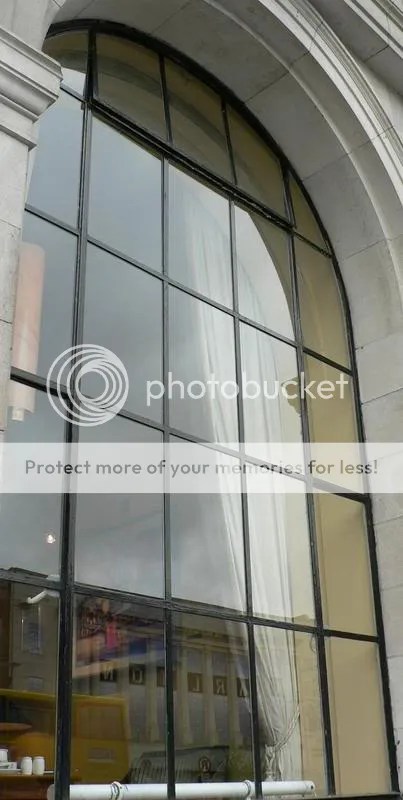
The top-opening lights are barely noticable, while they also feature beautiful hot-rolled latches.

Unbelieveably they seem to have been painted blue at one stage!
Charming diminutive rectangles also survive to either end of the main façade.
 May 11, 2007 at 3:07 am #744980Participant
In their most recent planning application, the Grssham proposed the reinstatement of all original steel frames to the O’Connell Street elevation – what a dramatic lift it would make for. Here it is in all its original steel-windowed glory in the 1940s, with balcony still intact.

It looks stunning with the windows painted black too.
In the mid-1930s, the Pearl Insurance building that’s now part of the Westin Hotel on Westmoreland Street also made use of steel frames in its elegant neoclassical elevations, probably the starkest contrast in architecture and window design yet used in the capital.


It appears these were restored in the c.2000 conversion with weather-stripping and new handles, while secondary white aluminum glazing was inserted to the interior.

A contemporaneous use of the material would also be the Dr. Quirkey’s building on Upper O’Connell Street.


A typical light industrial use would be this building on Great Strand Street, near the Lotts, with a highly curious timber shingle façade.

The steel frames add an elegant lightness of touch even to a surly building such as this.
 May 11, 2007 at 3:15 am #744981Participant
But of course it is not the grand neoclassical buildings of the 1920s that are at risk of losing their steel windows, now being so prized as icons of their age – rather it is the average residential street that is being left bereft of one of their most striking features thanks to a merciless obsession with thoughtless window replacement in this country. ‘Getting the windows done’ is as hot a topic of conversation as the market for their host properties is. It’s a pity so much hot air couldn’t be diverted into the sensitive appraisal of the various options available.
As we’ve seen, steel emerged as a major alternative to timber in the 1920s and 1930s, but it didn’t really catch on for typical developer-driven residential applications in the suburbs until around 1950, when metal supplies returned to normal after the war. Previously its residential use in Ireland was largely confined to one-off modernist houses of the 1930s, unlike in the UK where developers were already widely using the material. It was only in the late 1930s that it began to take off here, by which stage the war had kicked in and supplies quickly dried up. It is these average suburban houses that are so at risk from losing their most interesting features to vastly inferior and insensitive replacements.
As pictured at the start, this is now a highly unusual scene in an Irish suburb – one would be very hard-pressed to see this replicated anywhere else.
@Devin wrote:

Indeed even by modern window standards, on uniformity alone, it is highly unusual to experience such a pleasing coherent streetscape.
I have been able to take some images up-close of some typical steel frames in an average suburban house built in 1951, and in spite of their poor (and fixable) condition, their beauty still shines through. One of the greatest ‘image’ problems that steel windows have is their tendency to be associated with old-fashioned homes, décor and net curtains. Stripping these aside reveals a wonderful clarity of design and proportion.

And for once you can now appreciate their slim and elegant profiles, and indeed the original imperfections of the drawn glass.

A typical 1950’s toilet/washroom division, with stippled glass.

No doubt many a football has gone through the panes, hence the patchwork appearance.
Inside the silhouette is striking – what a beautiful feature for any room. How could anyone even contemplate five inch plastic bars, and patronisingly toy-like moulded handles?

And of course, the handles: elegantly crafted and a joy to look at and use. Almost icons in themselves.


Also attractively moulded support arms.

And of course typical casement armatures]http://img.photobucket.com/albums/v219/Dublin1/Dublin%20Archiseek/Steel%20Windows/SuburbanHouseSteel6.jpg[/IMG]
 May 11, 2007 at 3:20 am #744982Participant
Indeed here is one of Hope’s advertisements from 1958, extolling their experience through their fit-out of a major state office building outside Birmingham.

Presumably most steel frames were imported to Ireland.
The casements extend outwards so beautifully – strong but light, they allow almost uninterrupted views and a flood of light into the room.

They are supported on trademark external hinges that protrude to the sides of the frame, here seen on a bay window.

Top-opening lights also feature external hinges, however all opening parts are remarkably discreet as a result.

A charming feature of these windows is the consideration of the 1950’s housewife and her net curtains – you can see these studs have been provided to support the lines 🙂

Of course steel windows are not without their problems – indeed these frames suffer from various structural problems that essentially make them unusable anymore. As one might imagine, the armatures have seized up in places, while the casements and top lights are now so tight as to make opening or closing them a near impossibility. It took two hands and half my body weight to open the above casement, and about five minutes to close it again! Ironically they offer fantastic security as they ‘mature’! There’s also substantial degrading paintwork, and extensive rusting to the interior due to condensation. These windows were not galvanized. The joys of period steel frames.

 May 11, 2007 at 3:23 am #744983Participant
It’s no wonder people want the quick-fix solution, as Devin has shown us.
@Devin wrote:


Steel doors were also unusual in Ireland, and yet these are also being replaced with horrendous PVC in a piecemeal fashion in the Mespil House complex in Dublin.
@Devin wrote:

Here a c.1960 house in Whitehall has retained its elegant steel frames, while the house next door has replaced them with, it has to be said, relatively unoffensive aluminium, as the grid pattern has been maintained.


This was the most favoured replacement material for steel until the 1980s – not having to paint anymore was viewed as its greatest incentive, even though thermal efficiency was equally poor.
Unfortunately the biggest problem in Ireland is that there doesn’t seem to be anybody who produces or restores steel windows anymore, or even that specialises in them as part of wider metalworking. And because that type of service isn’t in the public consciousness (goodness knows even timber’s having a hard time of it), these frames simply get dumped, deemed to be old-fashioned, inefficient, and irreparable. Which is not the case.
There are a number of large firms operating in a nationwide basis in the UK that design, produce, install and restore steel windows; indeed some are the same firms that operated in the early 20th century, notably Crittall and Clement, which are still going strong today. There is an enormous steel window restoration industry in the UK, catering for the vast ageing stock of the 20th century housing boom – by contrast it’s as good as non-existent in Ireland. Indeed such is the level of restoration taking place in the UK, coupled with the renewed demand for steel windows in commercial structures and new-build residential today, business is as good as ever.
Restoration of steel frames like those pictured above entails removing them to the workshop, the stripping back of old putty and paint, brushing or pickling off of rust which usually appears much worse than it is, the welding of replacement parts if necessary, hot-dip galvanizing to protect from rust, and then coating with a polyester powder which comes in a variety of colours and finishes, and usually lasts 15-20 years. The windows can be painted as normal thereafter. This whole process is much cheaper and obviously more environmentally sound than replacement with new steels, or even PVC. Some period steel frames can also be double-glazed, and of course all can be weather-stripped. All newly made steel reproductions can be double-glazed to a minimum of 14mm, with impressive U-values provided gas-filled cavities and low-E glass is used.
May 11, 2007 at 3:29 am #744984ParticipantAn example of a double-glaze retrofit in Ireland is the former Dunlop factory on Upper Stephen Street in Dublin, recently refurbished as Dunnes Stores’ new headquarters.

It has a magnificent array of industrial steel frames from when the building was built around 1930.


As can be seen, its elegant glazing bars have been fitted with double-glazed panels to make them more efficient.

They appear to be 14-16mm units.

And not notable from even a moderate distance.


A job exceptionally well done. One would wonder if these were refurbished in this country at all…
Even the Department of Environment’s Architectural Heritage Protection Guidelines make but a passing reference to steel windows in a small paragraph, and with a single clichéd photograph of the former Department of Industry and Commerce building on Kildare Street as an example, out of the hundreds of timber window pictures in the document.So it is possible to restore and/or cast replicas of steel windows, as well as update many to modern-day requirements. The two biggest UK firms, Crittall and Clements still make and restore them, and have excellent websites, amonst others.
http://www.clementwg.co.uk/home/
http://www.crittall-windows.co.uk/menu.html
http://www.re-view.biz/restoration-steel.htmlCrittall sent over their brochure to me, and they make some really beautiful stuff. A pity they’ve no distributer in Ireland. It would appear they have since absorbed Hope’s too.
If there are restorers in Ireland, it’s a pity they wouldn’t make themselves a little more known. Our steel window heritage doesn’t have that much time left.
 May 11, 2007 at 10:14 pm #744985
mackers
Participant@GrahamH wrote:
Great stuff as always, Graham.
I clearly haven’t appreciated the impact of ‘the winders’ to even modest suburbia – how a well-proportioned, even handsome semi-d like this can be transformed so dramatically into something so ugly! 😮
Surely this is a case for mandatory planning permission for window frame changes?
May 17, 2007 at 9:17 pm #744986niamhy0101
Participanthi my family are doing up our grandparents house and are trying to get me to agree on aluminium sash windows because apparently “there’s nobody around anymore with the skill to restore or make new decent timber ones”. if anyone can give me a name or number of a decent company around leinster who can do the job it would be greatly appreciated. thanks
May 20, 2007 at 3:59 am #744987ParticipantHi Niamh – from the sound of things, you already know that it’s very possible to get timber windows restored or replaced, and possibly cheaper than total replacement, so no need to persuade you there.
The Irish Georgian Society has a list of experienced joiners on their site. It may seem terribly posh and conservation-focused, but these are all ordinary joiners, many of which do standard carpentry as well as more specialised work. I’d imagine most would be versed in the restoration of windows. If you rang the IGS, they may be able to guide you more specifically.
http://www.igs.ie/register/index.html
Sash Windows Ireland seem to be the biggest restorers nationally, though they don’t endear themselves to me with their promotion of PVC use in old buildings.
http://www.sashwindows.ie/restoration.html
Marvin Architectural are another – don’t know as to their quality.
http://www.marvin-architectural.com/owner/home.html
This post by cobalt is very helpful – it lists many.
https://archiseek.com/content/showpost.php?p=40015&postcount=136
There’s also the Yellow Pages – you’d be surprised…
May 30, 2007 at 1:30 pm #744988Conserve A Sash
ParticipantHi Niamh,
We replace and renovate sash windows across Munster. We have an excellent reputation and have a website for you to check out. http://www.conserveasash.com – it is being updated soon with a bigger gallery and detailed out line of our renovation service. Our range of work includes domestic to protected structures. Drop me an email if you have any questions.
August 6, 2007 at 1:08 am #744989Participant6/8/2007
I’m not sure if this is more suited to the Dundalk thread, but this thread seems to be increasingly covering vernacular stock as well as windows, so is perhaps more apt.
Up until recently, this delightful relic of times past stood picturesquely derelict on Church Street in Dundalk, leading into the main street of the town. A late 18th century merchant’s townhouse, it was clearly modifed around 1900 to accommodate a retail premises, with elegant timber shopfront added and its Georgian sash windows replaced with more fashionable plate.

The fast-disappearing soft pink paint also a distinctive remnant of 1930’s vernacular decorative treatment.

It suffered a small fire recently – all round a great opportunity for sensitive restoration.
Only, this is what it looked like during the works.

And completed as of a few weeks ago.

The late Victorian plate replaced with mock-Georgian sashes, and a hideous boxy plywood concoction tacked onto the ground floor.

What a monstrous contrivance. On a protected structure, in an ACA!
Similarly, the delightful Edwardian shopfront has received equally ridiculous ‘heritage’ treatment, with B&Q mouldings Pritt Sticked about its facade. They look even more incongruous in real life.

There were three sensitive options for this development: 1) Leave the ground floor residential window as it was, 2) Install a matching timber shopfront to that of the 1900 model on the other side, or 3) Install a decent contemporary interpretation. Instead we got the worst of all worlds – a typical developer piece of rubbish that compromises the entire building.
Similarly, why were the Victorian plates just dumped? Why ditch one aspect of the building’s history and retain another (shopfront)? Indeed if nothing else, the plate would at least have offered the opportunity for efficient double glazing. Instead, we have historically inaccurate, single-glazed, rubbishy mock-Georgian sashes in their place.

While decent enough from afar, if a tad chunky for the 1780s…

…up close they’re cheaply and clunkily beaded.
 August 6, 2007 at 1:22 am #744990Participant
And already falling apart.

What pray tell, is the logic of these yokes?
What was once an intriguing, readable, well-proportioned vernacualar building is now just another piece of developer tat, smothered in yet more ubiqutous slurry of yellow paint. And how crass is the colour of the shopfronts.
As if to confirm the superficiality of the whole restoration, the chimney stack and degenerating roof have received no attention – the first on the list of any decent job.

It’s a shame to have to be negative on this, but really – there are so few elements to get right with a classical vernaular, and they’ve failed on all fronts. Even when protected and ACA listed.
I see An Taisce submitted on the application – can’t see what it says online.Just around the corner in a separate development we have this plastic delight installed in a rubble stone warehouse conversion :rolleyes:

Nonetheless Dundalk, like many towns, is a treasure trove of vernacular design – it has street upon street of the most amazing period housing stock with original features. They’re so exciting to explore, and many are impressively ACA-protected, even if this means little on the ground.
Just look at this wee fella round the corner from the above development 🙂

It’s like a wendy house, with the most fantastic fenestration! There’s so much of this type of domestic architecture in the town. Alas I’d no choice to photograph it given it’s up for sale – those sashes are quite likely for the chop 🙁
And located in a delightful pair of cottages, the neighbouring one featuring once uber-cool early plate.

Lovely roofscape too.
August 6, 2007 at 1:42 am #744991ParticipantThe neighbouring house has beautifully maintained sashes, sadly such a rarity in Irish towns.

Around the side it has a classic Edwardian ‘seaside sash’ on the staircase – these are quite common in this area, as it’s near a river.

They tend to be more popular near water for some reason; maybe it’s just the Edwardian tendency to build near water lol. Nice bit of cylinder in there for the nerds amongst us. *whistles*

A grand late-Victorian streetscape nearby – lots of original features.

Magnificent windows in a delighful corner building on Chapel Street – what survivors! The ‘grand’ public facade to the street has later plate installed in the original sashes 🙂

Across the road, another amazing step back to the early 20th century. A lovely Victorian in the classic ‘Dublin style’.

And for what its worth, nearby, an incredibly enormous chinmey atop a miniscule vernacular terrace. What on earth?!

Surely a bakery orginally.

It’s sights like these that make Irish towns a joy to visit 🙂
August 12, 2007 at 8:14 am #744992Devin
ParticipantThe sooner we get to the end of this page the better! There are so many images on it now that it even hops around for several minutes with broadband!
[align=center:atm03jkz]~~~~~~~~~~~~~[/align:atm03jkz]
@GrahamH wrote:
The late Victorian plate replaced with mock-Georgian sashes, and a hideous boxy plywood concoction tacked onto the ground floor.
This is a big problem –]http://img169.imageshack.us/img169/131/deanstterraceqb5.jpg[/IMG]
Circa 2003 photo of No. 4 Dean Street (on the left), one of a group of three unlisted late Georgians opposite St. Patrick’s Cathedral, and the last one with original sash windows remaining.

During a recent refurbishment, the remains of an older shopfront was uncovered.

But sadly neither the old shopfront nor sashes with old glass were repaired and here is the finished job, with new, badly-detailed ‘traditional’ shopfront and sash windows, both in gic brown 🙁

Just as an example of the inconsistency of the Dublin Record of Protected Structures, there is another group of 3 houses – occupied by our friend Spar – adjacent to the Dean Street ones on Patrick Street (on the left, above), probably dating to the same time (the yellowey brickwork is due to a recent over-zealous cleaning). These groups of houses would’ve been built in the early 19th century to improve the setting of the cathedral.
But the Patrick Street ones are Protected Structures yet the Dean Street ones are not!
December 10, 2007 at 7:37 pm #744993Participant…………… Filling up the last post to avoid yet more images on this page ………
December 10, 2007 at 10:14 pm #744994ParticipantCould Ireland be finally getting sick of the white glare of PVC? A building on John’s Bridge in Kilkenny was seen recently either painting its white PVC windows brown, or replacing them with the same windows (of equally awful design) in brown:

 December 11, 2007 at 6:12 pm #744995
djasmith
ParticipantAh what a fantastic thread!!!! Im sorry to say Ive only discovered it now! I was reading through the first couple of pages when I thought Id have to have a rant in defence of Dublins council houses – but Devin has saved me the trouble and taken some fabulous photos of them – almost all within 5 minutes walking distance of my house too!
As Ive said in previous threads, my fascination is with the Council houses of Dublin. Ive done a lot of ‘noticing’ of both windows and chimneys (for another day) lately and Im delighted to see this thread! I know of almost every house in my side of South Dublin with original windows and front doors (also for another day because some of them are amazing).
Theres also a beautiful house up on myhome.ie at the moment in perrystown with all original windows etc. Its a house Id love to buy its got all its iron windows, and its completely original inside, all except for an aluminium front porch door. Its the type of house that should be preserved – tis like stepping back into a scene from a 60’s movie. Unfortunately this house will be gutted and redesigned to modern standards by whoever buys it which is an awful pity. But thats the celtic tiger for ya!
here’s the link:
http://www.myhome.ie/search/property.asp?id=DIIXN336231&np=&rt=search&searchlist=
I must start taking pictures of houses around now before they’re all gone! There’s been a couple of awful changes one in particular on whitehall road just last week. Beautiful painted red wooden windows in a lovely bungaloe ripped out and replaced with modern PVC’s.
Also on the note of PVC’s – there’s been a lot of attempts at replicas of the original wooden windows around Crumlin and they just dont work… Bring in a grant to restore the originals please please please!!!!
Dave.
(strange 17 year old who looks at houses)December 13, 2007 at 11:03 pm #744996ParticipantTis depressing, dja!
On a good note, I see the NIAH have recently added some more counties to their database – NIAH County Survey Index . It’s looking good now, with a sizeable chunk of the country covered. So well done boys & girls at the NIAH!
[align=center:1a9fxxwg]~~~~~[/align:1a9fxxwg]
Pictures (above) from the NIAH’s site of the Clarence Hotel in Sligo in all its Irish-town-white-flapping-plastic-windows-in-Georgian-stone-façade glory. (More Images)
But the building has just been refurbished (below), as part of which they had to remove the plastic and restore timber sashes – yayyyy!! It makes me so happy 🙂 Such an improvement, and a little victory over the plastic window, hoh!!!

 December 30, 2007 at 4:33 pm #744997Participant
Oh I didn’t see this – great news!
I suppose they were Victorian plate before being replaced, so it’s apt that it goes back in. Just a shame modern glass is so very reflective – you end up with mirrored expanses of grey sky rather than deep black voids, but hey, can’t have everything. Good to see progress being made.Alas a rare surviving semi-d composition bites the dust on St. Mary’s Road opposite the Crumlin Hospital 🙁
Before

After

You can’t really appreciate it here, but the replacement frame is particularly horrific to the ground floor.
While around the corner near the village, this wonderful house is the second last steel-windowed property on a road of over 80 houses, representing a surviving stock of around 5%.


It has just gone up for sale…
Great typically solid Dublin house out Castleknock way. The garage must have been an early conversion!

Beautifully maintained example in Rathgar.
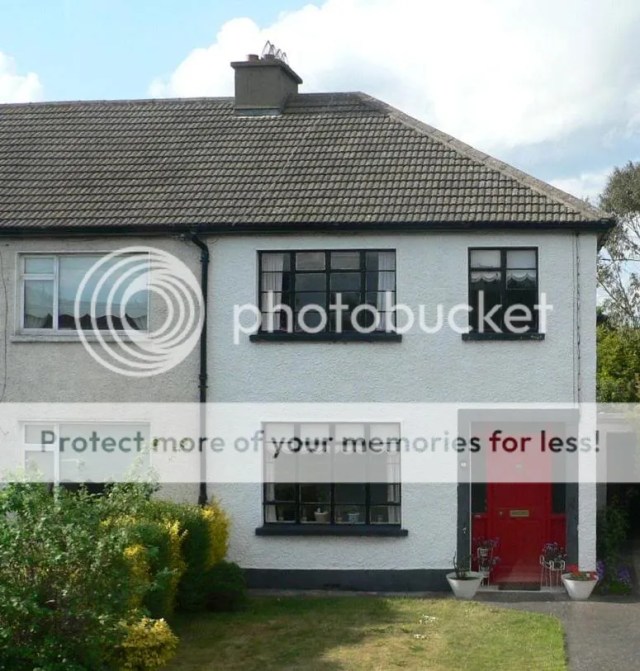
And a pair of others nearby.


Finally a Corpo house with original joinery. Shock!
 January 4, 2008 at 3:58 pm #744998
Ro1027
ParticipantSTEEL WINDOWS are my motivation for joining this discussion group! I’ve been ‘lurking’ on this thread for over a year, totally agreeing with the horror expressed about inappropriate PVC windows, but mostly looking for info on restoring/maintaining 1960s steel windows. I’ve inherited a 60s semi in Dublin and I want to keep the facade as it was when built, which means keeping the extremely chilly steel windows [ice on the inside of the window of my bedroom is my ‘Angela’s Ashes/We were so poor..’ trump card:o], and installing secondary glazing.
I was hoping someone in this thread had come across a company or tradesperson who could do a good job of restoring and painting steel windowframes. I haven’t seen any such recommendation, and so I’m putting a request out there.
Also, not many window companies seem to do secondary glazing, and the one quote I had was very expensive.
Any leads on either of these problems would be much appreciated, and you can bask in the knowledge that you may have helped save an endangered species: the suburban steel window! - AuthorPosts


- You must be logged in to reply to this topic.


