
Irish say no to PVC windows
- This topic has 340 replies, 64 voices, and was last updated 16 years, 1 month ago by
GrahamH.
- AuthorPosts
- April 14, 2006 at 5:49 am #744899
GrahamH
ParticipantSome of the Trinity windows below. The majority of the West Front’s old panes, certainly in the non-restored windows, seem to be an early form of cylinder glass, with that typical wrinkled and warped texture like the skin that forms on hot milk:
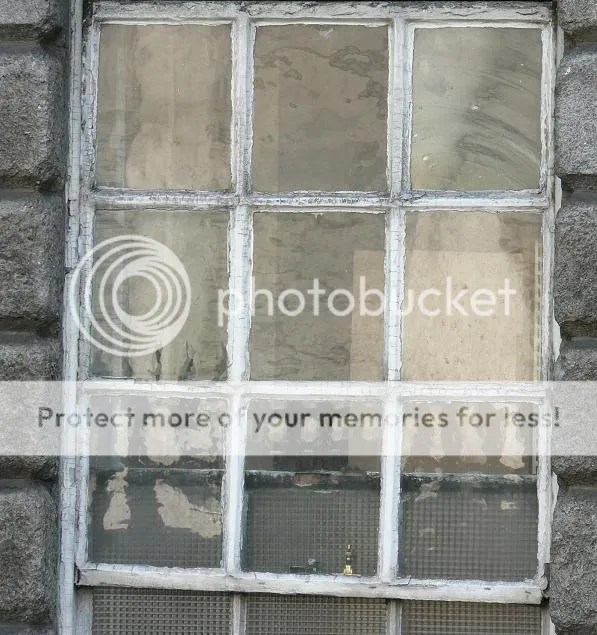
The only pane of 1750s crown glass above is that in the very top right corner with the very apparent swirls.
The crown glass featured in ‘The Legacy of Light’ seems to be the exception rather than the rule right across the entire 1750s Parliament Square complex incl the West Front. Many non-restored windows also appear to feature quite an amount of modern glass too, though it’s difficult to say how much such was the light at the time. This un-restored W F window seems to feature nearly all modern glass, with only two single panes of cylinder in opposing corners:

Otherwise though, un-restored windows with lots of modern glass do not seem to be that common.
This restored window on the W F features entirely modern glass which is very wavy in appearance, with the exception of a single surviving cylinder pane in the lower sash.

All of the other few windows that have been restored here so far also seem to feature lots of this strange glass. I don’t know if it was here before the restoration. Here’s another example, though this time a lot more cylinder:

Moving inside to the Front Square and the northern block, and again a mixture of cylinder and modern wavy stuff in this restored window:

Pretty much all of these windows in the northern wing feature exactly the same mixture of modern wavy and old cyclinder. No evidence of crown at all. Many of the upper windows in the northern block also feature 1830s horns which might explain the early cylinder in the older sashes below such as that pictured.
So all in all, a difficult one to call without examining all the glass exceptionally closely. There appears to be a difference between very flat modern glass in some windows and more wavy modern glass in others as pictured. If this difference could be confirmed, and the wavy glass distinguished as being only in restored sashes, then there could well be something fishy going on. Either way that wavy modern stuff isn’t very attractive – gives the impression of bendy plastic sheeting. Still, it does seem all of this was there before the restoration, and in the windows I looked at I didn’t come across any really dodgy stuff like that you pictured Devin.
Admittedly crown can look like plastic too in certain light – here’s some lovely stuff surviving high up in the side elevation of the Chapel. Note the blatently modern pane in the top left and the cylinder pane in the bottom left:

Also some stunning cylinder above the central doorway of the northern block:
April 14, 2006 at 5:24 pm #744900urbanisto
ParticipantYou guys amaze me sometimes with your knowledge of something as obscure (pardon the pun) as glass. I would never have imagined that the subject could be so complex. I think its would certainly be worth while contacting the Heritage Officer at DCC regarding this. It certainly woldnt be the average planners highest priority when assessing works such as these but I accept that the glass should be retained as much as is possible. Well done for opening a window onto the subject :rolleyes:
April 15, 2006 at 7:06 am #744901Devin
Participant@Graham Hickey wrote:
Some of the Trinity windows below. The majority of the West Front’s old panes, certainly in the non-restored windows, seem to be an early form of cylinder glass, with that typical wrinkled and warped texture like the skin that forms on hot milk:
Yes, most of the remaining old glass in the not-yet-restored windows of the West Front (and its rear, and the east block) is cylinder, with a lesser amount of crown – not surprising as it is a much older method than cylinder.
It would be tragic to lose all of this, but, imo on the evidence of the restored northern block, that’s exactly what’s going to happen unless the situation is intervened upon.(As you say some windows don’t have that much old glass – just a couple of panes – but overall there is a fair bit left, especially in the upper floors.)
Moving inside to the Front Square and the northern block, and again a mixture of cylinder and modern wavy stuff in this restored window:
I can’t agree with you here Graham. As far as I would be concerned the ‘cylinder’ you refer to is ‘fake old’ glass. It’s some type of agricultural glass, used perhaps for greenhouses and the like. It is used because it looks a bit like cylinder glass. It is just rippley]very odd [/I]pane of genuine cylinder seems to be surviving the restoration (there is one in the middle right of the above pic), but certainly none of the rare and more valuable crown.
I’m pretty sure the ‘wavy modern’ or ‘bendy plastic sheeting’ (good description!) glass – which makes up the majority of glass in the restored windows – is also new; it looks new and it doesn’t seem to exist in any of the not-yet-restored windows. As you hint, perhaps it is intended as a (crap) imitation of crown glass?

This also, as far as I would be concerned, is the ‘fake old’ glass.
[align=center:172goc4d]~~~~~~~~~~~~~~~~~~~[/align:172goc4d]
So, in short (I think), all of the former very-flat-modern / cylinder / crown glass of Trinity’s windows is being replaced with a combination of wavy-modern and fake-old glass, with maybe a very small amount of genuine old being saved and reinstated.
The reason for this I reckon is – just like so many things in Dublin at the moment – a need for speed … the number of windows to do versus the contract deadline; when they’re dipping the windows, removing the paint, splicing in new wood etc. it would just take too long to remove the old glass without breaking it … easier to just knock it all out and put new glass in when the work on the sash frame is complete …
The job is proceeding apace. As I said earlier, having completed the northern block, they’ve now moved onto the southern block, and in the last couple of days, a load of sashes have come out of the 2nd floor of the square facade to be taken away for ‘restoration’.
I’ve spoken to the DCC Conservation Officer and also a DoE conservation official and the situation is going to be investigated on Tuesday. Will update.
April 15, 2006 at 8:16 pm #744902ParticipantGood news – thanks.
So all in all there’s five types of glass in question here:
. Swirly crown – easily distinguished 1750s glass
. Highly dimpled cylinder – appears to be original, but later
. Modestly dimpled cylinder – questionable provenance, may be mock-historic, may be later again cylinder
. Flat modern glass – probably from the 1960s
. Wavy modern glass – questionable when it was installedRegarding the cylinder, as you see it Devin the more modest stuff is replacement mock-historic glass installed post-restoration. I’m not so sure – as we have seen, the quality of cylinder glass varies greatly. When making a higher quality product more attention was paid to the flattening-out process to ensuring it was as flawless as could be achieved. Similarly earlier cylinder glass pre-1830s/40s was also of a lower grade to later cylinder, so this could also account for the variety of type in the Trinity windows – very evident as you say in the upper sash of this window:
I’d also have to question the notion of the wavy modern stuff being post-restoration – it is after all in this non-restored West Front window, in abundance in fact:
I do see where you’re coming from though regarding the allegedly mock-histoic cylinder – there is a very clear difference between it and the more intensely dimpled glass. But it does beg the question – if some of the original cylinder is being kept, then why destroy other original panes? It’s either hampering efficiency or it isn’t. Above all though, I just cannot believe for a second that Trinity would even think about attempting to do this, in spite of their record elsewhere on campus. These windows are its most prized asset outside of the Library building – it’s akin to cutting the pages of the Book of Kells down to size beacause they won’t fit in the display case.
Hence I remain fairly optimistic that nothing untoward is going on, and that all the glass dates from a variety of periods – however naive it may be…Yes the southern block is underway now – which means they’ll spread back out onto the southern West Front before long where there seems to be a good amount of crown remaining. Here’s the southern Square block now with removed windows as mentioned:

Also the giant southern Venetian on Colleg Green being restored back in January:

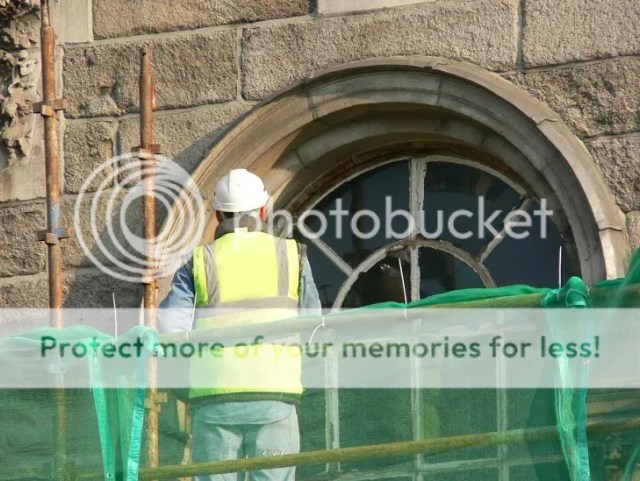
(thought I’d better airbrush out the contractor’s name ;))
Work was only getting started above, so there’d be no evidence of glass replacement here either way.April 21, 2006 at 9:02 pm #744903Participant@Graham Hickey wrote:
Above all though, I just cannot believe for a second that Trinity would even think about attempting to do this, in spite of their record elsewhere on campus. These windows are its most prized asset outside of the Library building – it’s akin to cutting the pages of the Book of Kells down to size beacause they won’t fit in the display case.
Hence I remain fairly optimistic that nothing untoward is going on, and that all the glass dates from a variety of periods – however naive it may be…A hi-profile instance of replacement of Georgian sashes/old glass with new sashes and fake-old glass would not be unknown, for e.g. in the rear bows of the National Gallery Georgian house:
(Re Trinity work: an inspection has been made by DCC Conservation Office – that’s all the info I have at the moment)
.April 22, 2006 at 3:54 pm #744904Anonymous
InactiveThe TV ad for this is surely the most annoying peice of TV ever made
It’s Safestyle UK’s famous BOGOF deal – for every window or door you buy, you get another one… Absolutely FREE!
http://www.safestyle-windows.co.uk/offers/offers.htm
http://www.safestyle-windows.co.uk/home/media.htm
Who doesn’t remember a Safestyle TV advertisement?
and the infamous Window Man, together with our own distinctive style, you’ll either love ’em or hate ’em! Either way, everybody remembers a Safestyle TV ad
It is clear the pvc has a price advantage however so had asbestos for industrial roofing
May 2, 2006 at 1:55 am #744905ParticipantAn interesting and current case of reproduction Georgian sashes being used to replace later Victorian frames is Dundalk Garda Station – an imposing Italianate pile sited prominently at the top of a small hill in the town (below). Built c.1852-54, it was still too early to have plate glass windows, especially in the regions, and so Georgian sashes were installed with typical small horns.

Over the course of the late 19th and probably early 20th century, some of the Georgian sashes were replaced with plate as can be seen below, with the grids simply cut out in a make-do-and-mend fashion :), though nearly all of the side elevation windows remained intact.
This picture was taken a few months ago, literally the day after the completion of what I thought was a conservation job on the windows, they having been cleaned up and painted over the previous few weeks as part of wider restoration including a magnificent reroofing job.

But after all that effort and expense was put in, bizarrely, as soon as the job was done – literally within a week or two if not mere days – the plate sashes were then all taken out, to be replaced with repro Georgian grids! It’s almost as if someone just came back from Dublin and discovered what was all the rage in ‘conservation’ jobs down south, and decided they’d like a bit of that too thanks very much! It’s nice to know at least that the Garda
May 3, 2006 at 3:52 pm #744906Jean
ParticipantI am in a 1940’s house that unfortunately has pvc windows – I am clueless about this sort of thing and have had Marvin in to quote – I am still waiting on their estimate but I know they are pretty expensive – he mentioned a figure of 20k!. I see from posts above Dansk is mentioned as a cheaper but as good alternative to Marvin – has anyone anymore info on this company? ? I am hoping to get aluminium clad cream windows (don’t shoot me – most of the road have these and they look great) Can anyone else recommend agood window company that do these or any window company at all? I am so desperate I am just googling everything and flicking thru the yellow pages………..whilst googling I found this site and registered in order to ask your learned opinions! Any info at all would be appreciated – save me from my pvc windows!
May 3, 2006 at 9:38 pm #744907ParticipantHi Jean. These threads might be a bit more specific to your question (this one is only for perverts and obsessives!) :
https://archiseek.com/content/showthread.php?t=3651&highlight=timber+windows
https://archiseek.com/content/showthread.php?t=4846&highlight=timber+windows
https://archiseek.com/content/showthread.php?t=3995&highlight=timber+windows
https://archiseek.com/content/showthread.php?t=4017&highlight=timber+windows
Rationel make nice timber windows and are not too dear.
May 3, 2006 at 11:48 pm #744908ParticipantThank you for your response – I spent my afternoon reading the entire forum and noticed that people asking for freebie advice don’t get many replies so I appreciate it!
May 4, 2006 at 1:07 am #744909ParticipantHow strange – only today I was passing through Mount Merrion Avenue and adjacent roads, surprised at the amount of cream aluminum that has cropped up in 1930s and 1940s housing there. Must be the latest D4 fad. It looks decent enough, certainly better than PVC.
However there was an interesting case of two houses right next to each other – one had cream aluminum frames while the other had timber frames painted exactly the same colour. There was little contest in my view as which looked better: the timber looked so much more substantial, architectural and simply more pleasing to the eye than the aluminum. Whatever the undoubted benefits of the latest versions of PVC and aluminium, they still cannot help looking like mere flat inserts in buildings. The lack of depth or relief in their frames can rarely match the more structural, sturdy appeal of timber that makes windows look like a part of a building rather than thin sheets stuck in to cover over the window holes.
@Devin wrote:
perverts
Ah now Devin, don’t be too hard on yourself 😀
May 4, 2006 at 5:08 am #744910May 4, 2006 at 5:23 pm #744911InactiveJean,
Finished our house last year and used Danske windows. Found that Marvin are fine if you want a basic sash (sliding up/down) window but any different style increases the price considerably.
The Danske windows have a very dense grain in their timber and the powder-coated aluminium on the outside is very well finished. The glazing bars are an integral part of the window structure, rather than that horrid “ornamental†strip. They can be ordered pre-painted on the inside if required. A feature I like is the lack of a mullion (centre bar) for the side-hung windows – the ones we have. In Ireland Danske are primarily a source of industrial windows but I believe they are branching out into residential. They have a showroom off the M50 in Dublin. I’ve no links with either Danske or Marvin.
Their English language web-site is rather poor and a new one is under construction. In the meantime look at
http://www.idealcombi.dk/Default.aspx?ID=777
Kerrybog
PS. I disagree with GH above that all modern windows look like flat insertsMay 4, 2006 at 5:41 pm #744912InactiveFirst attempt at posting a pic. ……
May 4, 2006 at 5:49 pm #744913ParticipantThat is great info – thanks a million! My windows aren’t sash and there are two huge bays so probably why the price is so high, Will definitely get Danske out to quote pronto –
Jean
May 6, 2006 at 5:24 am #744914ParticipantThanks for the link KerryBog2 – they appear a very professional company.
So are these the windows in your new(ish) house you mentioned before? A pity about the rather obvious double-glazing strips, they are of course regulation now anyway, but overall I agree they look very well. Would it be possible to get a picture of the all-important aluminium to the exterior?
(glad to see you’re not a pearl candle-bulber :))Agreed not all modern windows look flat, nor did I say this was the case. Rather it is the standard aluminium and PVC replacement frames that look like bland inserts – they contribute little to the appearance of buildings. The same can be said even of steel windows too, only in their case the multitude of glazing bars often employed generated their own decorative effect that helped overcome this.
But modern timber and alu-clad timber windows are generally highly flexible and can be adapted to many building forms and architectural contexts in a way that conventional market-driven muck cannot.Thank you Devin for your as-ever refined contribution re the horn. You can be quite a pane sometimes, pulleying people’s legs – everything just has to hinge on smut when you’re around, yet everyone else can keep it at bay, so just shutter it would you. You’ll be getting a box the next time, and feel the full weight of it let me tell you. Keep your acts of fenestration to yourself in future.
May 8, 2006 at 11:59 am #744915InactiveMine eyes glazed over with those puns GH but I do agree with the comments on the metal strips; however, usually they are not that obvious, either the cameraflash or the evening sun accentuated them. Incidentally, the ceiling rose and cornice are from the Old Mould Co. in Dun Laoghaire, they have losts of plaster goodies. (yeah, I can hear mutters of “pastiche” already.)
Outside photos – colour is an off-white on the aluminium, we did not want the full glare.May 8, 2006 at 2:02 pm #744916Participantnice house!
May 9, 2006 at 1:29 am #744917ParticipantLovely windows KerryBog2 – esp being a big fan of that continental casement format :). What makes them of course is the feature that is also mentioned on their site: the all-important sight-lines of the functioning parts being maintained with the rest of the frame, so there’s no bulky or otherwise different opening parts evident. Makes the world of difference.
Also shallow casements like these generally don’t alter the appearance of a building when opened like top-hinged windows do, as the angle created is hidden at the top and bottom of the open window maintaining the straight lines of the surrounding facade, whilst top-hinged ones crudely break them by their angles blatently protruding from the wall.You’d still know yours are alu-clad, but not in a bad way though :). Nice use of tan paint there on the skirting – adds something different to what is usually a rather predictable yellow.
May 9, 2006 at 12:13 pm #744918InactiveThanks Graham, they were expensive but worth it. Fell in love with that type when we lived in France. (Best flat I ever had, ground floor of what once was a convent, parquet, cloisters, parterre, the lot! ) Anyone who has had to paint small frame windows on a regular basis would chose the alu-clad and put up with the textural difference. The tan tone on the skirting (pediment?) is the same as the gutter; my idea was to paint the entire cornice the same colour (to visually integrete the gutter) but herself did not agree, said it would be too heavy and the mid-course/stringer would be like a belt. As she held her views rather strongly, peace reigned. Next time round I will paint the vertical face of the cornice and live with it for a while before a decision is made.
KB
PS the vent covers have since been fitted - AuthorPosts
- You must be logged in to reply to this topic.


