
Dundalk
- This topic has 137 replies, 28 voices, and was last updated 12 years, 11 months ago by
GrahamH.
- AuthorPosts
- December 30, 2009 at 8:01 pm #752724
GrahamH
ParticipantReturning to a building that was profiled here before, this grand c. 1800 house with Edwardian shopfront was recently ‘restored to its former glory’, with a ghastly developer shopfront installed in place of the pretty right-hand residential window – now unlettable – and badly detailed Georgian sash windows in place of the perfectly appropriate Victorian sashes seen here before works got underway.


The above was the completed result, yet here it is barely two years later.

It’s extraordinary how a building can deteriorate so markedly in such a short space of time. Of course the job was superficial from the outset, with paint slapped over render and rainwater goods that needed repair, cheap sash windows that were falling apart before the job was even finished, and a roof that was never repaired and is now worse than ever – all for the usual cheap buck that plastered over the past seven years of non-productivity in the Irish economy.
The sash windows of the top floor were also inappropriately designed with squat little horizontal panes of glass – a big no no in classical principles of proportion. One need only copy and paste a pane formation from the floor below to demonstrate that these should have been three-over-sixes with tall rectangular panes, as shown to the left-hand window.

The adjacent building, seen above, looks extremely ancient and requires further investigation. It’s not protected at the minute.
December 30, 2009 at 9:17 pm #752725Paul Clerkin
KeymasterQuite the deterioration for two years – combination of shoddy work and being left empty. Roof looks poorly patched in the “renovation” photo
December 30, 2009 at 9:33 pm #752726gunter
Participant@GrahamH wrote:
The adjacent building, seen above, looks extremely ancient and requires further investigation. It’s not protected at the minute.
. . . interesting window arrangement there Graham. On the basis of what we we just found out about Newry and what we know about Drogheda, could be worth looking into.
Just as an aside, I came across this ugly gem in Collon, other end of County Louth.


The shopfront seems to have been assembled using a truckload of architectural salvage, in no particular order.
However, in perhaps some measure of redress, the establishment is called ”The Hangin’ Head”

‘ASS’s [Architectural Salvage Suppliers] are a huge problem in this country in that, as well as supplying salvaged material they also create the demand for architectural features that can only be satisfied by ripping them out of their rightful place.
Further indications that there may be an ‘ASS’ holed up in the Collon area, is this house directly opposite ‘The Hangin’ Head’ which features a complete mid 18th century door surround, in amongst a diverse collection of salvages stone steps and a pair of ornamental lions.

nice :rolleyes:
Much of the rest of the streetscape of this one-street town is 18th and 19th century stuff, of understated quality.
 December 30, 2009 at 11:19 pm #752727Participant
Ah Collon – renowned as the most intact planned Georgian enclave in the county. A lovely spot as your pictures (mostly) demonstrate. That limestone doorcase is incredible! Where on earth did that come from I wonder? Those hideously over-scaled lamps flanking either side are now cropping up everywhere in the county too – woeful aul yokes.
@gunter wrote:
. . . interesting window arrangement there Graham. On the basis of what we we just found out about Newry and what we know about Drogheda, could be worth looking into.
Oh great. So a notorious IRA head was shot dead in broad daylight outside the pub across the road, and you want me to flounce into Sean’s Tavern extolling the virtues of 17th century gabled houses?!
I’ll see what the weather’s like tomorrow…
December 30, 2009 at 11:42 pm #752728Punchbowl
Participanthttp://www.daft.ie/searchcommercial.daft?id=42354
Tell me this isn’t what became of the bar I spent most of my college afternoons drinking Snakebites and hounding the jukebox in?
December 30, 2009 at 11:47 pm #752729ParticipantPunchbowl, yes, yes it is.

*pats Punchbowl on the back* There there now.
December 30, 2009 at 11:54 pm #752730Participant@GrahamH wrote:
Punchbowl, yes, yes it is.
*pats Punchbowl on the back* There there now.
What a tragedy. Punchbowl will be sleeping with the lights on tonight…
December 31, 2009 at 2:32 am #752731rumpelstiltskin
ParticipantYou know the more pictures you post, the more you back up my point. You can’t expect every business and resident in the country to be cursed with ugly, badly maintained, squat, and badly laid out little sheds because of the irrational architectural fetish of a tiny minority – especially when they are extremely unpleasing to the eye to begin with, like most of this crap in Dundalk. I mean, by what stretch of the imagination could that depressing grey slab of houses be called a “magnificent Georgian terrace”?
January 1, 2010 at 6:16 pm #752732Participantrumpel! your’re not a senior planning official, by any chance?
January 1, 2010 at 8:43 pm #752733ParticipantLol. The phrase saving the Irish from themselves springs to mind.
However unremarkable or modest the architecture of Irish towns may be, it is still a vernacular heritage that expresses the origins of place. Just because the sun doesn’t beat down on ranks of red tiled roofs, doesn’t mean our buildings are any less plain than those of a typical Italian town or village – indeed quite the opposite in many instances. Sadly, what does make our buildings unworthy is when they are decimated in a manner that strips away everything that makes then interesting and readable: the hand crafted windows hacked out, the chimneys lopped off, the stone roof slates replaced, the facade decked out in plastic, and faux heritage additions that are neither aesthetically pleasing or historically appropriate. Is it any wonder these buildings, and more specifically the streetscapes they inhabit, are undervalued.
To be a little more upbeat, here is a rare complementary, contemporary addition to a grand classically proportioned building of c. 1860, in the form of a crisp new shopfront.

Okay the polished stone may be a tad luxurious, but the proportionality and simplicity is there. A matching shopfront on the other side, a lick of paint and some restored upper floor fenestration and we’d be onto something.

A couple of doors down and these fine late Georgian houses have just been painted a very interesting palette of colours. Arguably the last house should not have been treated the same, but no matter.

The torquoise of the walls has been picked up in a satisfyingly robust splash on the doors and railings, while the windows and reveals are a lovely sea-green white. Extremely striking.

Though a shame the beautiful limestone of the carriage arch wasn’t stripped back. Never mind.
These fine knobbly railings feature all over Dundalk from the early to mid-19th century.

Strangely, the steps of this house’s front door step down at an angle – not quite sure what’s going on there. Great bootscaper.

On a less positive note, this little charmer with attendant grounds as shown here before was recently refused permission for demolition and the construction of apartments on the site.

All well and good, but this is the site today 🙁

They may have reapplied, but things aren’t looking good…
 January 1, 2010 at 8:48 pm #752734Participant
Also, some Christmassy scenes from the delightfully straight-laced St. Mary’s Road, which exudes an air of Protestant decency with its grand old houses, trim gardens and well-thumbed net curtains.

(I had to be restrained from pulling Santy out of the flower bed)


And the ‘night soil’ laneway.
 January 5, 2010 at 12:34 am #752735Participant
Just taking a closer look at that Georgian and yikes, things do not look good at close quarters.

There is an impressive rubble stone mill-like building to the rear, so it would explain the grand merchant character of the house.
This was lying forlornly in the shop window…

In fairness now, the Salon of Carton House was not exactly the best choice of cover photograph for engendering in the typical novice reader an appreciation of the modest charms of architectural heritage…
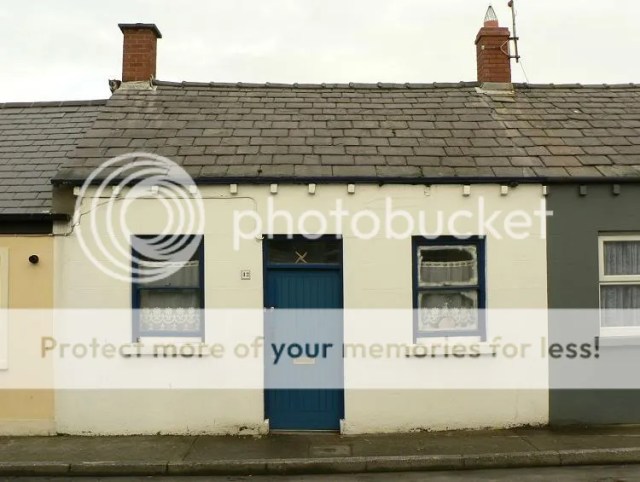
Like this incredible nearby street of tiny urban vernacular cottages for example; one of the most unique streetscapes in Ireland.

As you walk along Mary Street North, the eaves of the houses are almost level with your head. Alas, in spite of being an ACA for the past five-plus years, this is now the solitary house on the street in original condition. A crying shame.
Curiously, the houses appear to have been built with rather gradiose chimney pots. The vast majority have been replaced in recent years, so it’s almost impossible to tell which are the originals, but the predominance of this square type above all others suggests this yellow teracotta pot is it.

A stack with notions indeed.


Also, just to record it for posterity, as we all know what’s going to happen, this beautiful little vernacular house and shop, with typically Irish classical shopfront and attendant grounds, survives a short walk away.

The house next door appears to be a later addition entirely, rather than a modernised house.

What can we say other than RIP?
 January 11, 2010 at 12:21 am #752736Participant
@GrahamH wrote:
. . . . And the ‘night soil’ laneway.
??
Whatever about odd street names ?, Dundalk would seem to be in the running for the oddest public banner with this:

. . . . something to do with the Eucaristic Congress, or perhaps an endangered gorilla?
January 11, 2010 at 1:21 am #752737KeymasterIn 1846, Dundalk was granted by Royal Charter the right to maintain a town primate. The primate was brought to town borough meetings where it was chained to the alderman’s chairs. Under the charter, male primates were called Albert, while females were called Victoria. This practice survived the foundation of the Irish state and was continued until 1962, when it was discontinued after complaints from the ISPCA.
It would seem that this photo dates from the later years of the practice when it was under fire from animal lovers.
January 11, 2010 at 2:23 pm #752738tommyt
Participant@Paul Clerkin wrote:
In 1846, Dundalk was granted by Royal Charter the right to maintain a town primate. The primate was brought to town borough meetings where it was chained to the alderman’s chairs. Under the charter, male primates were called Albert, while females were called Victoria. This practice survived the foundation of the Irish state and was continued until 1962, when it was discontinued after complaints from the ISPCA.
It would seem that this photo dates from the later years of the practice when it was under fire from animal lovers.
Could possibly date from the local Pioneers protest against the ill conceived local bye-law, (as voted for by the UDC in 1944) that the sitting simian shall receive a ration of 40 Major and a quart of McArdles on a daily basis, unfortunately I can’t make out the communiqué on the sandwich board under the banner which would no doubt contribute further information.
January 12, 2010 at 3:28 pm #752739KeymasterIn the late 40s the primate was used in a series of Carroll’s print advertisements with the byline “he wants to be a real man too”
November 25, 2013 at 9:45 pm #752740KeymasterSome period internals of P.J. Carroll’s building added to
https://archiseek.com/2010/1969-former-carrolls-factory-dundalk-co-louth/#.UpPEr8TXTcwNovember 26, 2013 at 6:02 pm #752741ParticipantAh brilliant Paul. I’d completely forgotton that’s where my teenage bedroom desk came from!
There it is the foreground!Fabulous quality construction, with an elegant metal frame, black melamine panels, deep wood-effect drawers with brushed metal leaf handles, and a brilliantly chunky timber-effect surface. Delighted to see it in its original Mad Men context.
Sadly, the handsome concrete planters ended their life through freeze-thaw in the back garden. What a way to go.
- AuthorPosts
- You must be logged in to reply to this topic.


