
Dublin Graving docks / Grand Canal Docks / Alexandra Basin
- This topic has 46 replies, 23 voices, and was last updated 10 years ago by
lostexpectation.
- AuthorPosts
- August 23, 2008 at 12:39 am #793055
Paul Clerkin
KeymasterGunter, that’s the beginning of the Royal Canal, where it enters the Liffey.
August 23, 2008 at 12:27 pm #793056Anonymous
InactiveSorry about that. The absence of the ‘canal’ beside it should have been a clue.
August 31, 2008 at 8:49 pm #793057InactiveSome recent photos of the Graving Docks can be found here – they were taken last Easter when a number of wrecks were removed from the basin –
One of the photos is shown below:
 September 1, 2008 at 2:21 pm #793058Inactive
Great set of photos – how did they all get there in the first place? I hope they’re not all scrapped – presumably some ‘artist’ could do an assemblage of found objects – ‘The Spirit of Ringsend’?
September 1, 2008 at 4:25 pm #793059InactiveNovember 11, 2008 at 10:45 pm #793060InactiveI came across a biography of one Bindon Blood Stoney (I kid you not) one of the chief engineers of Dublin Port in the mid 19th century, and it appears that there is another significant graving dock located at the north west corner of Alexandra Basin, behind the boundary on East Wall Road.
This is a construction drawing of Graving Dock no. 1, which was begun about 1853 and opened on 9 February 1860.

This graving dock fell into disrepair after a second, bigger, graving dock was built as recently as the 1950s. Apparently the proposal now is to fill in Stoney’s granite Victorian graving dock with sand to preserve it and facilitate redevelopment.
Stoney was apparently also the man behind that huge iron diving bell contraption which sits on the south campshire at Sir John Rogerson’s Quay. This was a dredging work station which was lowered to the river bed and pressurized to allow labourers to manually dig the river bed and prepare an even surface to receive giant precast blocks of quay wall.

I will look at this thing with new respect the next time I go past.November 11, 2008 at 11:13 pm #793061KeymasterI didnt know of the graving dock, but I did know about the bell….
the dock is pretty impressive but obviously not used – judging by the amount of rubbish behind the gates in these shots
would love to see it close-up before its filled in
November 12, 2008 at 11:40 am #793062InactiveGreat pics – I’ve always been fascinated by these graving docks (we have a series of them here), but they seem to be prone to the vagaries of the ship repair market and no-one seems to have a clue what to do with them once they’re no longer needed for their primary purpose. Yet, as artifacts they are superb (apart from their intrinsic historic value) and they seem to be crying out for active use. Aquarium? Exhibition space? Workshops/offices? (All assuming the ability to roof them over and successfully dealing with the small question of the sea wanting to rush in!)
Alternatively, they could be used as a ‘feature’ framed by development on either side.
The worst thing to do is to fill them in and pretend they never existed.
Project anyone?November 12, 2008 at 11:54 am #793063InactiveVaranasi on the Liffey?
@gunter wrote:
fill in Stoney’s granite Victorian graving dock with sand to preserve it and facilitate redevelopment.
Does not compute. First we get ‘preservation by record’, now preservation by burial?
This is a pretty remarkable piece of Victorian engineering. It should be a centrepiece of any redevelopment, not a foundation.
November 12, 2008 at 12:52 pm #793064Inactive@ctesiphon wrote:
Does not compute. First we get ‘preservation by record’, now preservation by burial?
This is a pretty remarkable piece of Victorian engineering. It should be a centrepiece of any redevelopment, not a foundation.
The filling in with sand was secondhand information, may not be reliable, although filling in things does sound like the prefered modus operandi of Dublin Port Company, at the moment.
On re-reading the article, I think Bindon B. Stoney over-saw the construction of the graving dock, but it may have been designed by George Halpin II.
It’s supposed to be 80 feet wide (not sure is that at the top or the bottom) and 400 feet long, being built to accommodate the latest mail steamers. Apparently it cost over £116,000 back in the day and it only went out of service in 1989!
I agree that it would be nice to think that someting this impressive would merit a better fate than to be back filled and forgotten, but surely the ideal solution is to fix the gates and keep it in use! Do you not have to paint the bottom of boats any more?
November 12, 2008 at 2:08 pm #793065Keymasterbtw this building is named after Bindon Blood Stoney
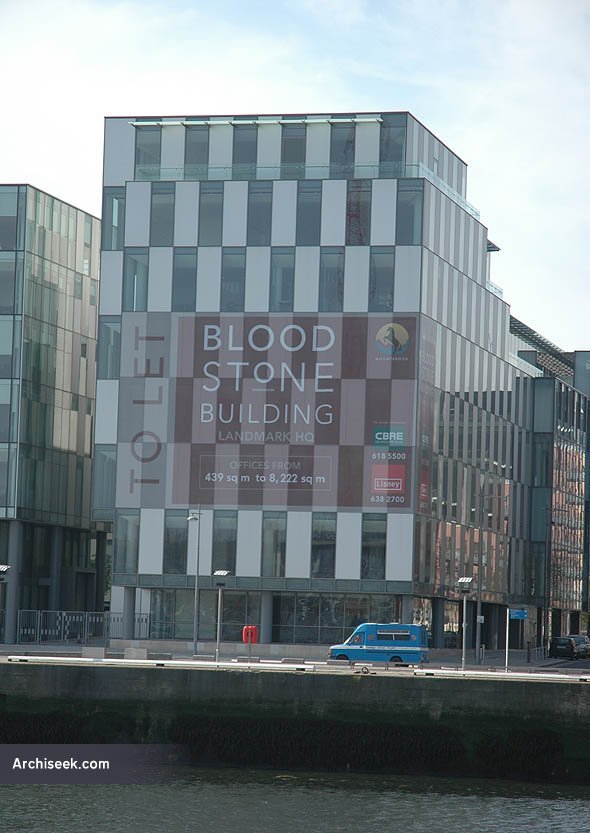
And here is more of his work
https://archiseek.com/2012/1879-design-for-swing-bridge-dublin/#.UJvRIsXA914November 12, 2008 at 2:53 pm #793066Inactive@Paul Clerkin wrote:
btw this building is named after Bindon Blood Stoney
Aah- I wondered.
My first guess was something to do with bankers…
November 12, 2008 at 7:17 pm #793067InactiveThe street that runs perpendicular to the river is also called blood stoney street.
The graving dock could make a great outdoor swimming pool!
November 12, 2008 at 9:57 pm #793068InactiveDecember 17, 2008 at 1:17 am #793069InactiveRe: Phibsboro dry dock, it was at one time the property used by the Phibsboro 19 th (“Panama”)Scout troop. I was in that scout troop back in the late ’60’s-early ’70’s. When we were kids, we thought it was an empty swimming pool ! I seem to remember the prison turned it into a parking lot for the officers.
December 17, 2008 at 8:36 am #793070InactiveInteresting to note from the birds eye images that the southern aspect was taken well before or after the other aspects given the ships in the larger graving dock are different. Always thought they were taken at the same time.
January 22, 2009 at 2:09 pm #793071Inactive@gunter wrote:
Stoney was apparently also the man behind that huge iron diving bell contraption which sits on the south campshire at Sir John Rogerson’s Quay. This was a dredging work station which was lowered to the river bed and pressurized to allow labourers to manually dig the river bed and prepare an even surface to receive giant precast blocks of quay wall.
I will look at this thing with new respect the next time I go past.Wow, thanks a mil for that little pearl of information, I have been wondering what on earth that thing was for ages, impressive stuff, must have been quite a horrible job… 🙂
January 22, 2009 at 4:23 pm #793072InactiveThat’s an incredible piece of kit. There was a hole cut into it when it was restored 8/9 years ago and the iron is about 4 inches thick!
February 4, 2009 at 2:04 pm #793073InactiveAnyone have any information on the constructional make up of the dock walls and/or the graving docks down in grand canal basin? I have information on the later dock walls built 1871 but have nothing for GCD which was completed 1796! Would welcome any suggestions…
May 1, 2010 at 8:03 pm #793074InactiveI visited the site of the Graving Docks today and found that the third dock that had recently been excavated has been completely filled in. Maybe it wasn’t filled in but has gone altogether. There is some clearing of the site going on. Does anyone know exactly what became of the third dock? When I last saw it, which wasn’t too long ago, a lot of the individual pieces of cut stone had been numbered in yellow paint.
- AuthorPosts
- You must be logged in to reply to this topic.


