
1895 – Court House, Washington Street, Cork
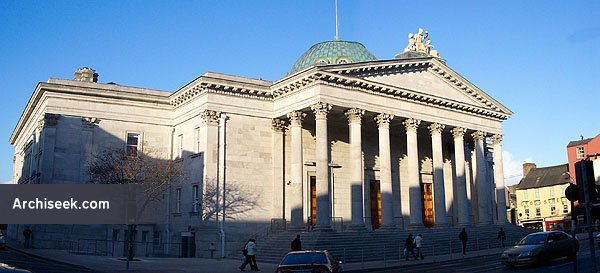


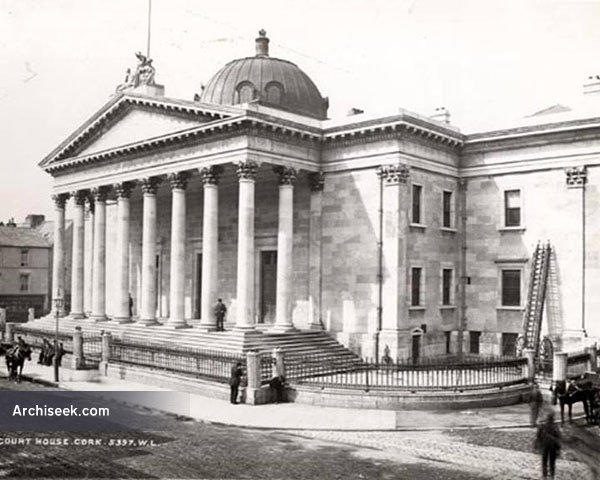

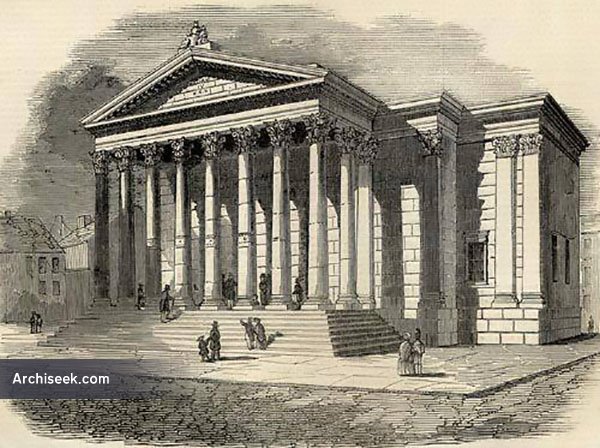

Originally designed by the Pains in 1835, though built by the Deane family of architects. The interior was destroyed by a fire in 1891 and subsequently redesigned by W.H. Hill who replaced the austerity of the original Neo-Classical revival with an early Rennaissance style. The courthouse closed in June 1994 to allow for a refurbishment and reopened in early 2005.
The original building was erected in the year 1835, by Messrs . Pain, at a cost of £22,000. The principal front is in Great George’s- street. It was almost the only portion of the building that escaped the ravages of the fiery element in 1891, and it is a matter for congratulation that it was spared. Here we have, on a platform of eleven steps, a boldly-projecting portico having eight columns supporting an entablature and cornice surmounted by three figures representing Justice between Law and Mercy.
The entire works at the building as it now stands have been carried out from plans by Mr. W. H. Hill, F.R.I.B.A. , B.E., by Mr. Samuel Hill, contractor (both of Cork). Total cost about £27,000.
A local journal, has the following, written up to date :-
Notwithstanding the occasional murmurs that arose because of the non-completion of the works at an earlier date, it must be said, when the amount of the work contracted for and the difficulties that beset its accomplishment, that the builder, architect , and committee have admirably fulfilled their responsible duties. A formidable obstacle to the commencement of the building was the taking down of the old structure-a tedious and laborious business . The completeness with which this portion of the contract was carried out may be learned from the fact that the building to be opened on Monday is entirely new, with the exception of the front wall facing Great George’s- street . The slowness of subsequent operations could be explained by the weather and the strikes of labourers, carpenters , and stonecutters , which incidents naturally hampered the fulfilment of the contract before this. Within the past month the building has made rapid strides , and where one could see nothing formerly but scaffolding from the basement to the cupola, there is now order, regularity, and architectural beauty. The footpaths surrounding the place have been restored to the public by the builder. The steps have been re- set, and the fluted pillars supporting the massive front look none the worse for the ordeal by fire through which they went on that eventful Good Friday.The central hall cannot fail to extort praise from all whose business brings them to the Court. On each side of the spectator and on the floor above him are noble arches starting from pillars of marble, displaying the finest grain of Kilkenny, Galway, Meath, and Midleton. A broad and well-lighted staircase leads up to the Admiralty and Bankruptcy Court and the numerous offices upstairs. To the right of the entrance is the City Court, and to the left the County Court, and these are of course the principal chambers on that floor. They are fitted up in pitch pine and mahogany. In each and a railed seat is provided to the right.
In each court a witnesses’ table is dispensed with and a railed seat is provided to the right of the judge, and facing counsel and the jury. The grand jury box is to the right, and the petit jury box is to the left of the bench. What will prove acceptable to the long- suffering juror, is a waiting-room where he may rest himself and read his paper, instead of hanging about the court, fearful of judicial penalties for non-attendance.There are two jury rooms , an arrangement which will help considerably to expedite business. The dock is in the centre of the court, and communicates by a spiral stairway with the capacious prison cells in the basement. The ceiling is of pitch pine, panelled, which is set off by a tinted glass dome. The windows facing the street are doubled, in order to deaden the sound of the traffic. There is a substantial gallery for the public at the end of each court, The County court is constructed on similar lines. The gentlemen of the long robe have their barroom midway between the courts and rising over their quarters is an open area which the area is faced with white glazed brick, which reflects the light, and gives a cheerful appearance to the whole scene. In addition to the main staircases, there are two back ones. All those leads to the County and City Grand Jury Rooms, the Admiralty and Bankruptcy Court, the offices of the clerks of the Crown and Peace, and the County and City Sheriffs, the County Treasurer, the Secretary to the Grand Jury, and others connected with the administration of justice. There are also rooms provided for the accommodation of solicitors and witnesses . The officials can by no means say they are cramped for space. The number of apartments provided for their use is so great , that even the builder does not carry the exact figures in his memory. The Grand Jury Rooms are splendid chambers with elaborate pitch pine ceilings and wall framing of the same material. The basement contains the offices of the official assignee, the muniment room , several strong rooms, lavatories, registry of deeds, jurors’ smoking-room, male and female prisoners’ cells , and a refreshment- room, which will be a desirable addition to the Court-house. In the basement are also the furnaces which disseminate hot air through perforated gratings placed in suitable positions in corridors, courts, and offices . All the walls of the strong rooms are of fire brick, and the ceilings of the basement storey are also fire-proof, so that if a fire broke out in that part of the building, the remainder of the structure would be perfectly safe. The sanitary arrangements are admirably carried out. All the space at the disposal of the architect and builder has been utilised to the utmost extent, and both may well take credit to themselves for the erection of a building, which, to use some oft-quoted words of late, leaves nothing to be desired on the score of ” dignity or importance.”
The Irish Builder, March 15 1895
Share!
Cite This Article
Published November 6, 2009 | Last Updated January 9, 2026


