
1891 – McKee Barracks, Blackhorse Avenue, Dublin


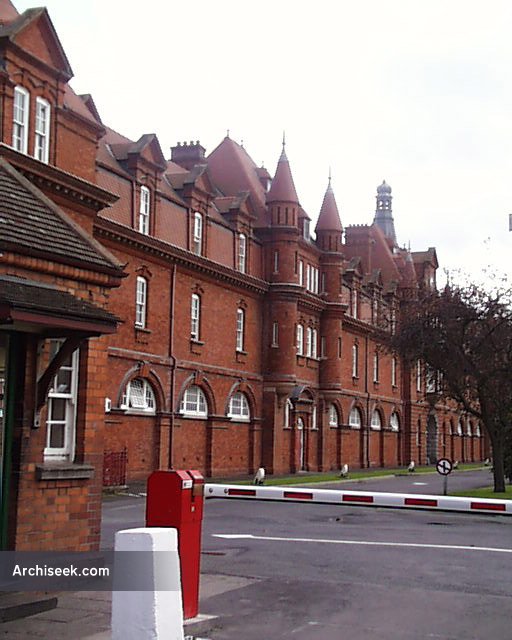

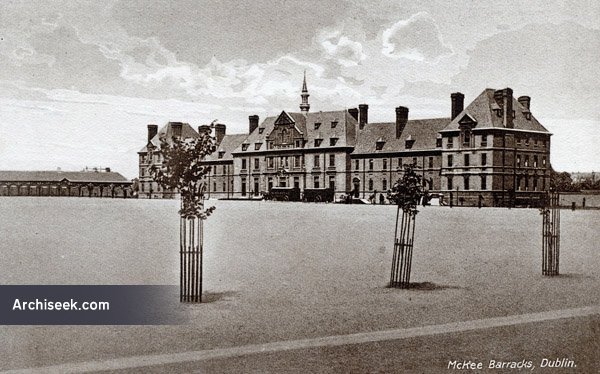
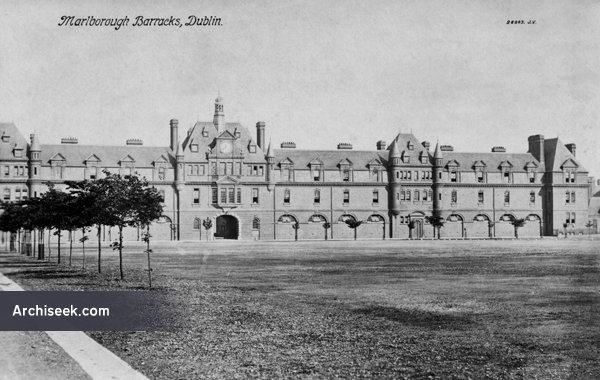
Imposing and extravagant cavalry barracks, completed 1891 as Marlborough Barracks. Plans prepared by Royal Engineers Dept, carried out under supervision of Robert Barklie, who was from Larne, Co. Antrim.
THE “Marlborough Barracks,” which have just been completed, are situated on an elevated position to the north of the Phoenix Park. During the present week the 10th Hussars have taken possession of the buildings. The material used in their construction is red brick. The roofs are of red tiles. The officers’ quarters and mess at the northwest angle of the barrack square occupies 3,700 yards, and rises to a height of 60 ft. The left wing are the commandant’s quarters, and the right are intended for the field officers. The central portion of the building consists of the great hall, reading-room, club room, dining-hall, &c. Above this hall a slender pinnacle rises to a height of 86 ft.
The style of this block is a mixture of Elizabethan and Queen Anne, and the design is exceedingly rich and effective, with its traceried windows, floriated pinnacles, parapets, and panelled battlements. Attached to this building is the guard-house. At the western side of the barrack square is the riding school, 180 ft. long by 60ft. wide and 56ft. high. It is fitted up with a riding ring and central space, intended both for the instruction of recruits and for riding practice in wet weather. To the south the square extends right down to the wall of the Phoenix Park. This square encloses 120 square yards of available ground for drill and parade. Compared with other barracks, this area is rather small, and it is very much so as compared with other cavalry barracks.
Military authorities, however, say that this space in ample for all the purposes of a cavalry regiment, and that a space to be used as a theatre for military display is unnecessary, owing to the proximity of the Park.
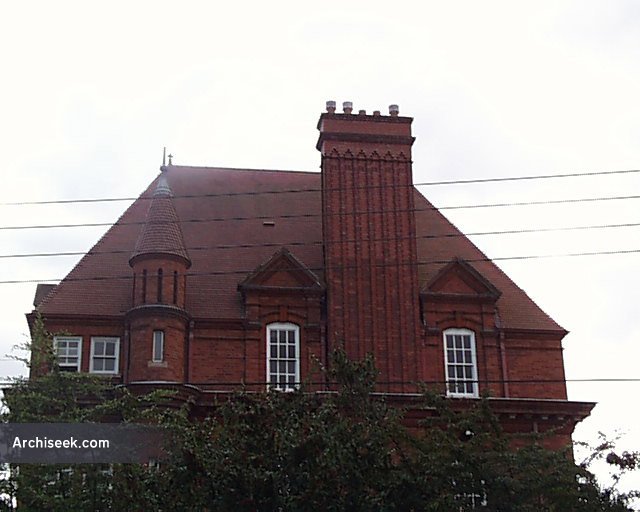
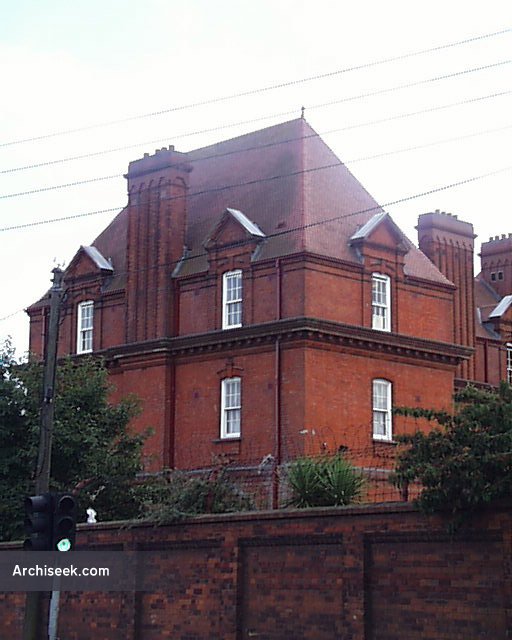
There will be a gate at the south side of the square opening into the Park. The men’s quarters are situated at the eastern side of the parade square, they face the west – an arrangement which the Engineers carried out in order to give the officers’ quarters a southern aspect. The men’s quarters consist of two oblong buildings running north and south, the ground floor of which is used for stabling, and alternating with the blocks are two other rows of stables, fifth within the eastern wall being appropriated to various stores and offices. These buildings will accommodate the non- commissioned officers and men of a cavalry regiment at the full war strength-viz., 862, and stabling is provided for as many horses. The two blocks appropriated to the men are in the Tudor style. They are built throughout of red brick, and have a very picturesque appearance, with their quaint and fantastic decoration. The chimney stacks-as in all the old English buildings-stand well out, and produce great effects from all points of view.
The importance of the chimney stack in this style of building may be judged from the fact that a large chimney stack over the great arch in the centre of the main building takes the place of the clock tower in the ordinary barracks. The characteristic feature of the block is its roof line, broken with gables, turrets, cupolas, and parapets. The red tiles of the roof, both by their novelty and picturesque effect, at once catch the eye of the spectator. At every corner is one of those perforated turrets commonly called pepper-box turrets which with the numerous gables give the idea of a Swiss cottage. These five blocks of buildings for men’s quarters, stables, and stores, cover an area of 10,000 square yards. In the centre of the principal or eastern block, near the main archway, is the sergeants’ mess, and the two wings are appropriated to the quarters of the non-commissioned officers. At the end of the block is the recreation hall for theatricals, readings, &c.
The third block belongs to the rank and file, and consists of canteen, reception-room, stores, and sleeping apartments. The second and fourth blocks are stables, and attached to the latter is the granary and the fodder store. The fifth block consists of various stores, cart sheds, commissariat stores and offices, armourers’ shop, cook-house and stores, tailors ‘ shop and clothing stores, bath house, recreation ground, and skittle alley. At the south-eastern angle of the square are the married men’s quarters.
Throughout the entire barracks every possible detail has been attended to, to secure site, which covers an area of over seven hundred thousand square feet, is well chosen for health and sanitation on a high ground contiguous to the city, where the prevailing winds blow fresh from the country. interior lighting, ventilation, and sanitary arrangements are as perfect as they well could be. The roomy sleeping apartments and the various reading and reception rooms are thoroughly lighted and aired by the large mullioned windows, which are peculiar to the Tudor style of architecture, and nothing has been left undone to secure good and healthy accommodation. drainage has been specially attended to. The plans of the building were prepared by the Royal Engineers Department, and were carried out under the superintendence of Major Barklie, R.E. The estimated cost is about £80,000. Mr. J. P. Pile was the contractor.”
The Irish Builder, October 15, 1891
Published April 27, 2009 | Last Updated January 2, 2026


