
1919 – J.H.G Russell design for War Memorial Museum, Regina, Saskatchewan


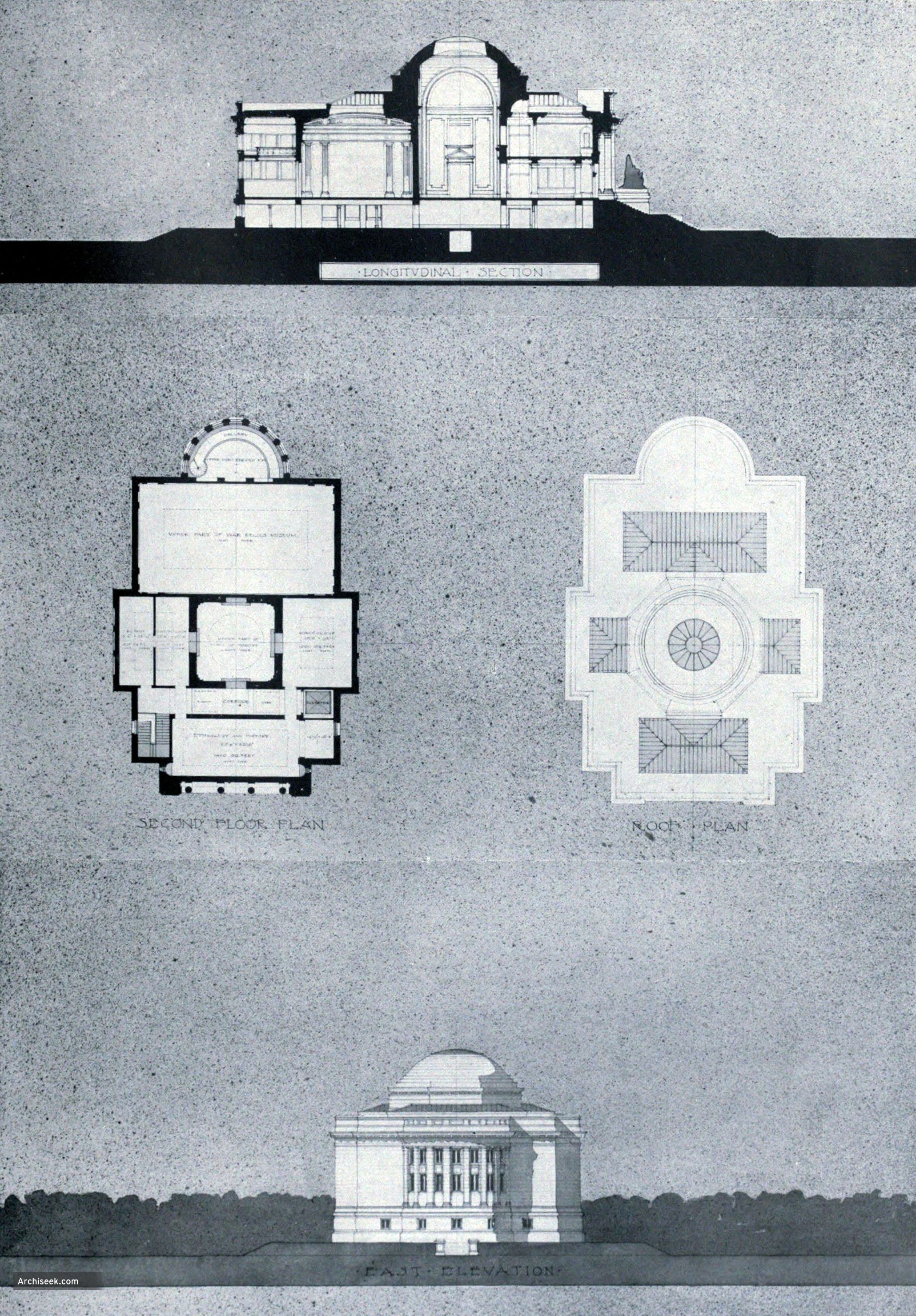
The third placed design in architectural competition for a museum and war memorial on the grounds of the Saskatchewan legislative building. Submitted by Winnipeg architect J.H.G. Russell.
As shown by the block plan, the building is to be located west and south of the Provincial Parliament Buildings, and placed on a terrace about 24 feet larger than the outside dimensions of the structure, and raised about four feet above the level of the street grade. The main longitudinal axis runs due east and west, which presents the greatest length to the principal approach from the city, provision being made on Albert Street for a wide central approach and a feature statuary group.
The building is three stories high with the exterior in Doric design to harmonize with the existing Parliament Buildings, the treatment being simple with little ornament, resulting in a dignified scheme emblematic of the purpose for which the building is intended. The plan is rectangular and symmetrical, permitting of simple construction. The basement or more properly the ground floor, is 12 feet in the clear, and the first and second stories each 16 feet in the clear. There is no basement in the ordinary meaning of the term, except a tunnel through the central portion for plumbing and heating pipes, and ventilating ducts, with a small space below the floor for branch lines.
On the ground floor, which is at a level about six inches above are the Curator’s general private office, toilet and vault; room and workroom with a large entrance on the side so trucks may be driven in to unload large pieces; the spare collections and storage rooms, men’s and women’s toilet rooms, and stairs and elevators to the upper floors and down to the tunnel. There is also an entrance from the grade to provide convenient access to the offices.
The first floor is reached by a wide and accessible flight of steps from which there are three imposing entrances to the main vestibule, opening from which there are the cloak room and the photograph room conveniently located. Opening from the main vestibule is the Hall of Honor, carrying up through the two stories to the dome ceiling. The War Relics Museum which opens from the Hall of Honor, is also carried up through the two stories. These two rooms are the main feature of the plan and have been treated in a simple but dignified manner, all unnecessary ornament has been eliminated in order to render them more adaptable to the purpose for which they are to be used. The record room opens off the rear of the War Relics Museum, and at either side of the Hall of Honor are the zoology and ornithology departments. The stairs are conveniently located to the left of the entrance, it not being necessary to make a memorial feature of them.
On the second floor are the departments for botany, ethnology and mineralogy at either side of the upper portion of the Hall of Honor, and across the front of the building is the departments of ethnology and history. The intention is to make the structure fireproof throughout, with interior construction of steel and reinforced concrete columns, beams, floors, ceilings, roofs, etc. The dome would be of light steel and concrete construction with a copper covered roof, and the exterior walls faced with Tyndall stone. The finished floors in workroom, spare collections and stores on the ground floor, would be of cement, and in all corridors and toilet rooms on this and the second floor of terrazzo. The main entrance, vestibule and Hall of Honor would have marble floors, and all other rooms, floors of oak. Where marble and terrazzo floors occur there would be a marble base, and wood base for wood floors.
All windows to have marble stools and plaster jambs, the openings around the main entrance and Roll of Honor to have marble jambs. Wood trim is confined to openings between the main exhibition rooms to which there are no doors, and to the trim and doors to minor rooms. Stairs to have cast iron strings and raisers with marble treads and platforms. Doors to elevator would be of steel, finished to match adjoining trim.
The area of the building, exclusive of the steps, is 1 1,900 feet, and the height of 48 feet, on which the cubical contents are figured, is from one foot below ground floor to the flat of the roof.
Construction, September 1919
Share!
Published March 22, 2026


