
1915 – Gare du Palais, Quebec City, Quebec
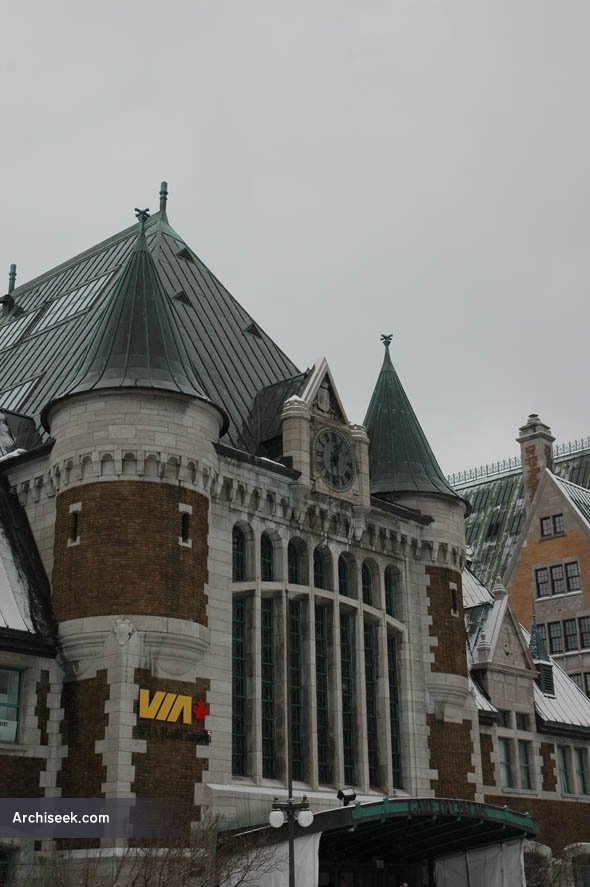

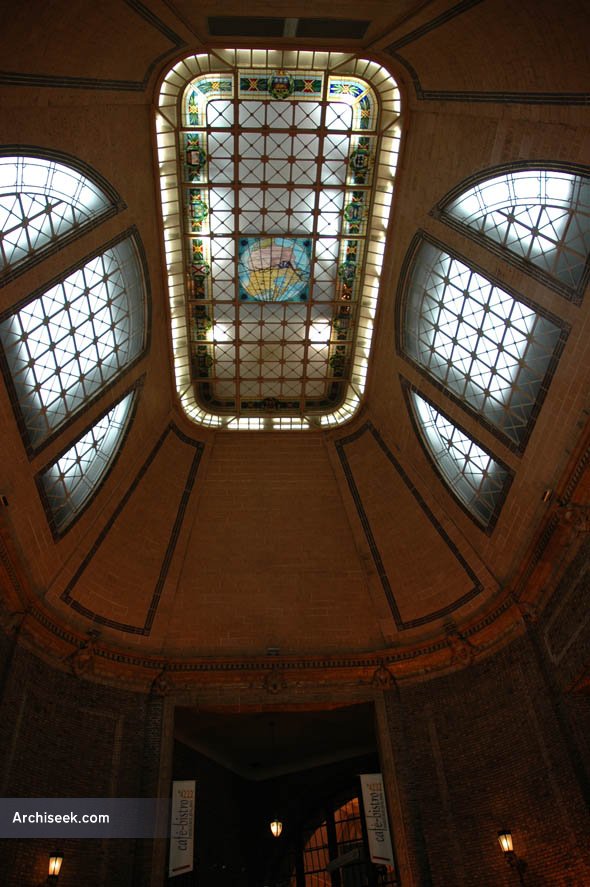
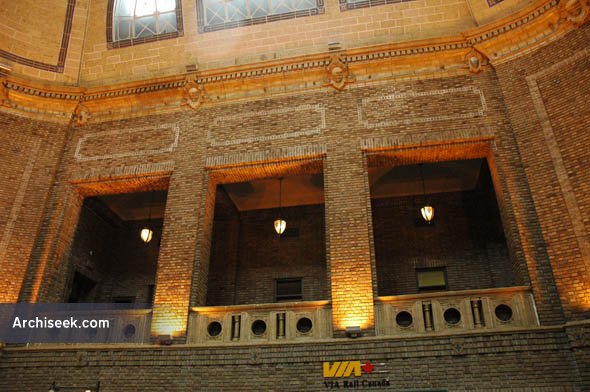

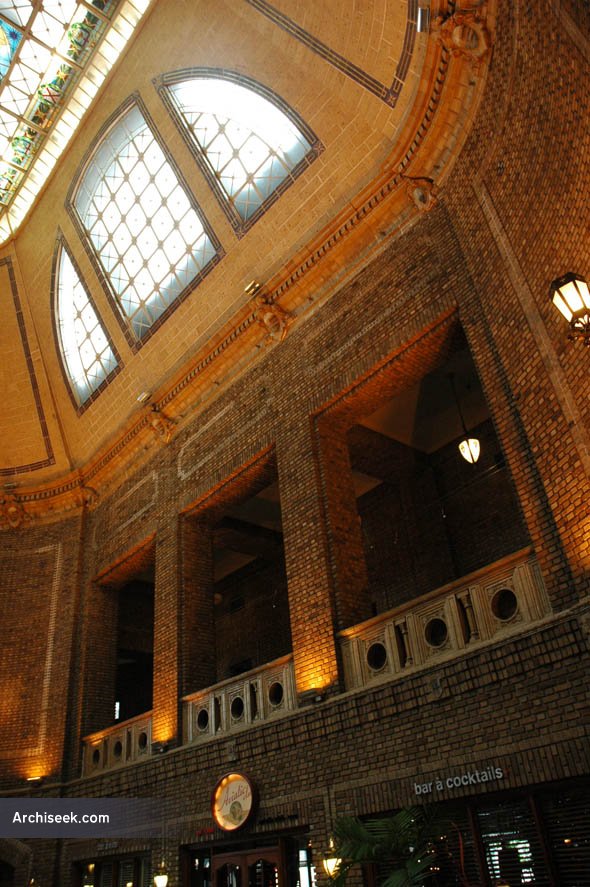
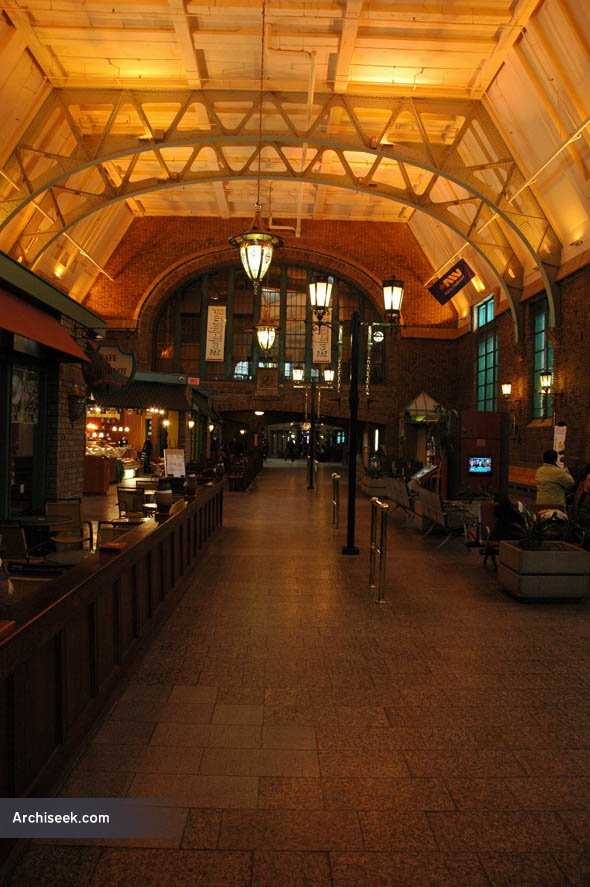


Built in the Chateau style to reflect the dominant Chateau Frontenac on the old town above the station, the real glory of the Gare du Palais is the entrance hall. With its beautiful brick, and vaulted and glazed ceiling, it presents a warm and intimate space. The entrance hall contains the ticket office, and is linked to the trains by a concourse area. This concourse although less ornate has an attractive high roof and more exposed brick.
Harry Edward Prindle (1873-1928) had received gold medals from the Architectural League of New York and the Chicago Sketch Club. He was at one time supervising architect of Cochise County, Arizona and in 1914 located in Montreal and designed the Quebec Union Station for the Canadian Pacific Railroad. During World War I he was supervisor of housing for the Emergency Fleet Corporation and built the town of Harriman, Pennsylvania. He wrote the following description of the station:
“The station is approached from St Paul Street by an open paved plaza, approximately 300 ft. X 300 ft. enclosed by broad curving sidewalk reaching the entrances, with a driveway into the express yard. The concourse opens directly into Henderson Street, which leads to the new freight offices. The plaza will be encircled with ornamental lamp standards and the central section flanked by tall steel Hag poles. The planting spaces around the plaza and on Henderson Street will be filled with Lombardy poplars and the spaces about the building occupied by harmonious masses of blue spruce and shrubs. The building is L shaped in plan, with the express wing approximately 46 ft. x 150 ft. parallel to St. Paul Street, with power house 46 ft. x 75 ft. with a boiler stack 100 ft. high on the end toward St. Roche Street. The concourse wing on Henderson Street is approximately 65 ft. X 150 ft. and is practically on the diagonal axis of plan.
The roof of the central block rises about 90 ft., the roofs of the wings being roughly 50 ft. high. The exterior walls are faced with a dark wire cut brick, laid in Flemish bond in white mortar with deep raked joints with stone facings and granite base. The roofs are of copper. The main entrance is 25 ft. wide, providing seven door openings, over which is a large window opening lighting the ticket lobby. The outer angles of the central block carry brick and stone tourelles between which, at the roof level, is a large ornamental illuminated clock dial. At the base of the tourelles are carved stone shields bearing the Fleur-de-Lys, Rose, Shamrock, Thistle and Maple Leaf; the pediment over the clock is ornamented with the coat of arms of the city of Quebec.
High up over the entrance, executed in leaded glass, are the armorial bearings of seven men famous in Canadian history, to wit:
Montmagny, Governor of Canada. 1636 to 1647.
De Tracy, Viceroy of Canada, 1665.
Beauharnois. Governor of Canada. 1726 to 1747.
Montcalm, Military Commander in Canada. 1750 to 1759.
General Wolfe, 1726-1759.
Frontenac, Governor of Canada, 1672.
Talon. First Intendant of New France, 166.T to 1672.
The walls of the entrance vestibule are of brick, with marble base, marble and terrazzo floors and vaulted tile ceiling. On either side of the vestibule are the office staircase and the Transfer Company’s office. The ticket lobby is 46 ft. x 65 ft. and 60 ft. high, with a marble floor, the walls being of a light tapestry brick, laid up white mortar with recessed joints. The high pitched ceiling, finished in Mosaic tile, is shaded in color, with inlay patterns. Around the lobby are the ticket offices of the Canadian Pacific Railway and Transcontinental Railway, women’s room and lobby, men’s room, telegraph and telephone offices, customs offices and parcel rooms and baggage space, with an entrance to baggage room and concourse. At the level of the offices on the floor above is an arcade opening into the upper portion of the ticket lobby. The cornice, balustrades, clocks, wall decoration, etc., are all of faience tile in several colours. The cartouches in the cornice bear armorial devices in color, symbolic of railroads, steamships and hotels. The design of the leaded glass in the ticket lobby ceiling expresses a world-wide development of the Canadian Pacific Railway.
Off the line of traffic in a connected location is a comfortable women’s room finished in oak, the walls being painted in harmonious tones with the toilet room adjoining. The concourse opens into the ticket lobbv and Henderson Street, with three wide train gates. It is approximately 65 ft. x 125 ft. x 40 ft. high, the ceiling construction being of concrete, carried on four large semi-elliptical steel trusses. There are large window openings on all sides. The walls are of light colored tapestry brick, laid up with recessed joints in white mortar, through which runs a faience diaper pattern bearing the floral emblems of France, England, Scotland and Ireland. The brackets under the trusses are of faience tile in color, on which the emblems are merged.
The prevailing colour of cornice is an old blue with dolphin and salamander inserts of faience tile. The floor is of marble and terrazzo. Along the two sides of the room are long seats, finished in oak with marble base. The train indicators will be of the most modern type. The smoking room which opens off one end of the concourse is finished in oak. adjoining which is the men’s toilet, with standard and pay toilets.
The baggage room contains approximately 2,550 square feet, and express space contains approximately 4,600 square feet. The upper portion of building is occupied by the offices of the Canadian Pacific Railwav and the Transcontinental Railway.
The entire building rests upon a system of concrete piles; the floor and part of roof construction is reinforced concrete, sloping surfaces of roof are of gypsum block ; the frame throughout is of steel encased in concrete and the walls are masonry. There are 430 concrete pedestal piles, approximately 400 tons of structural steel ; 2,000 yards reinforced concrete ; 400,000 common brick; 75,000 exterior face brick; 125,000 interior face brick, and 10,000 cubic feet of exterior cut stone. The building will be electrically illuminated, the bulk of the fixtures being indirect. The trainsheds will be low umbrella, or umbrella type.
The station proper will cost approximately $SOO,000 when completed.
Engineering and Contract Record, November 24 1915
Share!
Cite This Article
Published December 17, 2009 | Last Updated May 8, 2026


