
1914 – Marlborough Hotel, Winnipeg, Manitoba




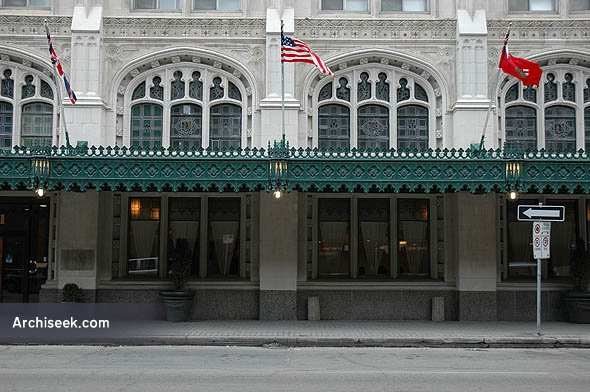


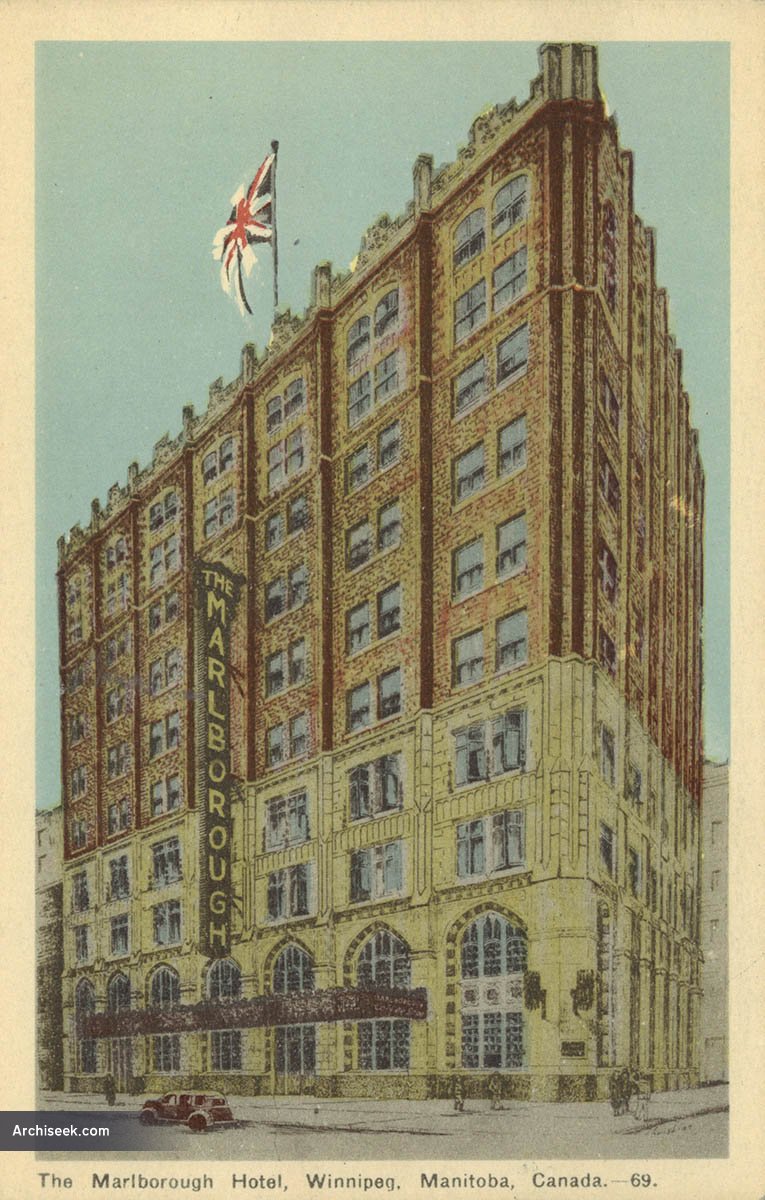


An impressive stone and brick purpose built hotel building from the early 20th century, the Malborough has Tudor Gothic detailing on its lower floors. Built in two stages, and originally called the Olympia, the lower floors are distinctly different from the brick finished upper stories. The elaborate canopy and stone tracery of the windows at ground level create an instant impression. Sadly down-at-heel hotel. Some potentially fabulous interiors still remain.
A New Winnipeg Hotel with Up-To-Date Constructional Features
IT is claimed for the new Olympia Hotel at Winnipeg that it contains some of the finest architectural work in Western Canada. At least, this is one of the features which entitles the building to special mention. The hotel, which is of steel construction throughout, with hollow fireproof tiling, is four storeys high, with basement and sub-basement, and contains accommodation for two hundred and fifty guests. The exterior finish is executed in terra-cotta, with gray brick facing the lanes and light wells. The fire escapes and stairways are enclosed in fireproof compartments opening into the corridors through metallic doors with wired glass. The architectural style follows the Gothic and Renaissance. The material used is a soft grey terra-cotta, which starts from the polished concrete base. The flat walls of the upper storeys terminate in a line of battlements deeply carved and ornamented. A feature of interest is the massive marquise which extends across the front and sidewalk, the whole structure being of cast iron and glass.
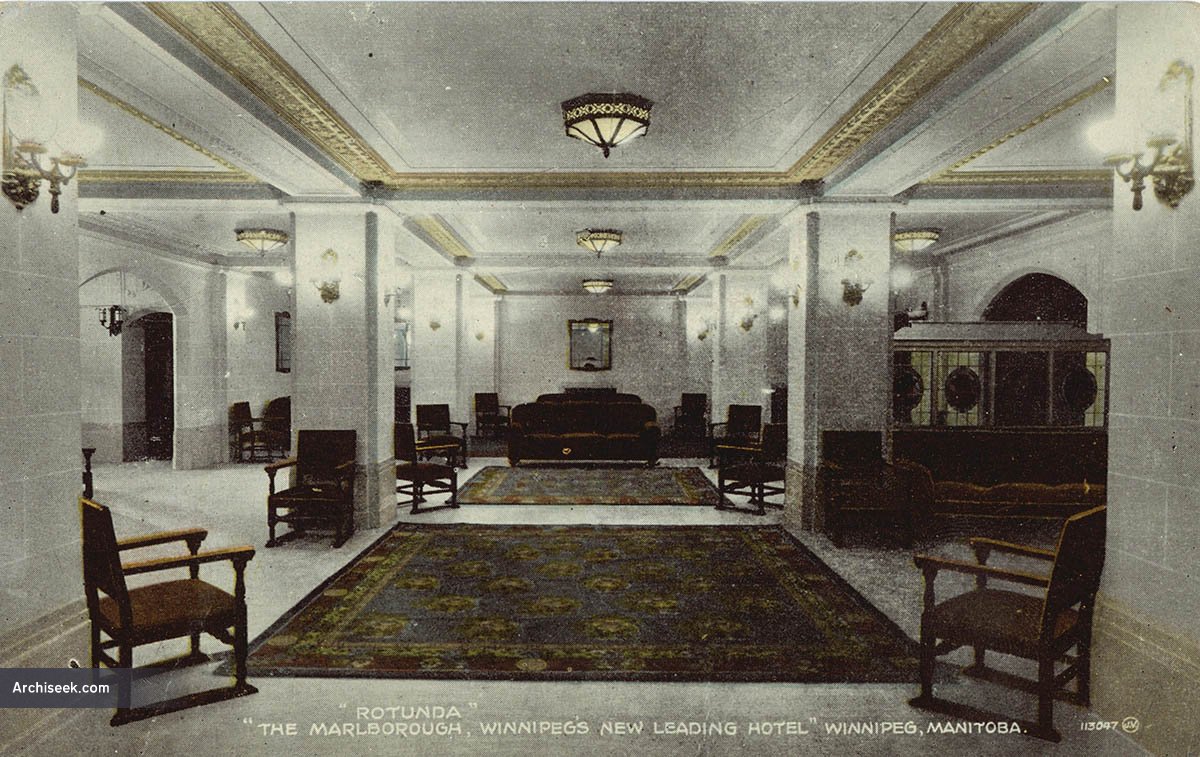
The rotunda and lounge are entered from the north vestibule, which is finished in oak and stained glass. The ceiling, which is heavily moulded and stencilled, is supported by massive pillars rising from a base of grey marble. The walls are of buff Caen stone, rising above a wainscotting of Tavernell marble, with floors of a colored variety of Tennessee marble. Here Gothic influence is seen in the arched openings, the heavily ornamented ceiling, the hammered brass fixtures and the stained glass doorways.
The commercial atmosphere of the routine offices on the ground floor is relieved by the excellent taste in woodwork and the skilful planning. The public telephone booths are of inlaid walnut, and are finished with stained glass doors and windows.
Adjoining the lounge is the ladies’ reception room, dining-room, bar, and service department. The main stairs, which are of marble, lead to the mezzanine hall on the second floor and to the grill room in the basement.
The guest rooms are commodious and well lighted. The private baths adjoining are fitted with porcelain fixtures, while the floors are finished with a composite white tiling. The approach to the mezzanine hall is by a staircase of Tennessee marble leading from the rotunda. The walls of the hall are panelled with a tightly stretched fibre covering. A heavy railing of bronze-stained oak separates the panels from the dee]) plaster frieze. The ceiling is arched and ornamented with a continuation of the sidewall decoration.
The design of the tea room follows that of the mezzanine hall. The beamed ceiling is supported by large pillars. Natural lighting is obtained through broad arched windows and skylights.
The dining-room, which is two storeys high, follows the Renaissance design. Here there are tapestried pilasters, with silk cord side-light fixtures suspended therefrom. Light is furnished through panels of stained glass.
The interior of the buffet is a particularly fine example of Gothic. Like the dining-room, it is two storeys in height. The walls west and south are faced with buff Caen stone rising above a base of polished marble. Iron lanterns are suspended from the heavy oak rafters. The appearance of the room is enhanced by a series of mural panels depicting Norman scenes. The floor is of red tile.
The walls of the grill room are finished with tapestried brick. The ceiling is done in light cream with skylights of the same tint. The floors are of red square tile and black mortar. The grill is separated from the lobby and coat room by an oak door.
Engineering and Contract Record, December 30 1914
Share!
Cite This Article
Published July 8, 2010 | Last Updated March 28, 2026


