
1913 – Former Bank of Montreal, Winnipeg, Manitoba
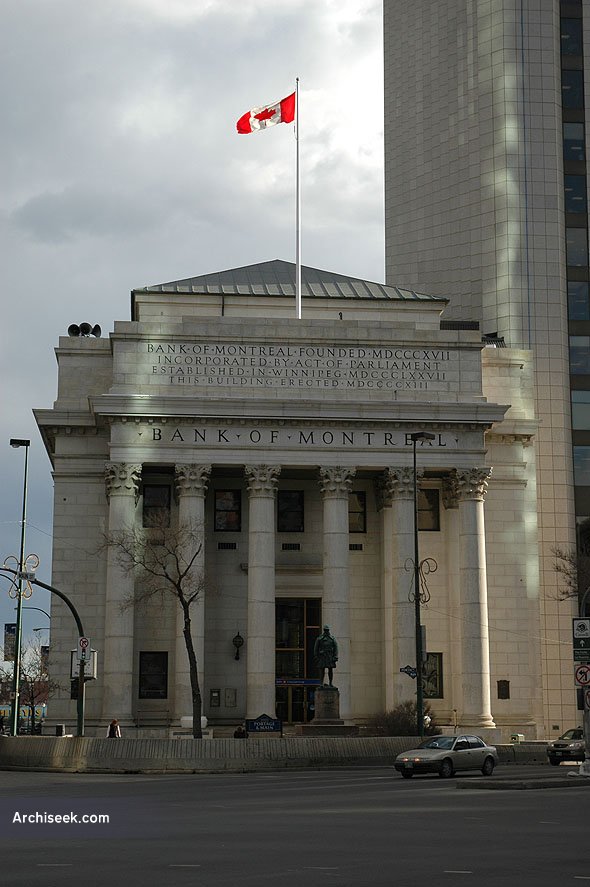
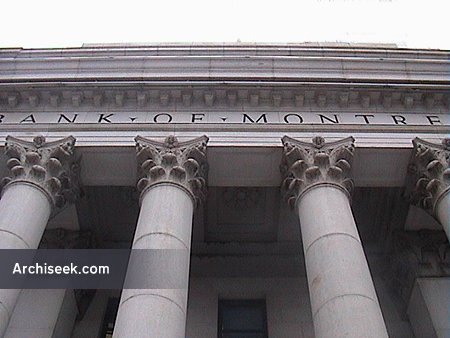
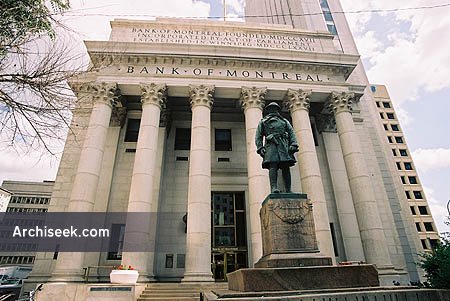


At the centre of Portage and Main, the Bank of Montreal branch was designed by McKim, Mead and White of New York, America’s leading exponents of Beaux-Arts Classicism. They had previously designed the Bank’s head office in Montreal. Surrounded on three sides by streets, the bank has an impressive columned front entrance which leads into a double height banking hall.
The banking hall is magnificent and vast. The double height hall is surrounded by Ionic columns in the local Tyndall stone. Many local buildings including the Legislature and Art Gallery are built with this unusual speckled stone – it has a distinctive pattern. These columns and the mezzanine level lead the eye upwards to the decorative and very opulent ceiling.
The ceiling is covered with gold leaf and in 1990 was valued at over 1 million Canadian Dollars (as a framed newspaper inside the bank boasts). The 50 tonne vault doors in the basement safe were described as “the thickest and heaviest in the world” at the time of their construction. Closed as a bank branch.
Features of the Design for the Classical Structure to be Erected in the Western Metropolis by the Bank of Montreal
The proposed new building for the Winnipeg branch of the Bank of Montreal is derived from purely classical models, handed down to us from the days of ancient Greece and Rome. The building is rectangular in plan. The exterior is to be built of a very white granite, closely resembling marble, from the quarries at Bethel, Vt., and its design consists of a Corinthian portico of six columns on the front, and a treatment of Corinthian pilasters, with windows between them, at the sides, the whole surmounted by an attic. Above and behind the attic rises a rectangular roof house, in which the quarters of the staff are located, and which forms a crown or roof to the structure when seen from a distance, taking the place of the domical form so frequently adopted on buildings which are square in plan.
The property on which the building is to be placed is triangular in shape in front, and a study of the ground floor plan will show that the portico and steps have been designed for the maximum amount of projection permissible within the property lines. By this treatment, the building is given the greatest possible prominence as to location, and the throwing of the triangular portion of the front part of the property into sidewalk and street practically creates a public space, or square, at this point of the city, so that the bank building becomes not merely an incident in a long street, but one of the distinguishing features, or landmarks which help to divide a city into familiar districts.
The interior of the building is in the form of a basilica, based on the colonnaded halls of ancient Greek times, which were used as meeting places, for business and social purposes. The design consists of superimposed Ionic colonnades, the central, or main portion of the room going through two storeys, with a gallery, for the use of the Royal Trust Company, on all four sides. The entire banking room is to be treated in practically a monotone, with columns and side walls of light buff Botticino marble imported from northern Italy, with a simple ceiling painted with light colors in the Greek manner. The use of one material will give the largest possible expression to the room, and the neutral buff tone of the marble chosen is well adapted to obtain a warm, cheerful sunny effect
In the basement are located extensive vaults, safe deposit coupon and storage rooms, clerks’ lavatories, boiler room, etc. Above the main banking room are two floors of quarters for the staff and janitor, with sitting rooms, bed and bath rooms, and kitchen, lunch and dining rooms conveniently arranged for serving all those connected with the bank.
Engineering and Contract Record, April 6 1910
Share!
Cite This Article
Published May 6, 2010 | Last Updated March 20, 2026


