
1867 – Former Provincial Bank, College Street, Dublin

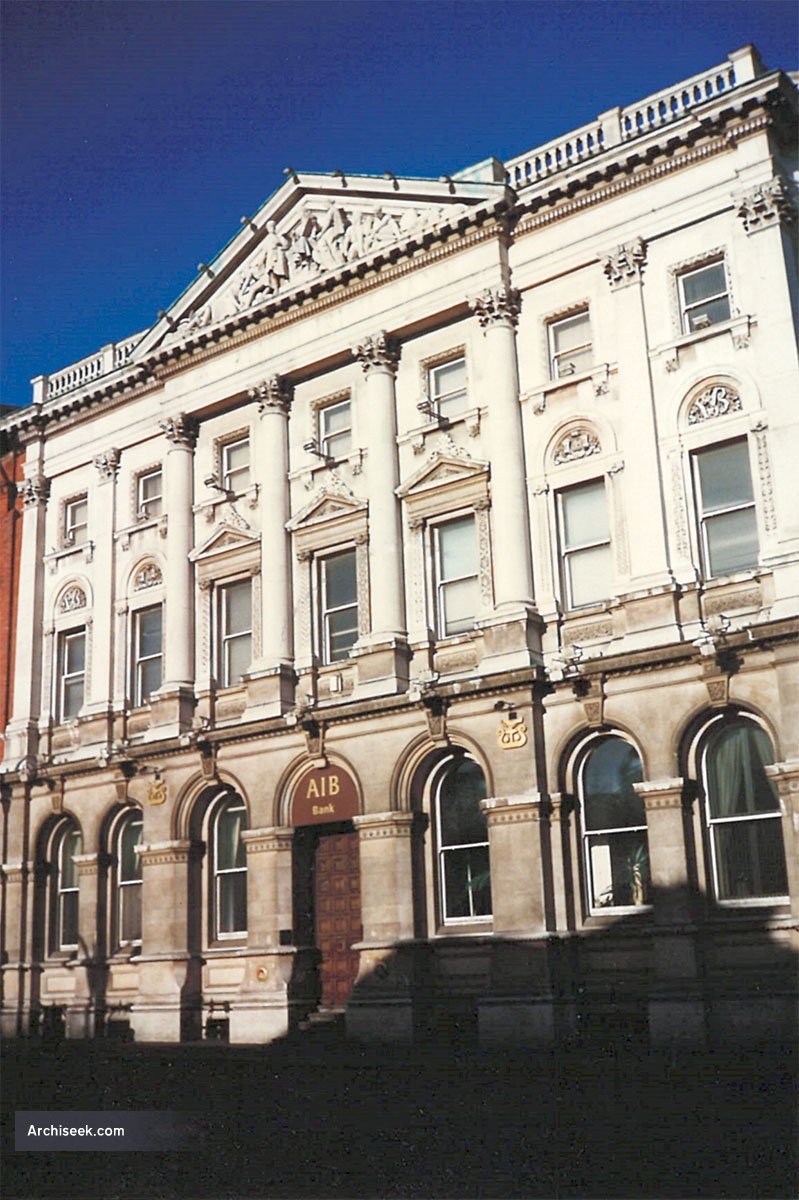

Now part of the Westin Hotel, designed in 1863 as the Headquarters of the Provincial Bank and built over the next few years. The architect William G. Murray died while in dispute with the bank over his fees – the cost of the building having been twice the estimate. The design comprises a seven bay main building over three stories with a pompous pediment and columns. The pediment relief sculptures are by S.F. Lynn and depict colonialism. To the rear on Fleet Street is an office block with round headed windows. The site is irregular leaving the central banking hall off-center in the plan.
THE NEW PROVINCIAL BANK OF IRELAND, COLLEGE STREET.
AMONGST the numerous acquisitions to the metropolitan street architecture which it has been our pleasure to notice lately, as either consummated, actually in progress, or projected, the subject of this notice is not the least important, and, owing to its central position in a leading thoroughfare, more than ordinary conspicuousness will be secured, a circumstance on which all parties concerned and the public will have reason to congratulate themselves. For some years past the Directors of the Provincial Banking Company—one of the most thriving institutions in the kingdom—have been desirous of removing from their backward and unsuitable premises in William street, to a more comprehensive and more conveniently circumstanced establishment, and for that purpose entered into negociations with the proprietors of the Police Divisional Station and Court building, of the Royal Irish Institution, and of the adjoining house, occupied by a confectioner, in College-street; which negociations, although unusually protracted, have been brought to a termination, the result being the intended total demolition of the existing buildings, and the erection of a handsome bank structure, from the designs of the company’s architect, Mr. William G. Murray. The total frontage is about 77 feet, and the rere will extend to Fleet-street, where a sepa rate entrance is provided. The elevation of the building will be 61feet, presenting a central projection of 37 feet in width, with four three quarter Corinthian columns, carried up two storeys—viz., the first and second—and surmounted by a pediment; antaes of the same order being introduced on the wings, which are finished with a balustraded parapet. In the interspaces the first floor central windows have enriched pediments, and those of the wings semicircular blind heads, with carved panels therein. A range of semicircular headed opens, with cable-moulded arrisses, vermiculated key-stones, and a bold pedestal and plinth perforate the ground floor wall, which is capped with an effective cornice. A spacious central doorway leads to a general entrance hall, 31 feet 9 inches by 18 feet, formed into hall and vestibule by coupled columns; and beyond this is the public office for banking business, 77 feet by 45 feet, with coved and panelled ceiling, large and handsome lantern light—the height from ground floor to soffet being 47 feet 6 inches. Immediately communicating with this apartment are numerous others, for manager’s consultations, the accommodation of clerks, waiting and ante, necessary adjuncts, &c., &c., and the runners’ office at the rere, next Fleet-street. A commodious residence, with separate entrance, is provided for the manager in the wing next Westmoreland street, and in the corresponding wing there is another private entrance for directors to the board-room, which is placed on the first floor, and to the resident clerks’ apartments in this portion of the building. Porters’ and servants’ living and bedrooms are provided in the block next Fleet-street. The public office, entrance hall, and passages will be floored with rich encaustic tiles. The internal fittings will, we understand, be of handsome and suitable character. A basement storey extends over the entire site, and displays comprehensive culinary arrangements, with fire-proof libraries for old books, stores, safes, &c., &c. The material for the facing of the front remains yet an open question, but we believe that either Glasgow or Portland stone find favour with the architect. The former is a very excellent and durable article, coming into great requisition, and we shall be pleased to hear of its adoption. Tenders for the erection of this building will be sought for immediately.
The Irish Builder

“Our illustration is of the entrance-doors or rather gates, by which the great cash-office of the new Provincial Bank is to be approached from the vestibule. The materials employed are to be oak, iron, and brass, and the gates, as well as the tympanum above, are to be filled with plate glass. They are to be the work of the Skidmore Art Metal Company. Mr. W.G. Murray, R.H.A. Architect.” The Irish Builder, May 1 1867.
Before the money run out, a magnificent banking hall was constructed. This still exists intact but has been swallowed into an hotel development. Unfortunately for the directors and management of the bank – there was no money left to provide similar style accommodation for them on the first floor level.
Published February 16, 2010 | Last Updated February 20, 2026


